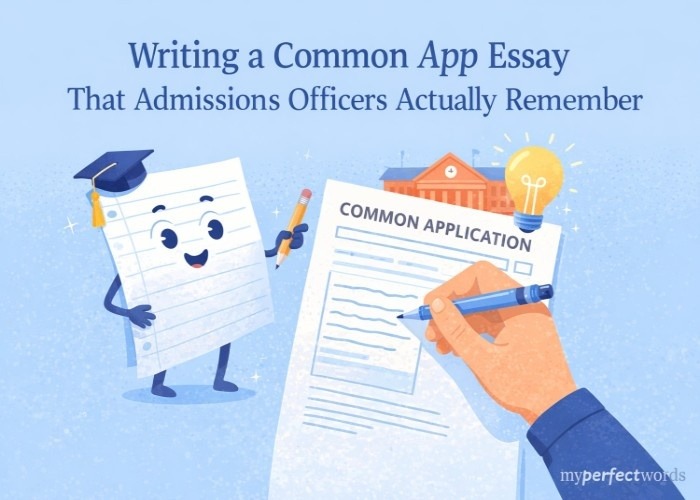
Common App Essay (and Why It's Different from Other Essays)?
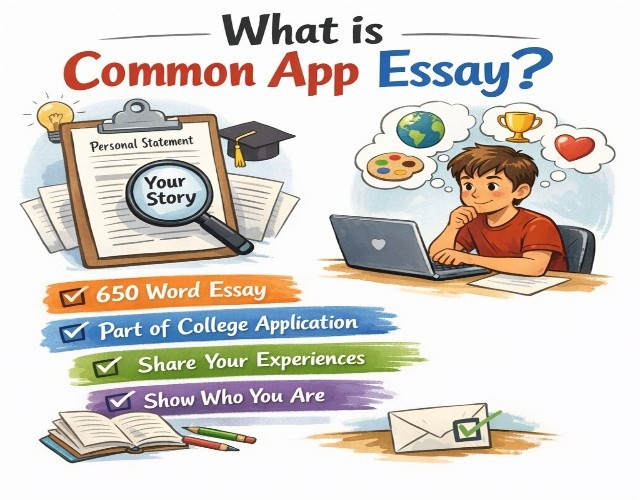
The Common App essay is a personal statement, a narrative piece about you, submitted through the Common Application. Because one application goes to every school you add to your list, your personal statement travels with it. You write it once, and admissions readers at dozens of schools see it.
That's what makes it different from your supplemental essays. Supplemental essays are school-specific, and you write a separate one for each college that requires them. The Common App essay isn't for any one school, it's for all of them.
It's also different from the Activities section. That part of the application is where you list what you've done. The personal statement is where you show who you are.
A few specs worth knowing before you start writing:
|
"The Common App essay is the one piece of writing that follows you to every school on your list, which is exactly why it needs to be excellent."
Writing the Common App Essay: A Practical Framework (Step by Step)
There are two structures that work for the Common App essay. Most students default to the first one without realizing the second exists.
Narrative Structure
It tells one focused story from beginning to end. You open in a specific scene, move through what happened, and end with a reflection or realization. This works best when you have a single experience that's emotionally rich and specific enough to carry 650 words.
Montage Structure
This structure weaves together a series of connected moments or images around a single central theme. Instead of one continuous story, you move between scenes that all reveal the same thing about you. This works better for students whose identity or interests can't be captured in a single moment.
Either way, here's how to execute:
Step 1: Find the specific story or moment
Not "my love of science", a specific Tuesday afternoon in the chemistry lab when something went wrong, and you couldn't stop thinking about why. The more specific, the better.
| Still struggling to choose the right topic? Explore our college application essay prompts to find ideas and inspiration for your essay. |
Step 2: Identify the insight
What does this story reveal about who you are? Not what you want to do, who you already are. That's what admissions officers are trying to understand.
Step 3: Open with a scene, not a thesis
Don't start with "I have always been passionate about..." Start with the moment itself. Put the reader somewhere.
Step 4: Build the middle
Include sensory detail, internal tension, and the specific moment of shift or realization. Keep it moving.
Step 5: End with forward momentum
Don't wrap up with a tidy moral. End with a sense of where you're going next, what this experience made possible, what you're curious about, and what you're becoming.
No headers inside the essay. No bullet points. Write in clean paragraphs and read it aloud. If it sounds like a report, you're not done yet.
| "The strongest Common App essays don't explain who the student is; they show it through a specific moment or pattern that no other applicant could have written." |
Common APP Essay Samples
The Broken RadioThe old radio on my grandfather’s shelf never worked properly. Every morning, he would tap the side, twist the dial slowly, and wait for the static to settle into music. I used to think he was wasting time trying to fix something that clearly couldn’t be repaired. One summer afternoon, curiosity got the better of me. I opened the back panel and stared at a maze of wires and circuits that made no sense. My grandfather watched quietly as I tried to figure it out. After a few failed attempts, he smiled and said, “Understanding something takes patience.” Over the next week, I researched how radios work, watched repair videos, and slowly started recognizing patterns in the circuitry. Eventually, after replacing a loose wire and cleaning a few contacts, the radio played clearly for the first time in years. That small moment changed the way I approached problems. Instead of seeing challenges as frustrating obstacles, I began to see them as puzzles waiting to be understood. Whether in physics class or robotics club, I now approach complex problems with the same patience I learned from that radio. The radio still sits on my grandfather’s shelf. It reminds me that progress often begins with curiosity and the willingness to keep trying. |
| For more inspiration, visit our college application essay examples blog, where you can explore real samples and learn what makes them effective. |
Still Staring at a Blank Page?
Our writers have helped 50,000+ students get their essays done right.
Don't let the deadline sneak up on you.
Common App Essay Mistakes That Get Students Rejected
Most essay mistakes aren't about the writing. They're about the thinking, choosing the wrong approach before a single word gets typed.
Writing a résumé in prose
If your essay lists achievements, activities, and honors in paragraph form, it's redundant with the rest of your application. Admissions officers can already see your transcript and activities section. The essay needs to add something that they can't find anywhere else.
Opening with "I was born..." or "Ever since I was young..."
These openings signal to the reader that nothing interesting is coming. Start in the middle of something.
Writing a tribute to someone else
The essay might be about your grandmother, your coach, or your best friend, but it has to be about what that relationship reveals about you. If you're describing them more than you're reflecting on yourself, rewrite.
Choosing an impressive topic that reveals nothing
Winning the state championship, getting into a selective program, and surviving a major illness are topics that can work, but only if the essay goes somewhere personal and specific. The topic doesn't do the work for you.
Using an overused subject without a fresh angle
Sports injury, mission trip, immigrant grandparent, pandemic pivot. These topics aren't disqualifying. But you need to take that no other student would have. If your essay could have been written by someone else who had the same experience, it's not done yet.
Going under 500 words
A short essay almost always signals an underdeveloped idea. If you're at 400 words, you haven't gone deep enough yet.
Stuffing it with vocabulary
Writing "ameliorate" when you mean "improve" doesn't make you sound smart. It makes you sound like you're performing intelligence rather than demonstrating it.
| "Admissions officers can spot a 'performance essay', the kind written to impress rather than to reveal, within the first two sentences." |
Common App Essay Tips to Make Yours Stand Out
The students who write great Common App essays aren't better writers. They're more honest about what they actually have to say.
1. Start with a scene, not a statement: Don't tell the reader what you're about to show them. Just show them.
2. Think small: A specific moment in your kitchen is more compelling than a sweeping statement about your culture. Specific is always more powerful than general.
3. Show values through action, not declaration: Don't write "I value hard work." Write the thing you did at 11pm on a Tuesday that shows it.
4. Let the prompt serve the story, not the other way around: Pick the prompt that fits the story you already have, not the story that fits the prompt you think sounds best.
5. Get feedback from someone who doesn't know you well: A friend or parent will fill in gaps you don't know you left. A fresh reader tells you what's actually on the page.
6. Write multiple drafts: Your first draft is for discovering what you actually want to say. It's not for publishing. Give yourself at least six to eight passes before you consider an essay done.
7. Don't open with a quote or a dictionary definition: Both signal that you ran out of ideas before you started. Check our guide on college application essay format for presentation basics and submission structure.
"Your best Common App essay is probably hiding inside a story you think is too small or too weird to matter, those are almost always the essays that get remembered."
To Wrap Up!
A strong Common App essay can make a lasting impression on admissions officers by revealing the person behind the grades and test scores. The best essays focus on authentic experiences, meaningful reflection, and a clear personal voice rather than trying to sound overly impressive.
By studying successful Common App essay samples and understanding what makes them effective, you can learn how to structure your story, highlight personal growth, and connect your experiences to your future goals. With thoughtful planning and honest storytelling, you can craft a Common App essay that stands out and strengthens your college application.
Your Common App Essay Deserves Expert Help
Get a professional, human-written essay delivered on your timeline.
- Expert-matched to your essay type and application deadline
- 3 hour rush delivery available for tight deadlines
- Unlimited revisions until you're completely happy
- Human writers only, zero AI, zero plagiarism
One essay. Every school on your list. Make it count.
Get Expert College Application Help
-20643.jpg)