Understanding Supplemental Essays
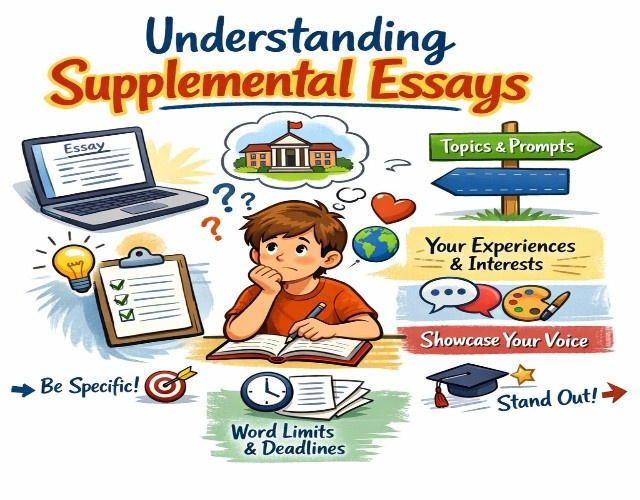
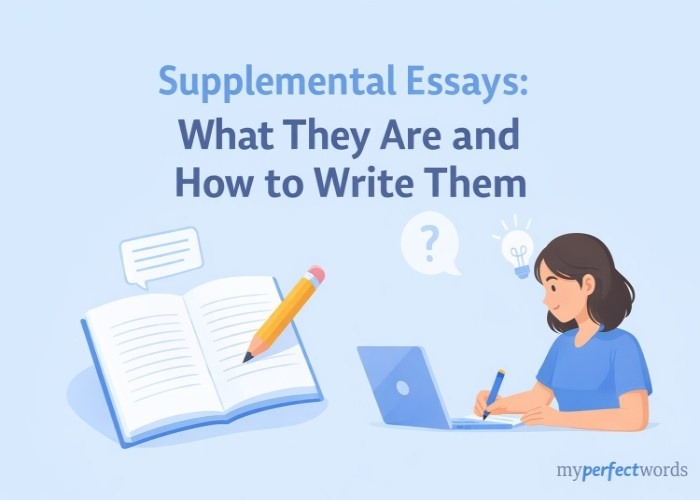
Supplemental essays are additional writing prompts that colleges require beyond your Common App personal statement. While your personal statement goes to every school you apply to, supplements are written specifically for each college; they respond to that school's own prompts and no one else's.
Word counts vary a lot. Some supplements ask for 50 words. Others want 650. Most fall somewhere between 150 and 300 words. And the number of supplements per school varies just as much; highly selective schools like Brown, Columbia, and Cornell require anywhere from 4 to 8 separate prompts, while many less selective schools ask for just one, or none at all.
| One thing that doesn't vary: how much they matter. Admissions officers read supplements carefully because they reveal something the personal statement can't, whether you've actually thought about why you want to be at their school specifically. |
Expert TipSupplemental essays let schools hear from the version of you that actually wants to be there, not just the you who wants to go to college.
How Are Supplemental Essays Different From the Common App Essay?
This is where a lot of students get confused, so it's worth being clear.
Your common app essay is 650 words, sent to every school, and covers who you are as a person, your story, your values, and something that defines you. It's broad by design. Supplements are the opposite: short, school-specific, and focused on narrow questions about fit, interest, or identity.
Here's the key distinction: your personal statement is about who you are. Your supplements are about why you belong at this specific school and what specifically they'd be missing if they didn't admit you.
| Personal Statement | Supplemental Essays | |
|---|---|---|
| Length | 650 words | 50 to 650 words |
| Sent to | Every school | One school each |
| Purpose | Who you are | Why you + this school |
| Scope | Broad | Focused |
| How many | One | Varies (1 to 8 per school) |
"If your personal statement could be copied and pasted to every school without changing a word, your supplements can't, and that's the point."
The 6 Main Types of Supplemental Essays
Most supplemental prompts fall into one of six categories. Once you learn to recognize them, you'll be ready for almost any prompt any school sends your way.
1. The "Why This School" Essay
What it asks: Why do you want to attend this specific college?
What admissions officers actually want: Genuine, researched specificity. Not a Wikipedia summary of the school. Not rankings or reputation. They want proof you've done real homework, a specific professor whose research connects to yours, a program you can't find elsewhere, a campus tradition that matters to you.
| Most common mistake: Writing things like "Harvard is one of the best universities in the world" or "I've always dreamed of attending your prestigious institution." Every applicant writes this. It tells them nothing. |
| Quick tip: Name at least two specific things unique to that school that connect directly to your actual goals. A course title, a lab, a student org, a professor's published work. The more specific, the better. |
Word count: Usually 250 to 650 words
2. The "Why Major" Essay
What it asks: Why do you want to study this subject? What got you here?
What they want: A clear throughline, how your interest developed, a specific moment or experience that crystallized your direction, and why this school's program specifically offers what you need for where you're going.
| Most common mistake: Vague passion statements with nothing behind them. "I've always loved science" tells an admissions officer exactly nothing. |
Word count: Usually 150 to 300 words
3. The Community and Diversity Essay
What it asks: How will you contribute to this campus community? What unique perspective or background do you bring?
What they want: Specificity about what community means to you and a concrete example of how you've already contributed to one. They're not looking for a list of your identity categories. They want the story of how you've shown up for others.
| Most common mistake: Treating it as a box-checking exercise rather than a genuine reflection on belonging and contribution. |
Word count: Usually 150 to 250 words
4. The Extracurricular Essay
What it asks: Tell us about an activity, club, sport, or job that matters to you.
What they want: Not a resume description; they can already see your activities list. They want the meaning behind the activity. What did it teach you? How did it change you? What would you lose if you had to walk away from it tomorrow?
| Most common mistake: Summarizing the activity instead of showing its impact on who you are. |
Word count: Usually 150 to 250 words
5. The Short Answer or "Oddball" Essay
What it asks: Ranges from "list five words that describe you" to "if you could have dinner with anyone, who would it be?" to "what book has influenced you most?"
What they want: Personality, creativity, and self-awareness. There's no correct answer. They want to see who you actually are when you're not trying to impress anyone.
| Most common mistake: Trying too hard to give an impressive answer rather than an honest one. These prompts reward students who are comfortable being themselves. |
Word count: Usually 50 to 150 words
6. The Additional or Optional Essay
What it asks: Is there anything else you'd like us to know?
What they want: Real additional context, a low grade that needs explaining, a late start to a passion, a major life circumstance that shaped your application. Not a rehashed personal statement.
| Most common mistake: Writing it just to fill the space when you have nothing new to add. If you genuinely have nothing new to say, it's okay to skip it. A blank, optional essay is better than a weak one. |
Word count: Usually 250 words max
How to Write Supplemental Essays (Step by Step)
Here's how students who handle supplements well actually work through them.
Step 1: Finish your personal statement first
Don't write a single supplement until your personal statement is done. Your supplements are easier to write when you know your story, and you'll avoid the mistake of accidentally repeating yourself.
Step 2: Pull every supplement for every school before you write anything
Go to each school's application portal or the Common Application and copy out every prompt you'll need to answer. All of them. Before you write one word.
Step 3: Sort prompts by type
Group all your Why Us essays together. Group your community essays together. Group your short answers together. Now you can see what you're actually dealing with and where the reuse opportunities are.
Step 4: Write your strongest version of each type, then adapt
Start with the school you're most excited about. Write the best version of each prompt type. Then adapt that version for other schools, swapping in school-specific details, adjusting tone, and matching word count requirements.
Step 5: Research each school specifically before writing the Why Us
This one can't be templated. Read the department page. Look up faculty research. Find a course in the catalog that genuinely interests you. The research is what separates a good Why Us from a generic one.
Step 6: Read every supplement out loud before submitting
If it sounds stiff, it reads stiff. If you'd never say it to another person, rewrite it. Natural language is what separates a memorable supplement from one that blends in.
For help with college application essay format and length guidelines, check out our dedicated guide.
"The students who struggle most with supplements are the ones who write school by school, the ones who thrive sort by prompt type first."
Supplements Stacking Up?
Ensure your supplemental essays reflect your best self with expert support and strategic insights.
Finish your supplemental essays with confidence and make your application stand out with expert help
Supplematal Essay Samples
Short Sample 1: Why This CollegeWhen I first visited the campus, I was struck not only by the architecture but by the energy of collaboration in the student labs. At the BioInnovation Center, I saw students discussing research findings, offering suggestions, and celebrating small breakthroughs together. That culture of shared learning aligns perfectly with my approach to science. I want to contribute to group research projects while bringing my own perspective on sustainable biotech solutions. This collaborative environment, paired with the school’s emphasis on hands-on experience, makes it the ideal place to develop my skills and grow as a future scientist. |
| Want to know what strong supplemental writing actually looks like in practice? Check out our guide to college application essay examples. |
Common Supplemental Essay Mistakes to Avoid
These come up constantly, and they're worth knowing before you start.
Being generic in the Why Us essay.
If you're naming rankings, campus size, or general reputation, you're writing the same essay as thousands of other applicants. Admissions officers have read every version of "your world-class faculty" and "vibrant campus community." None of it registers. Specific details do.
Repeating your personal statement
Supplements should add something new. If an admissions officer reads your personal statement and all your supplements, they should learn new things from each one. Repackaging the same story doesn't help your case.
Going over the word limit.
Some application systems cut you off. Others don't. Admissions officers notice when you ignore the limit they gave you, and it's not a good look.
Automatically skipping the optional essay
Sometimes the optional essay is your best opportunity, especially if you have an unusual circumstance, a gap in your record that needs context, or a major experience you haven't mentioned anywhere. Don't skip it reflexively.
Leaving the wrong school's name in
This sounds embarrassing because it is. Students who copy-paste supplements between schools and forget to update the school name happen every single application cycle. Build a review step into your process.
| "If your Why Us essay could work for any school by just swapping the name, it's not working for any school." |
To Sum Up!
Supplemental essays are a crucial part of your college application, offering a chance to showcase your fit, personality, and unique experiences. By understanding the different types, such as “Why This School,” Diversity, Leadership, or Challenge prompts, you can craft responses that highlight your strengths and align with each school’s values.
Studying strong supplemental essay examples and following a clear writing strategy can help you structure your ideas, convey authenticity, and make a memorable impression on admissions officers. Well-crafted supplemental essays not only complement your personal statement but also significantly increase your chances of acceptance.
Ready to Submit Essays That Actually Stand Out?
Boost your college application with professionally crafted supplemental essays that showcase your experiences, fit, and unique perspective.
- Matched with a writer who knows your target schools
- Every essay passes Originality.ai and Turnitin detection
- 3-hour rush available when deadlines are close
- Satisfaction guaranteed or we revise for free
100% original content delivered on time
College Application Essay Writing Service
-20643.jpg)