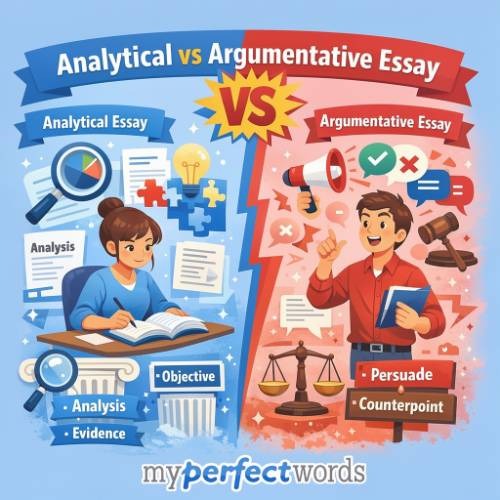
Quick Comparison: Analytical vs Argumentative Essay
Here's a side by side look at what separates these two essay types:
| Aspect | Analytical Essay | Argumentative Essay |
|---|---|---|
| Purpose | Examine how or why something works | Convince readers to accept your position |
| Your Stance | Neutral observer and explainer | Advocate with a clear opinion |
| Thesis Statement | Presents what you'll explore | States what you'll prove |
| Use of Evidence | Illustrates and supports analysis | Proves your claim and refutes opposing views |
| Tone | Objective and balanced | Persuasive and confident |
| Common Assignment Words | "Analyze," "examine," "explore," "evaluate," "discuss" | "Argue," "persuade," "defend," "take a position," "support or oppose" |
The main difference is that analytical essays explore and explain, while argumentative essays defend and persuade. You can spot which type your professor wants by looking at the verbs in your assignment prompt.
If you're asked to "analyze Shakespeare's use of symbolism," you're writing analytically. If you're told to "argue whether Hamlet's madness was real or feigned," you're writing argumentatively. The first asks you to break down and understand. The second asks you to take a side and convince.
Both essay types need solid evidence and logical thinking, but they use that research differently. An analytical essay presents evidence to illustrate patterns or meanings. An argumentative essay presents evidence to win a debate.
The Core Analytical vs Argumentative Differences Explained
Let's dig deeper into what actually separates these essay types in practice.
Your Relationship to the Topic
In an analytical essay, you maintain distance from your subject. You're like a scientist observing an experiment or a detective examining evidence. Your personal opinion about whether something is good or bad doesn't belong in the analysis. You might discover that a novel uses outdated stereotypes, but your job is to analyze how those stereotypes function in the text, not to argue whether the book should still be taught.
In an argumentative essay, you take a side. You have a stake in the outcome. You want readers to agree with you, change their behavior, or support your position. Your personal conviction drives the essay. If you think that novel with stereotypes shouldn't be taught, you build a case for removing it from the curriculum.
If you're trying to change someone's mind, it's argumentative; if you're trying to deepen understanding, it's analytical.
How You Use Evidence
Analytical essays use evidence to illustrate patterns, reveal meanings, or support interpretations. You might quote three different passages from a poem to show how the author uses water imagery to represent change. The evidence demonstrates what you found during your analysis.
Argumentative essays use evidence to prove claims and refute opposing positions. You might cite studies showing homework doesn't improve test scores, then use those statistics to support your argument for banning homework. The evidence isn't just illustrative. It's ammunition for your case.
The same piece of evidence can serve both purposes, but you'll present it differently. An analytical approach would explore what the evidence reveals about the topic. An argumentative approach would leverage the evidence to prove a point.
What Your Thesis Does
An analytical essay thesis statement presents the framework for your exploration. It tells readers what you'll examine and often how you'll approach it. Example: "Examining social media through three lenses, psychological, sociological, and economic, reveals why it affects different age groups differently."
An argumentative thesis states a claim you'll defend. It takes a position that requires proof.
Example: "Social media companies should face stricter regulations because their algorithms prioritize engagement over user wellbeing, particularly for vulnerable teenagers."
One thesis invites exploration. The other draws a line in the sand.
Struggling to Get Your Essay Right?
We Know the Difference Let Us Help
Stop second-guessing yourself and get the grade you deserve.
How to Tell Which Essay Type Your Assignment Wants
The verbs in your assignment prompt are the biggest clue 'analyze' means explore, while 'argue' means persuade. Here's how to decode what your professor actually wants:
Keywords that signal analytical:
- "Analyze"
- "Examine"
- "Explore"
- "Evaluate"
- "Discuss"
- "Interpret"
- "Investigate"
- "Compare"
These verbs ask you to break something down, look closely, and explain what you find. They don't ask you to pick a side.
Keywords that signal argumentative:
- "Argue"
- "Persuade"
- "Defend"
- "Take a position"
- "Convince"
- "Support or oppose"
- "Make a case for"
- "Justify"
These verbs explicitly ask for your stance. You need to convince someone of something.
Your rubric offers more clues. If it mentions "objectivity" or "balanced presentation," you're likely writing analytically. If it includes "thesis defense" or "counterarguments," you're probably writing argumentatively. The word "thesis" alone doesn't tell you much since both types need one.
When in doubt, ask your professor or TA. There's no penalty for clarifying expectations before you write. A quick email like "I want to confirm, are you asking me to analyze the causes of X, or to argue for a particular solution to X?" saves hours of potential rewriting.
| Looking for inspiration on what to analyze? Check out our list of analytical essay topics to get started. |
Analytical vs Argumentative Example: Same Topic, Two Approaches
Let's see how the same broad topic looks completely different depending on your approach. We'll use "social media's effect on teenagers" as our example.
Analytical Approach:
Thesis: "This essay will examine three ways social media affects teenage mental health through social comparison, sleep disruption, and communication patterns, analyzing both positive and negative impacts of each factor."
Body paragraph example: "Social comparison on platforms like Instagram affects teenagers in complex ways. Research shows 60% of teens report feeling worse about their appearance after viewing others' posts. However, the same platforms also provide exposure to diverse body types and mental health advocacy that previous generations lacked. The effect depends on individual resilience, time spent online, and the types of accounts followed."
Approach: You're exploring what's happening and why, presenting multiple sides, and helping readers understand the complexity. You're not telling them social media is good or bad. You're showing them how it works.
Argumentative Approach:
Thesis: "Schools should restrict student social media access during school hours because it harms academic performance and mental wellbeing, despite arguments about student autonomy."
Body paragraph example: "The evidence clearly shows that social media access during school hours damages student performance. A 2023 study of 50,000 students found that schools implementing social media restrictions saw test scores improve by 6% within one year. While critics argue students need autonomy to manage their own device use, teenagers' developing prefrontal cortexes make self regulation difficult. Schools have a responsibility to create learning environments that minimize distractions."
Approach: You're taking a side (restrictions are good), using evidence strategically to prove that point, and actively refuting counterarguments. You want readers to agree with your position.
The same topic can be analytical or argumentative depending on whether you're explaining what's happening or advocating for what should happen. Notice how the analytical version explores multiple angles while the argumentative version builds a case for one specific solution.
| For more examples of both essay types in action, see our guide to analytical essay examples. |
Can an Essay Be Both Analytical and Argumentative?
While these types can overlap, your assignment is probably asking for one primary approach. That said, advanced essays, especially at the college level, often blend both modes.
The typical pattern is analytical first, then argumentative. You analyze a problem deeply to understand all its components, then argue for a specific solution based on that analysis. For example, you might analyze why student loan debt has reached crisis levels (analytical) before arguing for a specific policy solution (argumentative).
Graduate level work often requires this combination. A thesis might analyze three competing theories about climate change effects, then argue why one theoretical framework best explains the data. The analysis establishes credibility and demonstrates your understanding before you make your case.
Some professors explicitly ask for this blend with prompts like "Analyze the causes of homelessness and argue for the most effective policy solution." When you see this, you'll need both skills. Spend about 60-70% of your essay on analysis and 30-40% on your argument.
For now, though, focus on what your current assignment asks for. If it says "analyze," don't slip into arguing. If it says "argue," don't spend so much time exploring all sides that you never commit to a position. Master each type separately before you try combining them.
| To learn more about argumentative essay components, check out the argumentative essay outline that will help you in compiling your essay data efficiently. |
Analytical vs Argumentative Essay: Common Mistakes to Avoid
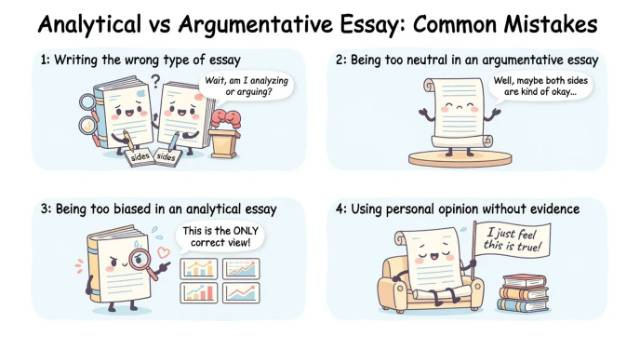
Mistake 1: Writing the wrong type of essay
This is the biggest disaster. You wrote a brilliant argumentative essay, but your professor wanted an analysis. Or you explored a topic thoroughly without ever taking the stance your professor expected. Always check your assignment prompt twice before you start writing.
| Fix: Highlight the verbs in your assignment. "Analyze" = analytical. "Argue" = argumentative. When in doubt, ask. |
Mistake 2: Being too neutral in an argumentative essay
You present both sides fairly, give them equal weight, then conclude "both perspectives have merit." That's not an argument. That's an analytical essay disguised as an argumentative one. Your professor will notice.
| Fix: Pick a side and defend it. Yes, acknowledge counterarguments, but only to show why they're wrong or less important than your position. |
Mistake 3: Being too biased in an analytical essay
You're analyzing a controversial novel, but your personal political views keep creeping into the analysis. You use loaded language or skip over evidence that contradicts your interpretation. That's an argument sneaking into analysis.
| Fix: Read your draft and highlight any sentence where your opinion shows through. Rewrite those sentences objectively. Analytical writing can interpret, but it shouldn't advocate. |
Mistake 4: Using personal opinion without evidence
This fails in both essay types. "I think Hamlet was truly mad" isn't an analysis or argument. It's just an opinion. You need evidence from the text, research, or logical reasoning to support any claim you make.
| Fix: Every major point needs backing. For analytical essays, that's evidence to illustrate your interpretation. For argumentative essays, that's evidence to prove your claim. No naked opinions allowed. |
Bottom line
Analytical essays focus on explaining and understanding a topic objectively, while argumentative essays focus on taking a clear position and persuading the reader, and knowing which one your assignment requires is essential to earning the grade you want.
Got Your Outline But No Time to Write?
Our writers deliver polished essays researched, structured, and ready to submit.
- 100% human written
- Delivered on time, every time
- Unlimited revisions
- From Outline to A+ Essay
Send your outline. We'll turn it into a finished essay.
Get Started Now