Understanding the Gibbs Reflective Cycle
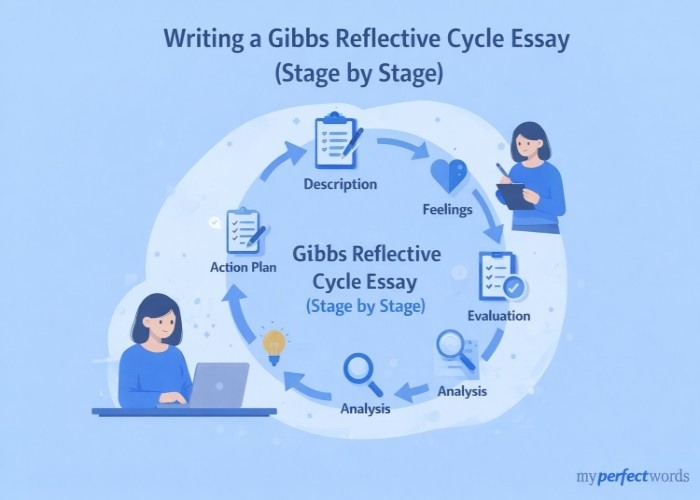
The Gibbs reflective cycle was developed by Graham Gibbs in 1988 as part of his guide Learning by Doing. It gives you a structured way to reflect on an experience so you can learn from it, not just describe it.
The six stages move in a specific sequence:
The process is called a cycle because it's designed to be repeated. |
You use what you learn in the Action Plan to prepare for similar situations, then reflect again when those situations arise.
Universities love Gibbs because it builds critical thinking and forces you to connect personal experience with theory, research, or professional standards. That last part, connecting to theory, is where most marks are won or lost.
Gibbs' model works because it forces you to move beyond "what happened" into the harder questions, why it happened, what it means, and what you'd do differently.
You might also have seen Kolb's model or Driscoll's "What? So What? Now What?" framework mentioned in your reading. Kolb is more abstract and better suited to theoretical learning. Driscoll is simpler but less rigorous for academic writing. Gibbs hits the right balance for students who need a structured, evidence supported essay.
Before You Write: What You Need to Get Started
Before you touch the keyboard, get clear on two things: the experience you're reflecting on, and the word allocation you're working with.
For the experience, pick something with enough complexity to analyze. You need to be able to connect it to a theory, professional standard, or research, not just describe what happened.
If you're a nursing student, think about a clinical placement moment. If you're in education or business, think about a challenging team interaction, a lesson that didn't go to plan, or a decision that had consequences. If you need inspiration, check out our guide to reflective essay topics.
Before you start writing, it also helps to have a plan for how to write a reflective essay at a structural level, so you know how the Gibbs essay sits within the broader format.
Once you've chosen your experience, map out your word allocation. This is a table most articles skip, and it's one of the most practical things you can have on hand:
Stage | % of Essay | 1,500-word essay | 2,000-word essay |
Description | 15–20% | 225–300 words | 300–400 words |
Feelings | 10–15% | 150–225 words | 200–300 words |
Evaluation | 10–15% | 150–225 words | 200–300 words |
Analysis | 25–30% | 375–450 words | 500–600 words |
Conclusion | 10–15% | 150–225 words | 200–300 words |
Action Plan | 10–15% | 150–225 words | 200–300 words |
These are guides, not rules; your lecturer may specify a different distribution. But if they haven't, this split reflects where the marks actually are.
The single biggest mistake students make is spending 60% of their essay on Description, the stage worth the fewest marks.
Stage 1 Description: Set the Scene Without Telling the Whole Story
Purpose: Give a factual account of what happened. Who was involved, what the context was, what you did, and what the outcome was.
That's it. No interpretation, no feelings, no judgment. Those come in the next five stages.
Guiding questions for this stage:
- What happened?
- Who was involved?
- What was the context or setting?
- What did you do, and what did others do?
- What was the immediate outcome?
Here's the most common mistake students make in this stage: they treat it like a full story and write far too much. Your description should give enough context for a reader to understand what happened, nothing more.
Weak: "During my placement, I was looking after a patient who needed medication, and I wasn't sure what to do, so I asked my supervisor, and they showed me, and then I administered the medication, and the patient was fine, but I felt quite nervous throughout the whole thing." Stronger: "During a clinical placement, I was asked to administer medication to a patient for the first time without direct supervision. My supervisor was available nearby but encouraged me to attempt the task independently. The patient received the medication correctly, but I felt significant uncertainty throughout the process." |
Notice the stronger version is cleaner, more precise, and leaves a feeling for the next section.
A useful trick: write your description first, then cut it back by a third.
Stage 2 Feelings: Be Honest Without Oversharing
Purpose: Explore your emotional response. What were you thinking and feeling before, during, and after the experience, and how did those feelings affect what you did?
This stage trips students up in two different ways. Some skip it entirely or write one throwaway sentence ("I felt nervous"). Others go too personal, turning this into a diary entry. Neither approach works academically.
Guiding questions for this stage:
|
In reflective writing, emotions aren't a personal indulgence; they're professional data.
A nursing student might write about feeling torn between confidence in their theoretical knowledge and anxiety about independent clinical action. An education student might reflect on frustration when a class didn't engage as expected, and how that frustration affected their response in the moment. These are academically valid observations because they connect directly to professional behavior.
Keep it honest and professional. You're not writing a therapy session, you're explaining how your internal state shaped your external actions.
Stage 3 Evaluation: What Worked, What Didn't
Purpose: Make a balanced assessment of the experience. What went well? What went badly?
Key word: balanced. This stage isn't a defense of your choices or a list of regrets. It's an honest audit of both the positives and the negatives.
Guiding questions for this stage:
|
Evaluation is the honest audit, not a defense of your choices, not a list of regrets.
Students often struggle here because they feel awkward either praising themselves or criticizing themselves.
Split this section into two short paragraphs, one on what worked, one on what didn't. Give roughly equal weight to both, even if one feels more significant. Your analysis in the next stage is where you'll explain why.
For a nursing placement, you might evaluate that your technical procedure was correct (positive), but your communication with the patient was rushed and unclear (negative). For a group project, you might note that the output was strong but the process was chaotic and stressful for the team.
Struggling to Make Gibbs Cycle Reflective Essay Work? Our writers have in depth expertise in the Gibbs Cycle and can craft a high quality reflective essay tailored to your needs. Delivered on time, even on tight deadlines
Stage 4 Analysis: Where the Real Marks Are
Purpose: Explain why things happened the way they did. This is where you connect your experience to theory, research, or professional standards.
If the Description tells the story and the Evaluation judges it, the Analysis makes sense of it. You're moving from "what happened" and "was it good or bad" to "what does this actually mean, and what explains it?"
Guiding questions for this stage:
|
This is where your references go. Use phrases like "This can be explained by…", "According to [author/theory]…", or "Research by [X] suggests…". For nursing students, this might mean referencing NMC standards, clinical guidelines, or a theoretical framework like Benner's novice-to-expert model. For more on this context, our nursing reflective essay guide goes into much more depth.
Remember! Analysis turns your personal story into professional learning; it's where reflection becomes worth reading.
A common mistake here is restating the evaluation in different words. Writing "the patient communication was poor because I wasn't communicating well" is not analysis, it's circular. Analysis would be: "The poor patient communication may be explained by communication anxiety in high-stakes clinical contexts, which Ley (1988) attributes to information overload combined with situational stress."
Spend the most time on this section. It's worth the most marks.
Stage 5 Conclusion: What You Learned (Really)
Purpose: Synthesize what you've learned. Not a summary of the experience, a statement of what changed in your understanding or your approach.
Guiding questions for this stage:
|
One important thing to clarify: this is the Conclusion stage, not the conclusion of your whole essay. Your essay structure may end with an overall conclusion paragraph after all six stages, which is separate.
The conclusion stage isn't about finishing the essay; it's about naming what changed.
|
Stage 6 Action Plan: What You'll Do Next
Purpose: Set specific, actionable steps you'll take based on what you've learned. This is what makes Gibbs a cycle; it feeds forward into your future practice.
Guiding questions for this stage:
|
The keyword is specific. Vague commitments are one of the most common weaknesses in this section.
A weak action plan sounds like a New Year's resolution, a strong one sounds like a professional development commitment.
|
See the difference? The strong version is measurable, time-bound, and referenced to a real resource. Your reader should be able to imagine you actually doing it.
Downloadable Resources for Gibbs Cycle Reflective Essay
Common Mistakes to Avoid in a Gibbs Reflective Essay
Most students lose marks in the same places. Here's what to watch for:
1. Too much Description, not enough Analysis.
This is by far the most common issue. Keep your description tight, around 15 to 20% of your word count, and put your energy into the Analysis stage.
2. Skipping Feelings or writing one sentence.
"I felt nervous" is not enough. Explain how those feelings are connected to your actions and decisions.
3. Informal first person.
Reflective writing uses "I," but keep it professional. "I was like, really stressed" belongs in a text message, not an essay. "I experienced considerable anxiety about the outcome" is the right register.
4. Missing theory in Analysis.
If your Analysis stage has no references, no author names, and no connection to frameworks or professional standards, it's not analysis, it's just more evaluation.
5. Vague Action Plan.
Generic commitments ("I will communicate better") don't demonstrate professional development. Be specific about what you'll do, when, and how.
6. Confusing the Conclusion stage with the essay's overall conclusion.
They're not the same. The Gibbs Conclusion stage (Stage 5) is about learning. Your essay's overall conclusion wraps up the whole piece.
7. Describing without connecting to a professional context.
Reflective essays aren't diary entries. Everything you write should connect back to your development as a practitioner, student, or professional.
Most reflective essays that lose marks don't fail at reflection; they fail at analysis.
| If you want to see how all of this looks in practice, our reflective essay examples show real-world responses across different disciplines and essay lengths. |
Conclusion
Mastering the Gibbs Cycle Reflective Essay becomes much easier when you understand each stage and apply it systematically. By following the six structured steps, description, feelings, evaluation, analysis, conclusion, and action plan, you can transform real experiences into meaningful academic reflection. This model not only strengthens critical thinking but also supports professional growth, especially in fields such as nursing and healthcare.
Use this guide as your roadmap to writing a well-structured, high quality Gibbs Reflective Cycle essay that demonstrates insight, learning, and continuous improvement.
Ready to Leave Your Gibbs Reflective Essay to an Expert?
Your Reflection Deserves More Than a Rough Draft
- Writers with nursing, education, and professional backgrounds
- Plagiarism free work tailored to your exact guidelines
- Free revisions until you’re completely satisfied
- Fast turnaround options available, even for urgent deadlines
Place your order today and get a professionally written reflective essay done right.
Order Now