What Makes a Nursing Reflective Essay Different?
A nursing reflective essay isn't a regular academic essay. You're writing in first person, drawing on a real experience, and doing it in a way that still has to meet academic standards. That combination trips a lot of students up.
| The purpose isn't to prove you had a good clinical experience. It's to show you can think critically about your own practice, what you did, why you did it, whether it was the right call, and what you'd do differently. Your assessor doesn't want to know what happened; they want to know what it means for how you'll practise. |
This expectation comes straight from professional standards. The NMC Code requires registered nurses to engage in reflective practice as part of their ongoing professional development. For student nurses, reflective essays are how you demonstrate that habit is forming.
You'll encounter nursing reflective essays in a few different contexts:
- University coursewor
- Clinical placement portfolios
- Post-qualification NMC revalidation.
The core principles are the same across all three, though the expected depth and length will vary.
Which Reflective Model Should You Use?
This is the question most guides dodge. They list four models, explain each one in a paragraph, and leave you to figure it out yourself. Here's a clearer way to think about it:
Model | Structure | Best For |
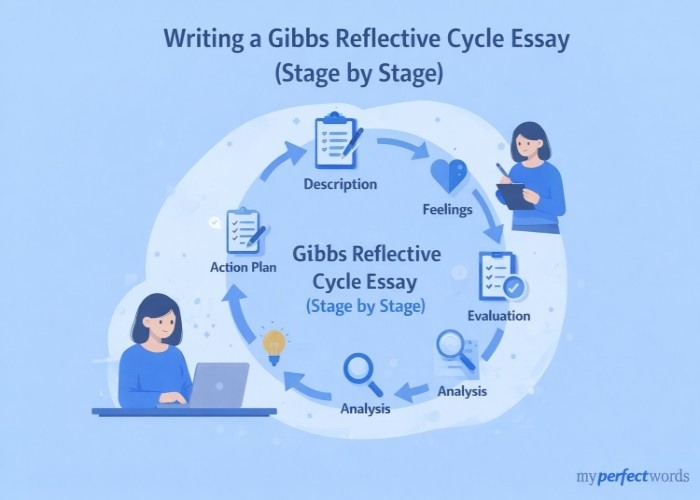
Gibbs (1988) | 6 stages: Description, Feelings, Evaluation, Analysis, Conclusion, Action Plan | Longer essays, complex clinical situations, nursing placements |
Driscoll (What? So What? Now What?) | 3 questions | Shorter essays, portfolio entries, quick reflection logs |
Johns (2000) | 5 cue areas with guided questions | Exploring ethics, values, and interpersonal aspects |
Kolb | 4-stage cycle: Experience, Reflect, Conceptualise, Experiment | When you want to link learning theory to clinical practice |
If your brief specifies a model, use it. If not, Gibbs is the safest choice for nursing, its six stages push you through every layer of reflection, and it's the most widely accepted framework in UK nursing programmes. Gibbs is the default choice for good reason: its six stages push you from description into genuine analysis.
One thing to avoid: don't mix models in the same essay. Pick one, commit to it, and follow it all the way through. Switching halfway through is a red flag for assessors.
| For a detailed breakdown of how to apply Gibbs in full, see our guide on Gibbs Reflective Cycle. |
Writing a Nursing Essay: Step by Step Guide
Writing a reflective nursing essay doesn’t have to be overwhelming. Follow these clear steps to create a well-structured, evidence-based essay that meets academic standards:
1. Understand the Assignment
Carefully read the essay brief. Identify the topic, type of essay (reflective, argumentative, or analytical), word count, and any clinical frameworks to follow.
2. Research and Collect Evidence
Use credible sources like nursing journals, textbooks, and clinical guidelines. Gather relevant case studies, statistics, and examples to support your points.
3. Plan Your Essay Layout
Organize your ideas into an introduction, body paragraphs, and conclusion. A structured outline ensures your essay flows logically and covers all key points.
4. Write a Strong Introduction
Hook your reader with a statistic, scenario, or question. Provide background and end with a clear thesis statement outlining your argument or purpose.
5. Develop Clear Body Paragraphs
Each paragraph should focus on one idea, backed by evidence and critical analysis. Connect each point back to your thesis or learning objectives.
6. Craft a Reflective Conclusion
Summarize key findings, reflect on learning, and explain the implications for nursing practice. Avoid introducing new information.
7. Reference Correctly
Follow the required referencing style (APA, Harvard, or Vancouver) and cite all sources accurately to maintain academic credibility.
8. Proofread and Edit
Check for grammar, clarity, and logical flow. Revise to make your essay polished and professional.
Organizing Your Nursing Reflective Essay
The standard structure is introduction, body (organised by your model's stages), and conclusion. That sounds simple, and it is; the challenge is getting the proportions right.
Introduction (roughly 10% of your word count):Set the context briefly. State which model you're using and why. Give a one or two sentence overview of the experience you'll be reflecting on, but don't give it all away. Your intro should end with a clear indication of what you'll demonstrate through this reflection. Body (roughly 80%):This is where you work through each stage of your chosen model. Each stage can be its own paragraph or a headed subsection, depending on the word count you're working with. The key is that you're writing towards each stage, not just describing what the stage means, but actually applying it to your experience. Think of each model stage as a prompt; your job is to write towards it, not just describe what the stage says. Conclusion (roughly 10%):Pull your learning together. Connect it back to your professional development. Look forward, what will you do differently, what will you seek out, what skills will you build? |
For a full structural breakdown, our reflective essay outline guide walks through each section in detail.
Description vs. Analysis: The Mistake Most Students Make
This is the part worth getting right, because it's where most marks are won or lost.
Description tells your reader what happened. Analysis tells them why it matters, what it means, and what you're going to do about it. Describing what happened earns you little. Explaining why it matters, and what you'll do about it, is where marks live.
Here's the difference in practice:
|
The shift isn't dramatic. Same situation, same feelings. But the second version connects the experience to theory, professional standards, and a forward-looking action. That's what reflection actually is.
A good rule of thumb: description should take up no more than 20 to 25% of your essay. Everything else should be evaluation, analysis, conclusions, and action.
How to Choose Your Clinical Experience (and What to Reflect On)
You don't need a dramatic experience to write a strong reflection. In fact, routine clinical moments often make better essays than high-stakes ones, because you can examine them clearly without the emotional weight getting in the way.
Good candidates include:
- A challenging patient interaction
- A moment where you weren't sure about a medication query and had to escalate
- A communication issue in a team, or a situation where your training felt insufficient for what was happening.
| The best reflective essays come from ordinary clinical moments seen with extraordinary honesty. |
Avoid two extremes:
- something so routine you genuinely have nothing to say about it, or
- something so traumatic you can't approach it with the analytical distance an assessor needs to see.
| An important nursing-specific consideration: confidentiality. You must always anonymise patient details. Change names, avoid specific ward identifiers, and alter non-essential details like age or diagnosis where they're not central to the reflection. Most universities require this explicitly, and the NMC Code makes clear it's a professional obligation. |
If you're still deciding what to write about, our guide on nursing reflective essay topics has a range of prompts organised by clinical context.
Too Busy for Another Nursing Essay?
Our expert writers handle nursing reflective essays for students at every stage.
Every essay is written by a human writer, zero AI content
Using Evidence Based Practice in Your Reflection
One of the things that separates a good nursing reflective essay from a weak one is the use of evidence. Your analysis stage isn't just your opinion; it's your opinion supported by sources.
Here's how to do it without it feeling forced:
Step 1: Identify the issue your reflection raises. If you're reflecting on a communication challenge, the issue is communication in nursing practice. Step 2: Find one or two academic sources relevant to that issue, a nursing journal article, a set of clinical guidelines from NICE, or a reference to the NMC Code. Evidence doesn't replace your personal reflection; it gives it credibility and shows you can connect experience to knowledge. Step 3: Weave these sources into your analytical points. Don't save all your references for one paragraph; spread them through your analysis wherever they support what you're saying. |
A common mistake is treating the evidence section like a separate box to tick. If you're reflecting on pain management, cite a relevant nursing journal when you make your point about what you'd do differently next time. It should feel like part of your thinking, not an appendix.
Nursing Reflective Essay Examples
Example 1: Caring for a Patient With Post Surgical Complications
Introduction:
During my surgical ward placement, I was assigned a patient recovering from abdominal surgery who developed unexpected post-operative complications. This was my first experience managing a patient with sudden changes in condition, and it challenged both my clinical knowledge and confidence.
Reflection:
At first, I felt anxious and overwhelmed, unsure how to prioritize tasks while monitoring vital signs, administering medication, and keeping the patient comfortable. Observing the senior nurse handle the situation calmly helped me realize the importance of preparation, quick thinking, and following protocols.
Learning:
I learned that nursing requires both technical competence and the ability to remain composed under pressure. By reflecting on this experience, I recognized the need for clear communication with the healthcare team and careful documentation to ensure patient safety.
Future Application:
Moving forward, I will focus on strengthening my skills in patient monitoring and emergency response. I plan to review clinical procedures regularly and shadow experienced nurses in high-pressure situations to build confidence and competence.
Example 2: Supporting a Patient With Anxiety During Routine Checks
Introduction:
While on my medical-surgical placement, I cared for a patient with severe anxiety who became visibly distressed during routine blood pressure and blood sugar checks. This situation made me aware of the emotional and psychological aspects of patient care, which are sometimes overlooked.
Reflection:
Initially, I felt uncomfortable and unsure how to ease the patient’s fear. By observing and mimicking the techniques of a senior nurse, explaining each step calmly and providing reassurance, I learned how important communication and empathy are in daily nursing practice.
Learning:
This experience taught me that patient-centered care extends beyond physical treatment. Small adjustments, like explaining procedures and giving patients control over minor decisions, can significantly reduce anxiety and improve cooperation.
Future Application:
In future practice, I will integrate empathy into all patient interactions, using clear communication and reassurance. I will also reflect regularly on each patient encounter to identify ways to improve both clinical and emotional care.
Free Downloadable Resources For Nursing Reflective Essay
| For full examples of completed reflective essays, see our reflective essay examples page. |
Common Mistakes to Avoid in Nursing Reflective Essays
Mistake 1: Writing a story instead of a reflection.
The fix is to go back through your draft and check that every paragraph is doing analytical work, not just narrating. Apply your model stages explicitly.
Mistake 2: Choosing a model and not following it through.
If you've committed to Gibbs, use headings or clear signposting for each stage. Assessors should be able to see the model working in your essay.
Mistake 3: Ignoring evidence-based practice.
Aim for at least 3 to 5 academic references woven through your analysis, not clustered in one place.
Mistake 4: Writing in third person.
First person is expected and required. This is your experience; write as "I."
Mistake 5: Identifying patients.
Always anonymise. Use a pseudonym, remove ward-specific identifiers, and adjust non-essential details.
Mistake 6: Vague action plans.
"I will improve my communication skills," tells an assessor nothing. "I will attend a patient communication workshop in the next term and ask my placement mentor to observe and give me feedback on a specific handover" is specific, measurable, and believable. A vague action plan signals you haven't really reflected at all; your assessor will notice.
Conclusion
Writing a nursing reflective essay is a powerful way for students and professionals to analyze clinical experiences, demonstrate personal growth, and improve patient care skills.
A well-structured nursing reflective essay combines critical thinking, empathy, and evidence-based insights, making it a valuable tool for academic success and career growth.
Use this guide to create high quality nursing reflective essays that showcase your skills, improve clinical reasoning, and help you excel in your nursing practice.
Struggling to turn your clinical experiences into a polished reflective essay?
Our professional writers help you craft a well structured, insightful essay that meets academic standards.
- Human-written reflective essays matched to your clinical experience
- Gibbs, Driscoll, Johns, or any model, we follow your brief exactly
- Includes proper academic referencing in APA, Harvard, or any style
- Fast turnaround: 3 hour rush available for urgent deadlines
100% human, 100% original. Your nursing essay, done right.
Order Now