Reflective Essay Example 1: Personal Experience (College Level)
Topic: Volunteering at a food bank for the first time
I expected it to be humbling. That's what everyone says about volunteering, that it puts things in perspective, that it makes you grateful. I went in with that framing already in place, which meant I wasn't really paying attention to what was actually happening in front of me.
I'd signed up through a module requirement. Twelve hours over four weekends at a local food bank. I thought I knew what to expect: sorting tins, maybe carrying boxes, feeling virtuous on the drive home. What I didn't expect was the conversation I had with a man named Keith on my second Saturday.
Keith wasn't a client. He was another volunteer, and he'd been coming every weekend for eleven years. He was an accountant. He told me he used to think volunteering was something you did when you had spare time, and then he realized it was something you made time for, and that realization had changed how he organized his entire week. I didn't have a good answer when he asked me why I was there. I said something about my module, and then felt embarrassed about it for the rest of the shift.
That discomfort was more instructive than any of the tasks I completed that day. I'd come in with a story already written, the kind of person who volunteers, what they gain from it, what it says about them, and Keith didn't fit the story. He wasn't doing this to feel better about himself. He was doing it because he'd decided it mattered, and that distinction, which seemed small, sat with me for weeks.
I went back for all four weekends, and then I kept going after the module ended. I can't claim it was purely selfless. I'm still not sure it is. But I think that's precisely what reflective writing is supposed to do: not resolve the questions, but get honest about what they are.
Why This Works
The hook sets up tension, not sentiment. The essay doesn't open with "volunteering was a meaningful experience." It opens by admitting the writer came in with a cliché already prepared, and then had that cliché disrupted. That tension is where real reflection begins. The thesis is built around expectation vs reality. The writer expected to feel virtuous. What happened instead was discomfort and a question they couldn't answer. That gap between expectation and experience is the engine of the whole essay. Each body paragraph moves from description to meaning. The encounter with Keith is described, but then immediately unpacked, why it mattered, and what it revealed about the writer's assumptions. This is the difference between recounting and reflecting. The conclusion doesn't resolve everything neatly. It admits the writer still doesn't have clean answers. That honesty is what makes it convincing. Reflective essays that wrap up too neatly feel dishonest; real insight rarely comes with a bow on it. |
Personal reflective essays work best when the writer's expectations clash with their experience; that tension is where the real reflection happens. If you'd like to dig into the personal essay format more specifically, our guide on personal reflective essays covers what makes this type distinct.
Reflective Essay Example 2: Academic Context (University Level)
Topic: A group project that didn't go as planned
Our presentation was scheduled for Tuesday. By Monday evening, two of the four group members hadn't contributed anything beyond a list of vague notes shared two weeks earlier. I spent that night doing work that wasn't mine to do, and I submitted it without saying anything about what had happened. I told myself it was about the grade. That was only partly true.
Looking back, I can see that my decision to absorb the group's failure rather than name it was driven by something I hadn't examined before: a deep discomfort with conflict in academic settings. I'd rather carry extra work than create friction, and in this case, that avoidance had real costs. The work was rushed, the presentation was uneven, and I felt resentful afterward in a way I wasn't prepared for.
Kolb's experiential learning cycle is useful here, not as a framework I'm applying retroactively, but because the model helped me name something I'd already intuitively sensed: that experience alone doesn't produce learning. What produces learning is reflection on the experience, followed by a deliberate change in approach. I had the experience. I'd skipped the reflection until now.
What I'll do differently is specific. In the next group project, I'll propose agreed contribution deadlines in the first meeting rather than assuming good faith and managing the fallout. I'll also be clearer with myself about the difference between being collaborative and being accommodating to the point of self-erasure. Those sound like small adjustments. From where I'm standing, they're significant ones.
Why This Works
It balances personal voice with academic structure. This isn't a diary entry, but it also isn't a detached analysis. The writing is honest about feelings (resentment, discomfort) while still engaging with the situation analytically. That's exactly the register a tutor wants to see in a portfolio reflection. The theory is used, not performed. Kolb isn't dropped in to prove the writer has done the reading. It's introduced because it's genuinely useful for making sense of what happened. The difference between citing theory and using theory is one of the marks of a strong academic reflection. Past tense for events, present tense for insight. "My decision to absorb the group's failure" (past) versus "I can see that..." (present). This shift is subtle, but it signals that the writer has moved from describing to reflecting. The conclusion commits to something concrete. "In the next group project, I'll propose agreed contribution deadlines" is a real action plan, not "I learned the importance of communication." Concrete next steps show the reflection has been genuinely productive. |
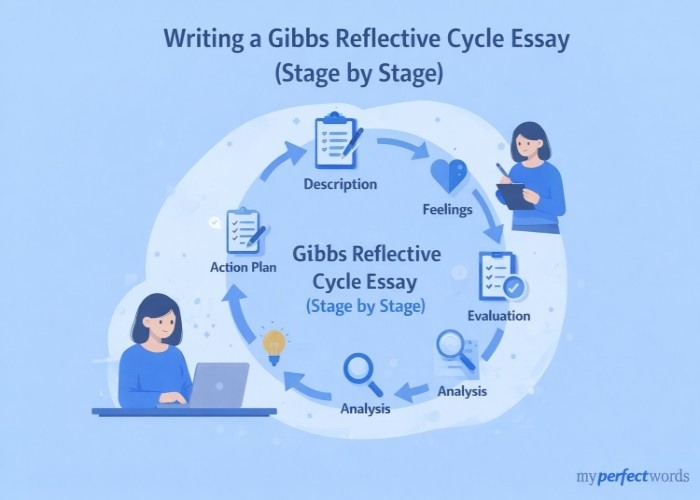
Academic reflective essays show your tutor you can think critically about your own practice, not just describe what you did." For more on frameworks like Kolb's, our guide on the Gibbs Reflective Cycle walks through how structured models can shape your reflection.
Reflective Essay Example 3: Nursing Context
Topic: First clinical placement, a difficult patient communication moment
On my fourth day of placement, I was asked to take a patient's observations. Mrs. P was in her late seventies and had been on the ward for six days following a hip replacement. She was polite but didn't engage with me beyond one-word responses, and when I tried to explain what I was doing as I worked, she turned her head toward the window. I finished the observations, recorded them, and moved on to the next patient. I told myself she was tired.
When I spoke to my mentor about it afterward, she asked a question I hadn't expected: "Did you find out how she was feeling?" I hadn't. I'd explained my clinical actions, but I hadn't asked Mrs. P anything about her experience. My mentor pointed out that patients who have reduced verbal responsiveness sometimes become that way after several days of feeling unseen rather than unwell.
That observation changed how I understood what had happened. I'd prioritized task completion over patient-centred connection, and in doing so I'd missed something that the observations themselves couldn't capture. The NMC professional standards are explicit about the importance of treating patients as individuals with preferences and emotional needs, not just as bodies with vital signs. I'd understood that in the abstract. I hadn't applied it in practice.
My response to Mrs. P was shaped by nervousness about getting the procedure right. That's understandable for a second-year student, but it's not enough to explain it away. Going forward, I'll set a deliberate habit: before beginning any patient interaction, pause for ten seconds and make eye contact before picking up any equipment. It sounds minor. The research on therapeutic communication suggests it isn't.
Why This Works
It opens with a specific clinical moment, not a vague statement. "On my fourth day of placement, I was asked to take a patient's observations," grounds the reader immediately in a concrete scene. Strong nursing reflections are always rooted in specific incidents, not general impressions. It demonstrates patient-centred reflection. The essay moves from what the writer did (task completion) to what the patient needed (to be seen and asked about her experience). This shift shows awareness of person-centred care, which is central to nursing practice and NMC professional standards. It maintains a professional tone without losing personal honesty. The writer admits nervousness and missed judgment calls without being self-flagellating or deflective. That balance, owning the learning moment without over-dramatizing it, is exactly what nursing educators want to see. The action plan is specific and testable. "Pause for ten seconds and make eye contact before picking up any equipment" is a real change in practice, not a general aspiration. Tutors reading nursing reflections will look for this kind of concrete commitment. |
Nursing reflective essays need to walk the line between personal honesty and professional awareness; the best examples do both. For a full guide tailored specifically to nursing students, our nursing reflective essay page covers frameworks, structure, and what assessors look for.
Don't Have Time to Write Your Reflective Essay?
Our writers create fully original reflective essays, tailored to your topic, tone, and deadline.
100% human written, zero AI content, passes Originality.ai and Turnitin
Reflective Essay Example 4: Short Reflective Essay
Topic: A difficult conversation with a professor that changed how the writer asks for help
I've always found it easier to struggle quietly than to admit I don't understand something. It felt safer that way; you could control the impression you were making. Asking for help felt like giving that control away.
Halfway through my second semester, I went to my professor's office hours for the first time. I'd been failing to understand a key concept for three weeks, trying to piece it together from textbooks and notes that weren't quite clicking. I sat down, explained what I was working on, and braced myself. What I expected was either a short answer I still wouldn't fully understand, or something that made it obvious I should have asked sooner.
Neither of those things happened. She spent twenty minutes with me, working through the concept from the beginning. She told me that the students who came to office hours regularly were almost always the ones who ended up doing well, not because they were smarter, but because they'd stopped treating confusion as something to be ashamed of. I left understanding the concept. That part I'd expected. What I hadn't expected was how much that conversation would change my behavior for the rest of the year.
The shift wasn't dramatic. I didn't suddenly become someone who raises their hand in every lecture. But I started asking for clarification when I needed it rather than waiting until I was lost. That sounds small because it is small. But small changes in behavior are often the ones that compound, and by the end of the semester, my grades reflected it.
What I took from this experience isn't "ask for help when you need it." That's too simple, and I already knew it as an idea. What I actually learned is that I'd been treating competence and confusion as opposites, and they're not. The professor who helps you understand something has probably been confused about something else this week. Knowing that made it easier to show up.
Why This Works
It proves a short essay doesn't need to sacrifice depth. At roughly 340 words for the example itself, this piece still delivers a clear experience, genuine analysis, and an insight that goes beyond the obvious. Word count isn't the same as substance. Single focal point, tight reflection. The essay doesn't try to cover multiple experiences or multiple lessons. One conversation, one change in behavior, one insight. That specificity is what gives it power. Every paragraph has a clear purpose. The intro establishes the writer's pattern. Paragraph two is the inciting incident. Paragraph three is the realization. Paragraph four is the behavioral change. The conclusion deepens the insight beyond the surface level. There's no padding. The ending subverts the expected lesson. "I already knew it as an idea" is a sophisticated move; it acknowledges that intellectual knowledge and behavioral change are different things. That's the kind of nuance that separates a good reflection from a generic one. |
Short reflective essays succeed when every sentence earns its place, one specific experience, reflected on deeply, beats a vague overview of many.
Free Reflective Essay Examples Downloadable Resources
| Just like the examples above, you can craft an equally strong reflective essay by starting with a clear plan. Begin with a structured framework, and explore our reflective essay outline guide to get started. |
Common Mistakes to Avoid (Based on What the Markers See)
If you've read through the examples, you've already seen what good reflection looks like. Here's what it doesn't look like, and what tutors flag most often.
Describing instead of reflecting.
This is the most common issue by far. A reflection that walks through everything that happened in sequence isn't a reflective essay; it's a recount. Every paragraph needs to move from what happened to what it meant.
Using overly formal or detached language.
Reflective essays are supposed to sound like you. If you'd never say "this experience facilitated my understanding of" in a conversation, don't write it. The formal register creates distance from exactly the honesty you're trying to convey.
Generic conclusions that float free of the opening.
A strong reflective essay ends by connecting back to where it started, either to confirm that something has changed or to complicate the initial assumption. Conclusions that just summarize what the essay said don't do that work.
Too much summary, not enough insight.
Students often feel that they need to establish what happened before they can reflect on it. That's true, but the setup shouldn't take more than a third of your word count. The insight is the point, not the backstory.
Inconsistent tense use.
Use the past tense for the events themselves and the present tense for your current understanding. Mixing these sends the reader a confusing signal about when you're describing and when you're reflecting.
The most common reflective essay mistake is turning it into a story; reflection isn't storytelling, it's sense-making.
Conclusion
Writing a high-quality reflective essay requires more than storytelling; it demands clear structure, critical thinking, and meaningful self-analysis. By following a proven reflective essay outline, organizing your ideas effectively, and linking your experience to insight, you can create a powerful, academically strong paper.
Whether you're working on a personal reflective essay, a nursing reflective essay, or an academic reflection assignment, applying the right format and reflective writing techniques will significantly improve your results.
Use this comprehensive reflective essay guide as your step-by-step roadmap to understand structure, refine your reflective voice, and strengthen your analysis. With the right approach, you can confidently write a reflective essay that meets university standards, demonstrates growth, and earns higher grades.
Ready to Submit Something You're Proud Of?
Struggling to organize your thoughts? We’ll transform your ideas into a clear, insightful reflective essay that meets academic standards.
- Custom written to your exact brief, not a template
- Every essay reviewed for structure, tone, and reflection depth
- Confidential, your order, your essay, your name on it
- Money-back guarantee if you're not satisfied
Join 50,000+ students who chose quality over shortcuts.
Order Now