Understanding a Personal Reflective Essay?
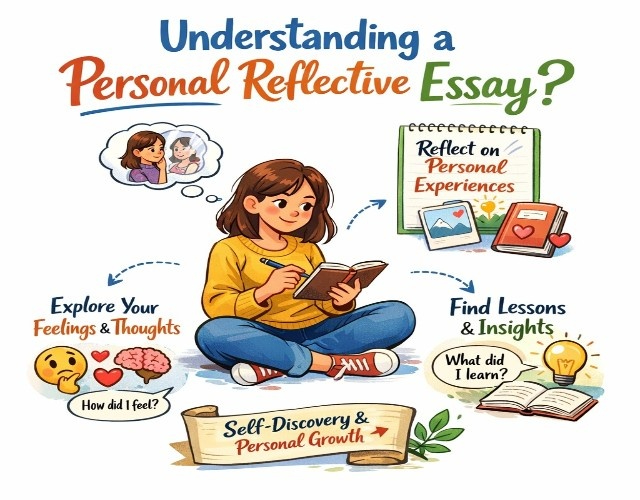
A personal reflective essay examines a real life experience to uncover growth, insight, or a shift in how you think. The keyword is examines, you're not just recounting what happened. You're asking yourself why it mattered, what changed because of it, and what that reveals about you.
It's written in first person, has a personal and honest tone, but it's still purposeful and organised. That's what separates it from a diary. A diary records. A reflective essay analysis.
You'll sometimes see this type of writing called a "self-reflective essay" or "personal reflection essay." Those are all the same thing, different names for the same task.
It's also worth knowing what this type is not.
|
If you want the full overview of reflective writing across all types, the how to write a reflective essay guide covers that broader picture.
"A personal reflective essay only works when you move from describing what happened to analysing why it matters, that gap is where the real reflection lives."
Personal Reflective Essay vs. Other Types of Reflective Writing
One of the most common points of confusion is how a personal reflective essay fits among all the other types of reflective writing. Here's a quick breakdown:
| Type | Focus | Tone | Context |
|---|---|---|---|
| Personal reflective | Life experience + growth | Personal, first-person | Academic or personal |
| Narrative essay | Story/events | Personal | Academic or personal |
| Academic reflective | Course content/texts | Semi-formal | Academic coursework |
| Professional (nursing) | Workplace/clinical | Formal, model-based | Professional settings |
| Diary entry | Raw thoughts | Informal | Personal only |
The biggest difference between a personal reflective essay and a diary entry is structure and analysis; a diary records events, but a reflective essay examines what they reveal about you.
The difference from a narrative essay is subtler: narrative essays tell a story. Personal reflective essays analyse what the story meant. Both are personal and first-person, but the focus is completely different.
How to Choose Your Personal Experience
This is where most students get stuck. There's a common assumption that you need a dramatic, life-altering event to write about. You don't.
What you need is an experience you can genuinely reflect on. The most ordinary moments often make the richest reflections, because they're real, and you actually remember what you thought and felt.
Here are four questions to help you find the right topic:
If you can answer one of those with a specific memory, that's your essay. |
Some broad categories to explore:
Personal challenges or setbacks
Identity and self-discovery
Relationships and people who changed you
Decisions with lasting impact
Growth through discomfort
|
Don't choose the most impressive-sounding story. Choose the one you can actually go deep on. The student who reflects genuinely on a small moment of failure will write a better essay than one who picks something "significant" but can't move past the surface.
For a bigger list of starting points, the reflective essay topics page has a full range of ideas.
"You don't need a life-changing event, you need an experience you can genuinely analyse, and the most ordinary moments often make the richest reflections."
Writing a Personal Reflective Essay Step by Step
Once you've got your experience, here's how to build the essay.
Step 1: Choose your experience and brainstorm
Write down everything you can remember about it, what happened, what you felt, what you thought in the moment, and what you did differently afterwards. Don't edit at this stage. Just get it all out.
Step 2: Identify the "so what?"
This is the most important step, and it's where most essays either work or fall flat.
Ask yourself: What did I actually learn from this? What surprised me? What would I do differently now? How did this change the way I see myself or others?
| The answer to those questions is the core of your essay. Everything else, the description, the context, the structure, exists to support that central insight. |
Step 3: Build your outline
A standard personal reflective essay outline looks like this:
- Intro: Set the scene briefly + state your thesis (the core insight or change)
- Body paragraph 1: Describe the experience with enough context for the reader
- Body paragraph 2: Your initial reaction, what you felt and thought at the time
- Body paragraph 3: The shift, what you realised, how your thinking changed
- Conclusion: Where you are now and what you carry forward
For more details on structure and format, the reflective essay outline guide breaks this down section by section.
Step 4: Write the intro
Your intro should hook the reader with the experience or a question it raised for you, and state your thesis. Not "I will discuss X" but the actual insight your essay is built around. For help specifically with opening lines, the how to start your reflective essay guide covers that in detail.
Step 5: Write the body with analysis, not just description
In every body paragraph, use this pattern: describe what happened, then reflect on what you thought and felt, and lastly connect it to the central insight of your essay.
If you only describe, you've written a story. The reflection is what makes it a reflective essay.
Step 6: Write the conclusion
Don't just summarise. Show where you are now, how the experience shaped you, what you carry forward, and how your thinking has shifted. Connect back to the thesis from your intro.
"Every strong body paragraph in a personal reflective essay does three things: it describes a moment, explores what you felt, and connects it to the insight your essay is built around."
Not Sure You'll Nail the Reflection Part?
Our writers craft personal reflective essays that actually reflect, no generic summaries, no AI content.
100% human-written, AI-free, delivered in as little as 3 hours.
Personal Reflective Essay Examples
Example 1: The Day I Learned to Speak Up
For most of my life, I avoided confrontation. I preferred silence over disagreement and comfort over conflict. That tendency followed me into university, where I often held back my opinions during group discussions. It wasn’t until one particular classroom presentation that I realized staying quiet was holding me back more than speaking ever could.
In my second semester, I was assigned to a group project that required us to present a research proposal. During our planning meetings, I noticed several weaknesses in our argument. The sources were outdated, and our thesis lacked clarity. Although I recognized these issues, I hesitated to speak up. I worried that my teammates would dismiss my ideas or think I was being overly critical.
As the presentation day approached, my discomfort grew. I knew our project could be stronger, but my fear of conflict kept me silent. On the morning of the presentation, however, one of my teammates admitted feeling unsure about our main point. In that moment, I decided to share my concerns. To my surprise, the group responded positively. They agreed that improvements were needed and encouraged me to explain my suggestions.
We quickly revised our thesis, replaced weak sources with stronger academic research, and reorganized our slides for clarity. The final presentation was confident and cohesive. We received one of the highest grades in the class, along with praise for our clear argument and teamwork.
Reflecting on this experience, I realized that my fear of speaking up was rooted in self-doubt rather than reality. I had assumed rejection before giving others the chance to listen. By finally voicing my thoughts, I not only improved the project but also strengthened my confidence.
This experience taught me that growth often requires discomfort. Speaking up does not mean creating conflict, it means contributing value. Since then, I have made a conscious effort to share my ideas in academic and professional settings. While I still feel nervous at times, I remind myself that my perspective matters.
Learning to speak up did more than improve one presentation; it reshaped how I see myself. I no longer view silence as safety. Instead, I see my voice as a tool for collaboration, improvement, and personal growth.
Example 2: The Failure That Changed My Direction
Failure was never something I handled well. Throughout school, I defined myself by good grades and academic success. So when I failed my first major university exam, it felt like more than just a bad result; it felt like a personal defeat.
I remember staring at the grade on the online portal, convinced there had been a mistake. I had studied for weeks, highlighted textbooks, and memorized key terms. Yet somehow, my effort had not translated into success. My initial reaction was embarrassment. I avoided talking about it and began questioning whether I truly belonged in my program.
After a few days of frustration, I scheduled a meeting with my professor. During our conversation, she explained that the exam required critical analysis, not just memorization. I had understood the material, but I struggled to apply concepts in complex scenarios. That feedback shifted my perspective. My failure wasn’t proof that I wasn’t capable, it revealed a gap in my study strategy.
Reflecting on the experience, I realized I had focused on working hard instead of working smart. I had equated effort with effectiveness. This setback forced me to change how I approached learning. I began practicing application-based questions, joining study groups, and seeking feedback earlier.
The following semester, my grades improved significantly. More importantly, my confidence became grounded in growth rather than perfection. Failing that exam taught me resilience and adaptability. It showed me that failure is not an endpoint, it is a redirection.
Today, I no longer fear mistakes in the same way. I see them as opportunities to refine my skills. That failed exam remains one of the most valuable lessons of my academic journey.
Free Downloadable Resources for Personal Reflective Essay
Personal Reflective Essay Format and Length
The standard format for a personal reflective essay is intro + 3 to 4 body paragraphs + conclusion. It's clean, it works, and most tutors expect it.
Length depends on the assignment: most academic personal reflective essays run 500-1,500 words. College application essays (Common App and similar) are typically capped at 650 words. Always check your brief; the target length matters.
A few formatting notes worth keeping in mind:
|
"A personal reflective essay should read like an honest conversation with a thoughtful friend, personal enough to feel real, structured enough to actually say something."
Common Mistakes in Personal Reflective Essays
Writing a story instead of a reflection.
The most common error, you cover what happened but never analyse what it meant. Every section needs to connect back to insight and growth.
Choosing a topic that's too vague.
"My childhood" or "growing up" is too broad. Narrow it to a specific moment, conversation, or period you can actually examine in depth.
Feelings without analysis.
Emotions are essential to personal reflective essays, but they need to lead somewhere. "I was scared" only works if it connects to "and that fear taught me something about how I deal with uncertainty."
Skipping the "so what."
Ending your essay without showing what changed or what you carry forward is the equivalent of stopping mid-sentence. Your conclusion should demonstrate growth, not just summarise events.
Losing your voice.
A personal reflective essay should sound like you. The moment you shift into a formal academic register, it stops working. Write the way you'd explain this experience to someone who knows you well.