



What Makes a Business Case Study Different?
Not all case studies are the same, and treating them that way is usually where things go wrong.
A business case study focuses on measurable outcomes. You're not just telling a story about what happened at a company. You're building an argument about why it happened, what the right response was, and how success gets measured in dollars, percentages, and market share. ROI, revenue impact, cost reduction, customer retention rates, these aren't optional extras. They're the point.
Business case studies also require specific analytical frameworks. A general case study lets you narrate. A business case study requires you to demonstrate that you understand the underlying mechanics of the problem, competitive dynamics, internal capabilities, and stakeholder pressures.
Then there's the stakeholder dimension. In business, decisions don't happen in a vacuum. Who's affected, who has to approve, who benefits? These questions shape which solution actually works, not just which one looks best on paper.
There are also two distinct types you'll encounter:
- Academic case studies (MBA programs, business management courses) require you to apply formal frameworks and structure your analysis around a specific prompt.
- Professional case studies (marketing and sales tools) are written to demonstrate a client result to potential buyers. Both follow similar structures, but the purpose and emphasis differ.
If you're trying to decide which type of case study fits your brief, that distinction matters before you start writing. This guide covers both.
| "A general case study tells a story; a business case study makes a business argument every section has to earn its place with evidence." |
The Core Structure of a Business Case Study
There are seven sections in a standard business case study. Here's what each one does and why it matters.
Executive Summary
This is a 150–200 word overview of the entire case:
- what the problem was
- what approach was taken
- what the outcome looked like.
Write it last, even though it appears first. Readers often decide whether to keep reading based on the executive summary, so lead with business impact, not process.
Background / Company Overview
Set the scene with relevant context: the industry, the company's market position, and any financial or competitive data that frames the stakes. A mid-market manufacturer losing market share to new entrants is a very different situation from a startup burning through runway. Make the reader understand what this company was up against.
Problem Statement
One clear, data-supported statement of the core business challenge. This is the spine of your case study. Get it right here, and everything else follows logically. If you can't write the problem in one or two sentences, you haven't defined it clearly enough yet.
Analysis
The analysis section is where frameworks do their job. You're not just describing what happened. You're explaining why, using tools like SWOT or Porter's Five Forces to make a structured argument. The next section covers this in detail.
Proposed Solutions
Present two or three options and evaluate each against defined criteria. Don't just list them. Show why one is better than the others, using ROI thinking best return relative to cost, risk, and implementation complexity.
Implementation Plan
Walk through the timeline, phases, team requirements, and key dependencies. Be realistic about constraints. An implementation plan that ignores resource limitations or organizational politics isn't credible.
Results / Outcomes
Quantify everything you can: revenue growth percentage, cost savings, market share gained, NPS improvement, payback period. If you're writing a hypothetical academic case, use projected outcomes grounded in your analysis.
For detailed formatting rules around layout, citations, and structure, see our case study format guide.
| "Every business case study section has a job the analysis section earns the conclusions, and the results section proves they worked." |
Business Frameworks That Strengthen Your Analysis
This is where most case study guides fall short. They mention SWOT, maybe list a few other frameworks, and move on. That's not enough. You need to know which framework fits which problem, and how it actually connects to your argument.
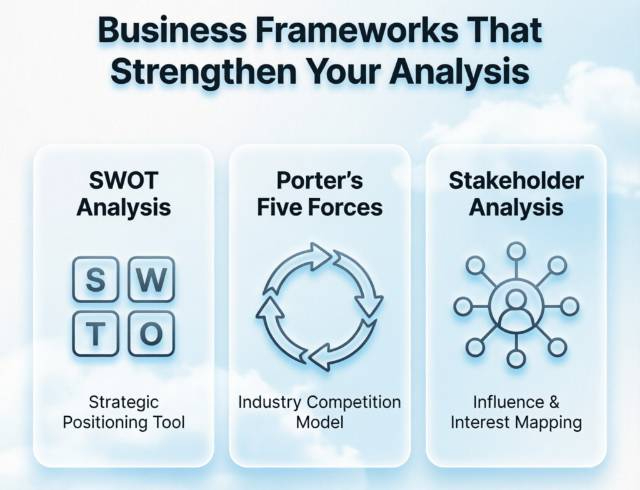
SWOT Analysis
Use SWOT Analysis when you need to understand the internal and external factors driving a business problem. In your case study, it doesn't just sit in the analysis section as a four-box diagram. It should explain why the problem exists (a weakness exposed by a threat) and why your proposed solution is viable (a strength that enables you to capture an opportunity). Don't just list items. Connect them directly to your argument.
Porter's Five Forces
Use this when competitive dynamics are at the center of the problem. If a company is facing margin pressure because suppliers have too much leverage, or market share loss because barriers to entry have dropped, Porter's Five Forces gives you the framework to prove it. Focus on the two or three forces most relevant to the case rather than mechanically working through all five.
Stakeholder Analysis
Use this when your solution depends on organizational buy-in. Map the key stakeholders board, customers, employees, suppliers and show what each group needs from the solution. This is especially important for MBA-level assignments, where ignoring stakeholders is a common reason strong analyses still get marked down.
There are other frameworks worth knowing: the Business Model Canvas works well for market entry cases, and Value Chain Analysis is useful when the problem is operational or cost-focused.
If you're not sure which framework to use, start here:
|
| "Frameworks aren't decoration they're how you show you understand the business problem, not just the symptoms." |
How to Write Each Section of a Business Case Study
Structure tells you what to write. This section tells you how.
- Executive Summary Write it last. Keep it to 150–200 words. Open with the business impact: what was at stake, what changed. Don't bury the outcome. If a reader only gets three sentences into your case study, those three sentences should tell them whether the intervention worked.
- Background / Context Ground your reader in specific, relevant data. Don't just say the company was "a mid-sized retailer facing challenges." Say it was "a $50M mid-market manufacturer facing a 15% year-over-year revenue decline as two new competitors entered the premium segment." The specificity is what makes it credible.
- Problem Statement This is where most drafts go wrong. Compare these two:
Wrong: "Sales were declining." Right: "The company lost 18% market share to two new entrants over 24 months, reducing gross margin from 42% to 31%." |
The second version tells you what happened, how much, over what timeframe, and what it cost. That's a business problem statement. The first is an observation.
- Analysis Section Use your framework here, but don't just present outputs. Interpret them. A SWOT with four filled boxes but no argument isn't analysis. Connect each finding directly to the problem and to your proposed solutions. Your reader should be able to trace a clear line from "here's what the analysis shows" to "here's why that leads to this recommendation."
- Proposed Solutions Present two or three options. For each, evaluate feasibility, cost, risk, and expected ROI. Then make a clear recommendation with a clear rationale. Avoid the academic trap of presenting all options as equally valid. In business, tradeoffs exist for a reason. Pick one, defend it.
- Implementation Plan Break it into phases. Assign resource requirements. Name the key decision-makers and approval dependencies. A plan that works in theory but doesn't account for budget cycles or leadership bandwidth isn't a plan it's a wish.
- Results and Outcomes Quantify wherever you can: revenue growth percentage, cost savings in dollars, market share gained, retention rate improvement, payback period in months. If this is an academic hypothetical, use projected outcomes anchored in your analysis. "Revenue is expected to recover by 12–15% within 18 months based on comparable market re-entry data" is far stronger than "revenue should improve."
| "The problem statement is the spine of your case study if it's vague, everything that follows is soft." |
Transform Projects Into Powerful Case Studies
From research and results to polished, persuasive storytelling
Showcase your expertise in a story your audience can trust.
Business Language: What It Sounds Like (and What to Avoid)
One of the fastest ways to lose credibility in a business case study is vague language. Business writing is specific, data-driven, and outcome-focused. Here's what that looks like in practice.
Generic | Business-Specific |
"The company had trouble with sales" | "Revenue declined 14% year-over-year, driven by a 22% market share loss to new entrants in the premium segment" |
"The solution worked well" | "EBITDA improved 8 percentage points and customer retention rose from 67% to 81% within 12 months of implementation" |
"Management decided to change strategy" | "The executive team approved a 3-year product diversification plan, allocating $4.2M across two new market segments" |
Notice the difference. The business-specific versions tell you who, what, how much, and when. They don't leave room for interpretation. That's the standard.
A few things to avoid in business case studies specifically:
|
The tone you're aiming for is analytical and professional but not robotic. Use third person for companies, active voice for actions, and specific attribution for key decisions. Read it aloud. If it sounds stiff or unnatural, it probably is.
If you're still looking for a topic, check out our business ?case study topics list.
| "In a business case study, 'the company struggled' is not an analysis the specific why, what, and by how much it is." |
Common Business Case Study Mistakes to Avoid
Even well-structured case studies fall down in the same predictable ways. Here's what to watch for.
Defining Multiple Problems
Pick one core business challenge and build your entire case around it. Trying to solve three things at once usually means you've solved none of them convincingly.
Dumping Framework Outputs Without Interpretation
Four SWOT boxes with bullet points isn't analysis. It's a list. Interpret your findings in the context of the problem and connect them to your recommendation.
Listing Solutions Without Trade-Off Analysis
The point of presenting multiple options is to show you can evaluate them. Pick one and make the case. If you treat all options as equally valid, your recommendation carries no weight.
Qualitative Results When Quantitative is Expected
"The company performed better" doesn't demonstrate impact. If you have data, use it. If you're writing a hypothetical, project outcomes and anchor them in evidence.
Writing a Narrative Instead of an Argument
Telling a story about what happened is not the same as making a business case. Every section should be building toward your conclusion. If a paragraph doesn't serve that purpose, it probably doesn't need to be there.
Ignoring Stakeholder Interests in the Solution
Especially at MBA level, a solution that works financially but creates significant resistance from key stakeholders isn't a strong recommendation. Show you've thought about implementation, not just optimization.
| "Listing a SWOT analysis doesn't demonstrate analytical thinking interpreting it in context of the problem does." |
Business Case Study to Learn From
Looking at how strong case studies are structured is one of the most useful things you can do before you write your own. Here are three common business scenarios and the frameworks that work best for each.
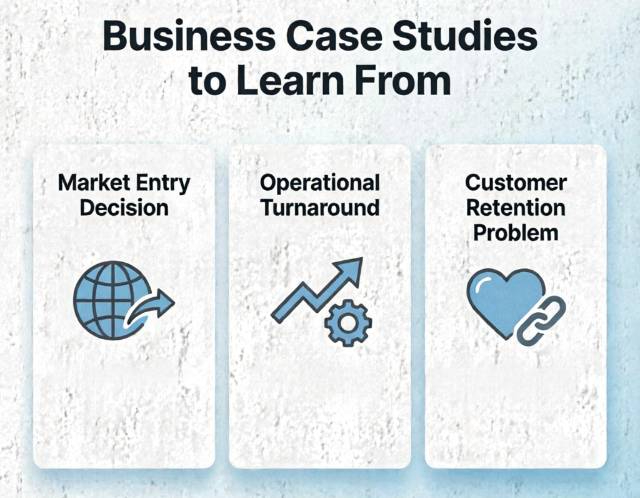
Market Entry Decision
The best frameworks here are Porter's Five Forces (to evaluate the competitive landscape of the new market) and Stakeholder Analysis (to map internal and external resistance to the entry). Strong results sections in this type of case define a specific market share capture target and compare cost-to-entry against projected 3-year ROI.
Operational Turnaround
SWOT works well here because the problem is usually a combination of internal weaknesses and external pressures. Pair it with a detailed Implementation Plan section. Strong results in this type of case quantify efficiency gains as a percentage, cost savings in dollars, and the timeline to break-even.
Customer Retention Problem
Customer lifetime value analysis combined with SWOT is the typical framework combination. The results section should show retention rate improvement as a percentage and the revenue impact of reducing churn by a specific amount.
If you want to read complete worked examples across business and other disciplines, our ?case study examples page has sample files you can use as a reference.
| "The best way to internalize business case study structure is to read strong examples and trace how each section builds the argument." |
In conclusion,





-20616.jpg)
-20617.jpg)