


-20616.jpg)
What Makes a Psychology Case Study Different?
Most case study guides treat every type of case study the same. In psychology, that's a mistake.
A psychology case study isn't a generic research paper. It has a field-specific structure one built around assessment, diagnosis or formulation, treatment planning, and evaluation. You're not just analyzing what happened. You're explaining why it happened, using established psychological theory as your interpretive lens.
There are two main types of psychology case study you're likely to encounter as a student.
- The first is an academic psychology paper, where you use a case (historical or hypothetical) to illustrate or test a psychological theory.
- The second is a clinical case report, which focuses on a real patient's treatment and outcomes, and is most common in counseling, clinical, and healthcare training programs.
- These two types have different structures and different expectations knowing which one your professor wants will save you a lot of confusion.
| "Unlike other case studies, a psychology case study doesn't just describe what happened it explains why, using psychological theory as the lens." |
Types of Psychology Case Studies
Psychology case studies come in several forms, and the type shapes how you approach the whole paper. For full definitions of all case study types, see our complete guide to types of case studies.
Descriptive case studies document behavior or symptoms without making causal claims. Explanatory ones connect observed behaviors to psychological causes or theory. Exploratory case studies investigate new territory and generate hypotheses rather than testing them.
You'll also see case studies described as intrinsic (studied because the case itself is unique and significant think Phineas Gage) or instrumental (studied because it helps illustrate a broader theory think Little Hans). Some involve a single subject; others study a group or collective.
| "The type of case study you're writing determines the structure, depth, and evidence standards your professor will expect." |
Famous Psychology Cases (And What We Can Learn From Them)
One of the best ways to understand what a psychology case study should look like is to read the ones that made history. Each of these famous cases followed a recognizable structure and that's the same structure you'll use in your own work.
Case 1: Phineas Gage (1848)
It is the classic example of an intrinsic case study. After an iron rod passed through his frontal lobe in a railroad accident, Gage's personality changed dramatically. Researchers documented his full subject history, the behavioral changes, and drew neuropsychological conclusions from a single case. That combination of background, behavioral observation, and theoretical analysis is exactly what you'll need in your own paper.
Case 2: Anna O (Bertha Pappenheim)
Treated by Breuer and later theorized by Freud, is the foundational psychoanalytic case report. It shows how a psychological framework in this case, early psychoanalytic theory shapes how symptoms are interpreted and treatment is designed.
Case 3: Little Hans (Herbert Graf)
It is a single-subject study of a child's phobia, analyzed through Freud's Oedipal theory. It demonstrates how one case can be used instrumentally to test or illustrate a theoretical framework which is exactly what most academic psychology papers ask you to do.
Case 4: Patient HM (Henry Molaison)
It was studied for decades after a surgery left him unable to form new long-term memories. His case shaped modern understanding of memory and the hippocampus, and also raised important retrospective questions about ethical consent. Every famous psychology case study from Phineas Gage to Anna O follows a structure that you can replicate in your own work.
Browse our case study examples for psychology case studies PDFs you can use as a reference.
Psychological Frameworks to Apply (This Is What Most Guides Miss)
Here's the part most case study writing guides skip entirely. Knowing the structure of your paper is only half the job. The other half is choosing the right psychological framework because your framework determines how you interpret every piece of evidence you present.
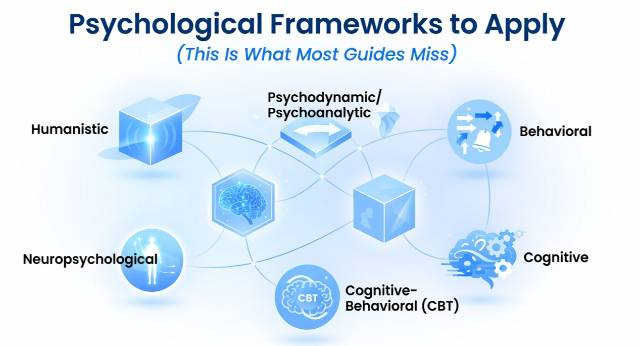
Psychodynamic/Psychoanalytic
Focuses on unconscious drives, defense mechanisms, and early childhood experiences. Most useful when your case involves trauma, early relationships, or recurring behavioral patterns that aren't explained by surface-level factors.
Behavioral
Looks at observable behaviors, stimulus-response patterns, and conditioning. Good for cases involving specific learned behaviors, phobias, or habit-based problems (Skinner, Pavlov).
Cognitive
Examines thought patterns, cognitive distortions, and schemas. Developed by Beck and Ellis, this framework works well when the case centers on how a subject's thinking contributes to their distress or behavior.
Cognitive-Behavioral (CBT)
The most commonly required framework in clinical training programs. It combines cognitive and behavioral analysis and has strong evidence backing if you're in a counseling or clinical program and your professor hasn't specified a framework, CBT is usually a safe bet.
Humanistic
Centers on self-actualization, personal growth, and unconditional positive regard (Rogers, Maslow). Useful for cases where the focus is the subject's self-concept and potential rather than pathology.
Neuropsychological
Examines brain-behavior relationships. Most relevant for cases involving brain injury, neurological conditions, or cognitive impairment like the Phineas Gage or Patient HM cases.
How do you choose? Match the framework to the subject's presenting problem and, where possible, to your course module. Your module will usually signal which theoretical orientation is expected.
| "Your chosen psychological framework shapes how you interpret every piece of evidence in your case study pick it before you start writing, not after." |
How to Write a Psychology Case Study: Step by Step
This is where you put it all together. Follow these eight steps in order, and you'll have a complete, field-specific psychology case study.
Step 1: Choose and Define Your Subject
Start by identifying who or what you're studying. This might be a historical figure (academic paper), a hypothetical composite (sometimes used in clinical training), or a real patient (clinical report with proper consent).
If you're writing a clinical case report on a real person, get ethical clearance and written informed consent before collecting any data. For academic papers using historical figures, you still need to acknowledge the ethical limitations of the source material, especially for older cases where consent wasn't obtained.
If you're still choosing a subject, our psychology case study topics list can help you find something manageable and researchable.
Step 2: Gather Background Information
Before you write a single word of your case study, gather everything you can about the subject. This includes personal history (upbringing, education, relationships), medical and psychological history (prior diagnoses, medications, previous treatment), and contextual factors like stressors, trauma, or cultural background.
Your data collection methods will vary depending on the type of case study. Academic papers draw on published literature and historical records. Clinical reports draw on interviews, behavioral observations, psychological assessments, and patient records.
Step 3: Write Your Introduction
Keep this tight 150 to 200 words. Introduce the subject (use a pseudonym or initials if they're real), state the presenting problem, and briefly identify the psychological framework you'll use to analyze the case.
Don't bury the lede. Your reader should know within the first two sentences who you're studying and what the central issue is.
Step 4: Assessment and Background Section
This is where you document what's happening. Describe the subject's presenting symptoms and current functioning across three areas: behavioral (what they do), emotional (what they feel), and cognitive (what they think).
Use DSM-5 or ICD-10 diagnostic criteria as reference when identifying symptoms this shows your professor you're working within recognized clinical standards.
Step 5: Case Formulation (Diagnosis/Analysis)
This is where your framework does its work. Apply the psychological theory you chose in Step 1 to interpret the symptoms and behaviors you documented in Step 4.
A good formulation identifies three things: the precipitating factors (what triggered the problem), the predisposing factors (what made the subject vulnerable), and the maintaining factors (what keeps the problem going). If you're using a CBT framework, you'd identify cognitive distortions and the behavioral patterns that reinforce them. If you're using a psychodynamic lens, you'd explore early experiences and defense mechanisms.
| "The assessment tells you what is happening. The formulation tells you why. The treatment plan tells you what to do about it." |
Step 6: Treatment Plan (Clinical) or Analysis Section (Academic)
If you're writing a clinical case report, your treatment plan should include: goals (what outcomes you're working toward), the intervention method (which therapeutic approach you'll use), a timeline, and measurable criteria for success.
If you're writing an academic psychology paper, this section becomes your analysis section. You're not prescribing treatment you're doing a deep analysis that connects the evidence to the theoretical framework, identifies patterns, and draws implications for the broader psychological literature.
Step 7: Results and Evaluation
What changed? For clinical case reports, document the outcome of the intervention: what symptoms improved, what remained, what the prognosis looks like. For academic papers, focus on what the case reveals what does it tell us about psychological theory or human behavior that we didn't fully understand before?
Be specific. Vague statements like "the subject improved" don't cut it. Reference measurable changes where possible, and compare outcomes against the goals set in Step 6.
Step 8: Discussion and Conclusion
Interpret your findings in the context of the broader psychological literature. What do your results confirm, challenge, or add to existing theory? Acknowledge the limitations of your case case studies can't be generalized to entire populations, and a single case can never prove a universal claim.
Suggest directions for further research, and close with a clear summary of your key finding. Don't start your conclusion with "in conclusion" just state your takeaway directly.
For more on analyzing another person's case once your professor assigns one, our guide on how to analyze a case study walks you through that process.
Make Your Projects Shine With a Case Study
Expertly crafted case studies for business, marketing, and research
Turn your work into a story that inspires confidence.
Ethical Considerations in Psychology Case Studies
Ethics aren't optional in psychology they're built into the field. If you're writing a clinical case report, here's what you need to know.
- Confidentiality is non-negotiable. Anonymize all identifying information: change the subject's name, location, workplace, and any details that could identify them to someone who knows them. This applies even if you have the subject's consent.
- Consent needs to be in writing. Informed consent means your subject understands what you're doing, why you're doing it, and how the information will be used before you collect any data.
- Competence is an issue in clinical training specifically. Only licensed professionals or directly supervised trainees should write clinical case studies based on real patients. If you're an undergraduate writing an academic paper, you're almost certainly working with hypothetical or historical cases which sidesteps this issue entirely.
- For historical cases, acknowledge the ethical gap. The research on Phineas Gage was valuable, but Gage never consented to being studied. Patient HM was studied for decades; the ethical questions around consent for someone with severe memory impairment are real, and a thoughtful case study acknowledges them.
| "A psychology case study that violates confidentiality isn't just an ethical problem it's an academic integrity problem." |
Psychology case studies share some structure with nursing case study writing, especially in the assessment section though the ethical framework and theoretical lenses are quite different.
APA Format for Psychology Case Studies
Psychology is one of the strictest fields for citation every claim about a diagnosis, theory, or intervention needs a source. APA 7 is the standard format for psychology coursework, and your case study will need to follow it throughout.
Title Page
For a student paper, your title page should include the paper title, your name, institution, course name, instructor, and date. You don't need a running head. An abstract (150 to 250 words) may or may not be required check your assignment instructions.
Intext Citations
In-text citations follow the (Author, Year) format. Any time you reference a psychological framework, cite the foundational source. Any time you reference a diagnosis from DSM-5, cite the American Psychiatric Association. Any time you build on a previous case study like referencing Freud's work on Anna O cite the original source, not a summary of it.
Reference Page
Your references page goes at the end: alphabetical order, hanging indent, double-spaced. For detailed formatting rules and template outlines, see our case study format guide. The official ?APA 7 guidelines are also worth bookmarking.
Common Mistakes in Psychology Case Studies
Most mistakes in psychology case studies come from treating them like a general case study with a few psychology words sprinkled in. Here's what to watch for.
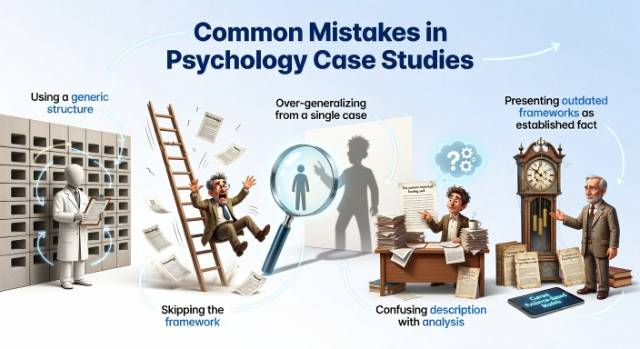
Using a generic structure
A psychology case study has specific sections assessment, case formulation, treatment plan or analysis that you won't find in a business or marketing case study. If your outline doesn't reflect the field, your marks won't either.
Skipping the framework
Describing a subject's symptoms without connecting them to a psychological theory isn't analysis it's description. Your framework is the whole point. Make sure every claim you make in the formulation section is grounded in a recognized theoretical approach.
Over-generalizing from a single case
Your conclusions need to stay appropriately scoped. One case can support a theoretical argument; it can't prove a universal claim about human behavior. Acknowledge this in your discussion.
Confusing description with analysis
Listing symptoms is step four. Explaining them why they exist, how they connect, what theory predicts is step five. Many students stop at the list and never do the interpretation. That's where most of the marks live.
Presenting outdated frameworks as established fact
Freudian theory is influential but contested. If you're using a psychodynamic lens, acknowledge that critics exist and that the framework has limitations.
- The psychology case study method is covered well by Simply Psychology if you want a solid methodological grounding.
- Business case study writing shares some structural similarities with psychology but differs significantly in its theoretical frameworks and evidence standards.
In conclusion,
A psychology case study is your chance to connect theory with real human behavior. When you follow the correct structure, apply APA guidelines, and carefully address ethical considerations, your analysis becomes clearer and more credible.
Focus on explaining why behaviors occur, not just what happens, and support your insights with research. With a thoughtful approach, psychology case studies become less about memorizing rules and more about understanding people in a meaningful way.
Ready for a Work That Truly Flows? Our writers handle everything from structure to delivery-ready polish. Trusted by students, professionals, and public speakers worldwide






-20617.jpg)