


-20617.jpg)
What Does It Mean to Analyze a Case Study?
Case study analysis gets confused with case study writing constantly, and it's easy to see why. They sound similar. But they're completely different assignments.
When you analyze a case study, you're responding to a scenario someone else wrote. Your professor hands you a business situation, a management problem, or a real-world scenario, and your job is to examine it critically. When you write a case study, you're building the document yourself from original research.
Analysis shows up in two main contexts:
- The first is an academic assignment where you read a case and submit a written response.
- The second is a business school case discussion, think Harvard or Stanford MBA programs, where you analyze the case before class and defend your thinking out loud.
Either way, your professor or instructor isn't looking for a summary. They already know the case. They want to see your thinking.
| Case study analysis isn't about summarizing what happened it's about explaining why it happened and what should happen next. |
Before You Start: Read the Case the Right Way
Most students read a case once and start writing. That's why most case analyses are shallow.
You need at least three reads before you touch your keyboard.
- The first read is a skim get the context, the setting, the key players. Don't stop to highlight. Just understand what's happening.
- The second read is where you slow down. Go line by line. Highlight key facts, major decisions, financial figures, and outcomes. Pay attention to what feels like it's being emphasized and what's mentioned only once.
- The third read is where analysis starts. You're looking for what's unresolved, what tensions exist, what questions the case is implicitly asking. This is when you distinguish symptoms (the visible problems) from root causes (what's actually driving them).
Note every stakeholder mentioned in the case. What do they want? What are their constraints? Stakeholders matter more than most students realize when it's time to make recommendations.
Reading a case once gets you the story. Reading it three times gets you the analysis.
How to Identify the Core Problem
Here's where most students lose points: they analyze the symptom instead of the problem.
A company's revenue is declining. That's a symptom. Why is it declining? Maybe customer acquisition costs are too high. Why are they too high? Maybe the wrong channels are being used. Maybe the product-market fit is off. That's the root cause and that's what your analysis needs to address.
The 5 Whys technique is simple but effective. Take the visible problem and ask "why?" five times in sequence. Each answer becomes your next question. By the time you've gone five levels deep, you're usually at the real issue.
Once you've identified what you think the core problem is, frame it clearly before you move to solutions. Write it out in one sentence: "The central problem in this case is X, caused by Y." Professors grade problem identification heavily because it determines whether everything else in your analysis is headed in the right direction.
Most students write about symptoms. The best analyses go one level deeper and find the problem behind the problem.
Analytical Frameworks You Can Apply
Frameworks give your analysis structure. They're not formulas they're lenses that help you look at the case from the right angle. The mistake most students make is forcing one framework onto every case, regardless of whether it fits.
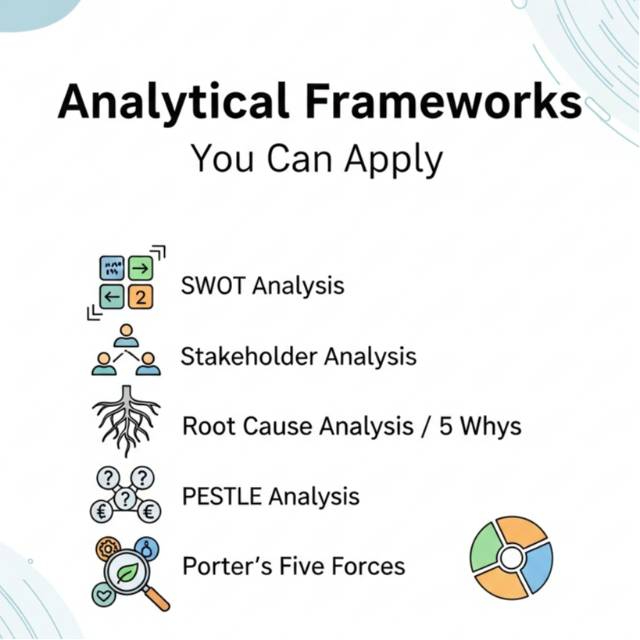
SWOT Analysis
(Strengths, Weaknesses, Opportunities, Threats) works well for strategic decisions, turnaround cases, and situations where you need to assess a company's overall position before recommending a direction.
Stakeholder Analysis
It is best for conflict cases, change management scenarios, or any situation where different parties have competing interests. Map out who's affected, what they want, and what they're willing to accept.
Root Cause Analysis / 5 Whys
It fits problem-solving and operations cases where the main task is diagnosing what went wrong and why. It pairs well with the problem identification step above.
PESTLE Analysis
(Political, Economic, Social, Technological, Legal, Environmental) is the right call when you're analyzing market entry, regulatory shifts, or macro-environment factors affecting a business or sector.
Porter's Five Forces
It belongs in competitive strategy and industry analysis cases. Use it when the case centers on a company's position within an industry threats from new entrants, supplier power, buyer power, substitutes, and rivalry.
Framework | Best For |
SWOT | Strategic decisions, turnaround cases |
Stakeholder Analysis | Conflict, change management cases |
Root Cause / 5 Whys | Operations, problem-solving cases |
PESTLE | Industry analysis, market entry |
Porter's Five Forces | Competitive strategy, market cases |
A framework is a lens, not a straitjacket use it to focus your thinking, not to box it in.
The 6 Steps to Analyze a Case Study
These steps work whether you're in a first-year business class or a graduate MBA program. The rigor you bring to each step is what changes at different levels the process itself stays the same.
Step 1: Read the case at least 3 times
Skim for context, scan for key facts, then do a deep analytical read. Never write based on a single read.
Step 2: Identify all stakeholders and their motivations
List every party mentioned in the case. What does each stakeholder want? What are they afraid of losing? Understanding stakeholder dynamics often reveals where the real conflict lives.
Step 3: Define the core problem not the symptom
Use the 5 Whys to drill down from what's visible to what's actually driving it. Write the core problem in a single, precise sentence before you proceed.
Step 4: Apply the right analytical framework for the case type
Use the table above to match your framework to the scenario. If the case doesn't clearly fit one framework, you can combine two just make sure the combination serves your analysis rather than complicates it.
Step 5: Evaluate at least 2–3 alternative solutions
Professors want to see that you considered options, not just jumped to a conclusion. For each alternative, note the pros, cons, risks, and which stakeholders it serves or disadvantages.
Step 6: Form a clear recommendation with supporting evidence
Pick the best solution and defend it. Every claim in your recommendation needs to be tied back to specific evidence from the case. "I think this is the right approach" isn't analysis. "Based on the company's cost structure in Q3 and the stakeholder constraints outlined in Section 4, this approach minimizes risk while addressing the core pricing problem" is.
| These six steps work for a Harvard MBA case or a first-year business class assignment the rigor of your analysis, not the case itself, determines the grade. |
Transform Projects Into Powerful Case Studies
From research and results to polished, persuasive storytelling
Showcase your expertise in a story your audience can trust.
How to Write Your Case Analysis Paper
You've done the thinking. Now you need to turn it into a deliverable your professor can actually grade.
A case analysis paper has a standard structure, and sticking to it matters. Professors reading 30 papers in a row will notice immediately if yours is disorganized or missing a section.
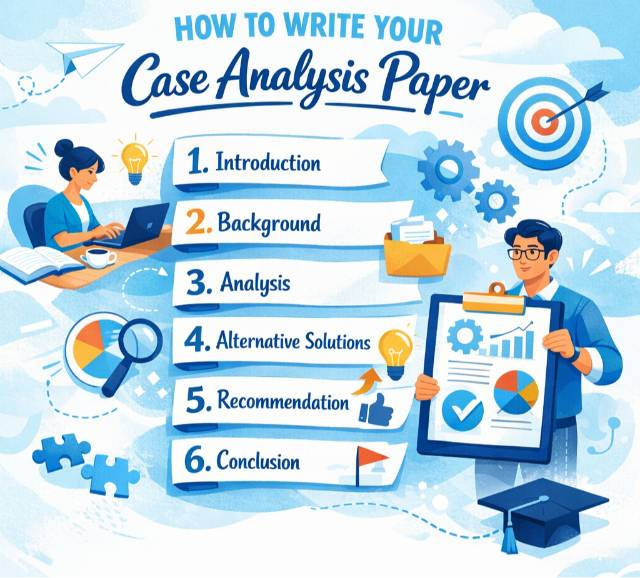
1. Introduction
State the problem you identified and your thesis your recommended course of action upfront. Don't save it for the end. Your intro should tell your professor exactly what problem you found and what you recommend before they read a single page of your analysis.
2. Background
Give brief context about the case. Not a summary your professor already knows the case. Just enough to orient your analysis. Aim for one short paragraph.
3. Analysis
This is the meat of the paper. Walk through the frameworks you applied and what they revealed. Show your reasoning, not just your conclusions.
4. Alternative Solutions
Present 2–3 options you considered, with honest pros and cons for each. This shows you thought critically rather than jumping to the first answer.
5. Recommendation
Your best solution, clearly stated, with evidence from the case supporting every claim. This should connect directly back to the problem you defined in your intro.
6. Conclusion
Tie everything together. Restate the core problem, summarize your recommendation, and explain why it addresses the root cause rather than the symptoms.
Use topic sentences that lead with your point, not your supporting evidence. Support every claim with specifics from the case. And don't restate what happened in the case analyze it.
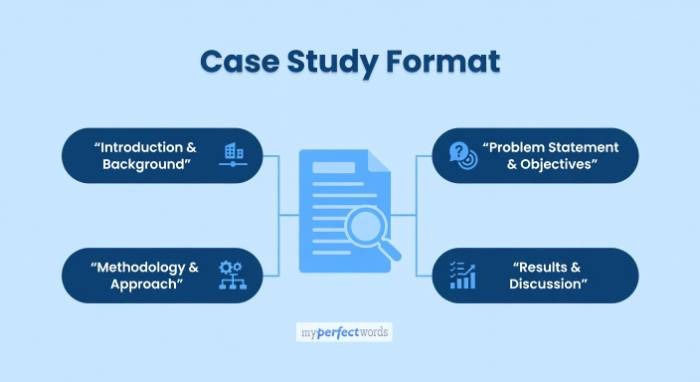
For formatting rules, citation styles, and title page guidance, see our case study format guide.
Common Mistakes Students Make When Analyzing Case Studies
The difference between a B paper and an A paper is usually one of these:
Summarizing instead of analyzing
The most common mistake by far. Describing what happened in the case is not analysis. Your job is to explain why it happened and what should be done about it. If your paper could have been written without reading the case carefully, it's a summary.
Solving the symptom, not the problem
If you identified "low sales" as the core problem, your analysis is already off track. Low sales is a result. Your analysis needs to find the cause behind it.
Forcing one framework onto every case
SWOT is versatile, but it doesn't fit every situation. Using Porter's Five Forces on a case about internal HR conflict will produce a weak analysis. Match the framework to the case.
Making unsupported recommendations
"The company should increase its marketing budget" needs to be supported by case evidence. Why that solution? Why that amount? What specific data from the case supports it?
Ignoring alternatives
Even if you're certain about your recommendation, showing that you evaluated other options is expected. It demonstrates analytical depth.
Starting to write before completing the analysis
Running out of time is real, but the fix isn't to skip the analysis. The fix is to start the analytical reading earlier.
| The single most common grade-killer in case analysis? Writing a summary with a recommendation bolted on at the end. |
Case Study Analysis vs. Writing a Case Study What's the Difference?
If you're reading this and realizing you might have the wrong assignment, here's a quick clarification.
Analyzing a case study means responding to a case you've been given. Someone else wrote the scenario your job is to read it, evaluate it, and produce a written analysis.
Writing a case study means creating one from scratch. You're researching a real company or situation, gathering data, and building the document yourself.
Different skills. Different outputs. Different assignments.
If you're looking for finished examples to study before your own analysis, our case study examples guide has annotated examples across multiple fields.
In Conclusion,
Analyzing a case study is all about looking beyond the surface and understanding what the situation really reveals. When you break the case down into key issues, apply the right framework, and support your insights with evidence, the analysis becomes much clearer and more focused.
Take your time, question assumptions, and connect your findings back to theory or real-world practice. With a structured approach, case study analysis becomes less overwhelming and far more insightful.
Deadline Breathing Down Your Neck?
Our writers deliver polished work, researched, structured, and ready to submit. Your information stays secure while we deliver outstanding work.






-20616.jpg)