Why Counterarguments Make Your Essay Stronger
You might worry that bringing up the other side will weaken your position. But here's the thing: your professor already knows those counterarguments exist. Pretending they don't just makes you look like you haven't done your research.
A counterargument doesn't weaken your argumentative essay. It shows you're confident enough to face opposing views head on.
Including counterarguments demonstrates critical thinking. You're not just cherry picking evidence that supports your view. You're showing you've considered multiple perspectives and still believe your position is strongest.
Think about it from your reader's perspective. If they already have doubts about your argument, you need to address those doubts directly. Counterarguments let you tackle objections before they become deal breakers.
Professors specifically look for this skill. They want to see that you can engage with complexity, not just make a one sided case. Acknowledging the other side shows intellectual maturity and fairness.
What Is a Counterargument?
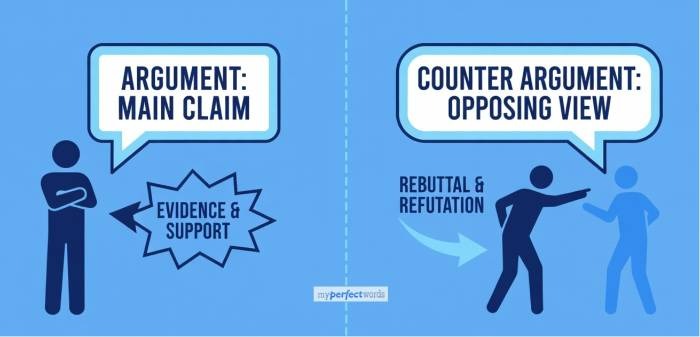
A counterargument has two essential parts: the concession and the refutation.
The concession is where you acknowledge the opposing viewpoint. You're saying, "Yes, I understand why some people believe this." You present their position fairly and accurately. No strawman arguments.
The refutation is where you respond to that opposing view. You explain why your original argument is still stronger despite the opposing point. This is where you prove your argumentative thesis holds up even when challenged.
Here's what a counterargument is NOT:
- It's not just listing opposing views without responding to them
- It's not dismissing the other side as "obviously wrong"
- It's not setting up a weak version of the opposing argument just to knock it down
- It's not agreeing with the other side (that would be changing your thesis)
Think of it like a debate. Your opponent makes a point. You acknowledge their point is worth considering, then you explain why your position is still the right one. You're being fair, but you're standing your ground.
| The key difference between a counterargument and just mentioning opposition is the refutation. You must respond. Acknowledge the opposing view, then refute it. That's the complete package. |
The 3-Step Counterargument Formula
You'll write stronger counterarguments when you follow this three step process. It removes the guesswork.

Step 1: Acknowledge (The Concession)
Start by introducing the opposing viewpoint. Use a transition phrase that signals you're presenting an alternative perspective.
Your job here is to present the counterargument fairly. Don't exaggerate it or make it sound ridiculous. Present it the way someone who genuinely believes it would present it.
Template: "Some argue that [opposing position] because [their reasoning]." Example: "Some argue that college athletes should not be paid because they already receive scholarships that cover tuition, room, and board." |
Notice you're not saying they're wrong yet. You're just showing you understand their perspective.
Step 2: Validate (Show You Understand)
This step is optional but powerful. Briefly acknowledge the merit in the opposing view. This shows you're thinking critically, not just dismissing anything that disagrees with you.
Template: "This perspective has merit because [genuine strength of their argument]." Example: "This perspective has merit because scholarships do provide significant financial value, often covering $50,000+ per year." |
You're not agreeing with their conclusion. You're just showing intellectual honesty by acknowledging what they got right.
Step 3: Refute (Prove Your Point Is Stronger)
Now you explain why your original argument is still more valid. You can use several refutation strategies from different types of arguments.
Strategy 1: Show limitations Point out what the opposing argument overlooks or fails to consider.
Example: "However, this view ignores the revenue college athletes generate. Top programs earn hundreds of millions annually, yet players receive none of this profit while risking career-ending injuries."
Strategy 2: Present stronger evidence Offer data or examples that support your position more convincingly.
Example: "Research shows that 86% of college athletes live below the poverty line, even with scholarships. Meanwhile, their coaches earn multi-million dollar salaries from the athletes' labor."
Strategy 3: Challenge the underlying assumption Question the foundation of the opposing argument.
Example: "The claim that scholarships are sufficient compensation assumes education alone is fair payment for full-time athletic work, but this logic doesn't apply to any other industry where people generate profit for others."
Strategy 4: Highlight consequences Show the negative results of accepting the opposing view.
Example: "Refusing to pay college athletes perpetuates exploitation and prevents them from building financial security during their peak earning years."
You don't need to use all strategies. Pick the one that works best for your specific counterargument.
Putting It All Together
Here's the complete formula in action:
"Some argue that college athletes should not be paid because they already receive scholarships covering tuition, room, and board (acknowledge). This perspective has merit because scholarships do provide significant financial value, often covering $50,000+ per year (validate). However, this view ignores the revenue college athletes generate; top programs earn hundreds of millions annually, yet players receive none of this profit while risking career ending injuries. Research shows that 86% of college athletes live below the poverty line even with scholarships, while their coaches earn multi million dollar salaries (refute)."
That's your template. Modify it for any counterargument you need to address.
Where to Place Your Counterargument in an Argumentative Essay
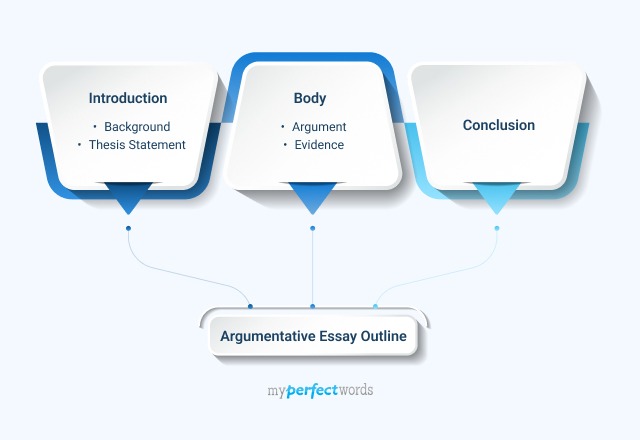
You have three main options for where to put your counterargument. Your choice depends on your argumentative essay outline and structure, and rhetorical strategy.
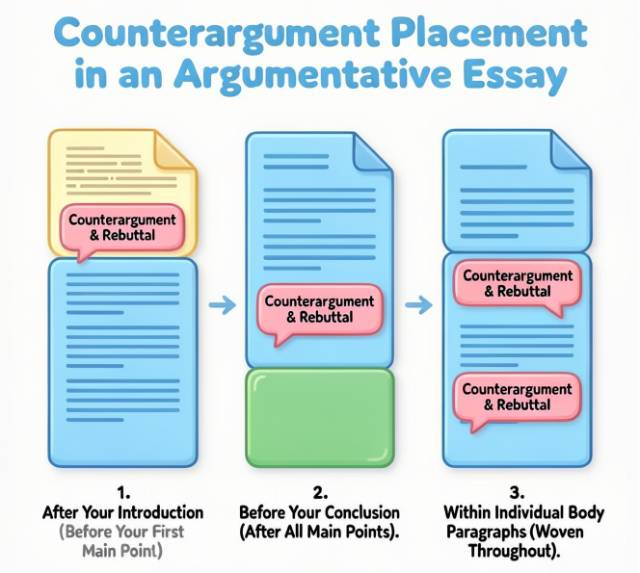
Option 1: After Your Introduction (Before Your First Main Point)
This placement works well when you want to address the elephant in the room immediately.
Use this when:
- The opposing view is so common that readers are already thinking it
- You want to clear objections early so readers can focus on your argument
- Your essay is relatively short (under 1,500 words)
Structure:
|
Advantage: Gets potential objections out of the way early
Option 2: Before Your Conclusion (After All Main Points)
This placement lets you build your case first, then address objections once readers have seen your evidence.
Use this when:
- Your argument needs full development before addressing opposition
- You want to end on a strong note by "defending your territory"
- Your counterargument is complex and needs context from your main points
Structure:
|
Advantage: You've already persuaded readers before introducing doubts
Check out our blog to learn how to write perfect argumentative essay conclusion.
Option 3: Within Individual Body Paragraphs (Woven Throughout)
Advanced writers sometimes weave counterarguments into their main points, addressing objections as they go.
Use this when:
- You're writing a longer, more complex essay
- Each main point has a specific counterargument worth addressing
- You want a more sophisticated, nuanced approach
Structure: Each body paragraph includes: Claim, Evidence, Counterargument, Refutation, Tie back to thesis |
Advantage: Addresses objections at the precise moment they'd arise
Which option should you choose?
For most student essays, Option 1 or Option 2 works best. If you're unsure, go with Option 2 (before the conclusion). It's the safest approach for standard argumentative essays.
Struggling With Your Argumentative Essay? We'll Write It For You. From Thesis to Conclusion Your grade matters. Let us help you protect it.
Transition Phrases for Introducing Counterarguments
The right transition phrase signals you're presenting an opposing view. Here are the most effective options:
Acknowledging Opposition
- "Some argue that..."
- "Critics contend that..."
- "It might be argued that..."
- "One could claim that..."
- "Opponents of this view suggest..."
- "An alternative perspective holds that..."
Moving to Refutation
- "However, this view..."
- "Yet this argument overlooks..."
- "While this perspective has merit..."
- "Despite this concern..."
- "This reasoning fails to account for..."
- "A closer examination reveals..."
Showing Limitation
- "This claim ignores..."
- "This perspective overlooks..."
- "This argument doesn't account for..."
- "This reasoning fails to consider..."
Presenting Stronger Evidence
- "Research shows..."
- "Studies indicate..."
- "Evidence demonstrates..."
- "Data reveals..."
Don't use the same transition phrase repeatedly. Vary your language to keep your writing engaging.
Common Counterargument Mistakes to Avoid
Mistake 1: The Strawman Argument
You set up a weak or distorted version of the opposing view just to knock it down easily.
Bad Example: "Some people think we should just let students cheat because AI exists."
Nobody actually argues this. You're creating an easy target instead of addressing the real opposing view.
Good Example: "Some argue that AI tools should be available for student writing because they can help improve clarity and catch errors." This fairly represents a genuine opposing viewpoint. |
Mistake 2: Weak Refutation
You acknowledge the counterargument but don't actually respond to it effectively.
Bad Example: "Some say school uniforms limit self expression. But uniforms are still important."
You didn't explain WHY they're still important or address the self expression concern.
Good Example: "Some say school uniforms limit self expression. However, research shows students find other ways to express individuality through accessories, hairstyles, and after school choices, while uniforms reduce bullying and increase focus on academics." You addressed the concern AND explained why your position holds up. |
Mistake 3: Dismissing Without Acknowledging
You act like the opposing view is ridiculous or obviously wrong.
Bad Example: "Anyone who thinks [opposing view] is clearly mistaken."
This makes you sound close minded and weakens your credibility.
Good Example: "While this perspective is understandable given [context], it doesn't account for [your stronger evidence]." You acknowledge the view has some logic before explaining why yours is stronger. |
Mistake 4: Not Including a Strawman Argument at All
Some students skip counterarguments entirely, hoping readers won't notice.
Why it's a problem: Your professor WILL notice. And readers who already have doubts will leave unconvinced.
| The fix: Always include at least one counterargument in an argumentative essay. It's not optional. |
Strong vs. Weak Counterarguments: Side by Side Examples
Example 1: School Uniforms
Weak Version: "Some people don't like school uniforms. But they're wrong because uniforms are good."
Why it's weak:
- Vague opposing view ("don't like")
- No validation of opposing concern
- No specific refutation
- Dismissive tone
Strong Version: "Critics argue that school uniforms restrict students' freedom of expression and individuality, which are important for adolescent development. This concern is valid self-expression does play a role in identity formation. However, research from the University of Nevada shows that schools with uniform policies report 30% fewer disciplinary incidents and higher academic focus, suggesting that the benefits of reduced social pressure and increased learning time outweigh the limitation on clothing-based expression. Students can still express individuality through extracurriculars, social activities, and personal interests outside of school dress."
Why it's strong:
|
Example 2: College Athletes Payment
Weak Version: "People say college athletes already get scholarships. But that's not enough money."
Why it's weak:
- Oversimplified opposing view
- No acknowledgment of merit
- Vague refutation ("not enough")
- No supporting evidence
Strong Version: "Opponents of paying college athletes point out that full scholarships can be worth $50,000-$70,000 per year, providing free education and housing. This argument has merit scholarships do cover significant costs. However, this view fails to account for the fact that top college athletic programs generate hundreds of millions in revenue annually, while athletes receive none of these profits despite dedicating 40+ hours per week to their sport. A Northwestern University study found that 86% of college athletes live below the poverty line even with scholarships, unable to afford basic necessities while their labor enriches coaches and institutions. Fair compensation acknowledges both the value of education and the economic reality of their athletic contribution."
Why it's strong:
|
Example 3: Homework Ban
Weak Version: "Teachers think homework is educational. But kids need free time."
Why it's weak:
- Superficial opposing view
- No validation
- Competing claims, not refutation
- No evidence
Strong Version: "Proponents of homework argue that practice outside class reinforces learning and teaches time management skills essential for college success. These are legitimate educational goals worth pursuing. However, research from Stanford University shows that more than two hours of homework per night correlates with increased stress, physical health problems, and reduced family time, without improving academic outcomes. When homework exceeds a reasonable threshold, it becomes counterproductive damaging student wellbeing without delivering educational benefits. A balanced approach with limited, purposeful homework addresses time management skills while protecting students' need for rest, family connection, and personal development."
Why it's strong:
|
Want to see complete examples? Check out our blog on argumentative essay examples.
In conclusion
Counterarguments aren't weaknesses in your essay. They're proof that you can think critically and defend your position against opposition.
Use the 3-step formula: acknowledge the opposing view fairly, validate its merit, then refute it with stronger evidence. Place your counterargument strategically based on your essay's needs. Avoid common mistakes like strawman arguments and weak refutations.
Master this skill, and your argumentative essays will become significantly more persuasive. BUT don't make it too persuasive, and for that, do check our argumentative essay vs persuasive essay.
Confident Writing Starts Here Expert guidance for essays that stand out. Write smarter and analyze deeper.

-20402.jpg)


-20437.png)