What Is a Dissertation Defense? (And What It's Really Like)
Think of the dissertation defense less as a high-stakes test and more as a structured conversation about work you know better than anyone in the room.
By the time you sit down in front of your committee, they've already read your dissertation. They're not learning about your research for the first time. They're there to probe your thinking, challenge your choices, and confirm that the work is genuinely yours.
Here's what the format typically looks like: you'll give a presentation lasting around 20 to 30 minutes, followed by a Q&A session from your committee. After that, the committee deliberates while you wait outside, then you're brought back in for their decision.
The whole process usually runs between one and two hours, though this varies by program and institution. Some defenses are open to the public: faculty, fellow students, and family members may be in the room. Others are closed. Your advisor can tell you exactly what to expect for your program.
If you're at a UK institution, you'll hear this called a "viva voce" or simply a "viva." The format is similar, though UK vivas tend to be more conversational and less formal than North American defenses.
The defense is also quite different from the dissertation proposal stage earlier in the process. By now, your research is complete.
One thing worth understanding clearly: the committee isn't trying to catch you out. Your dissertation defense isn't a test of whether you know your subject; it's proof that you do.
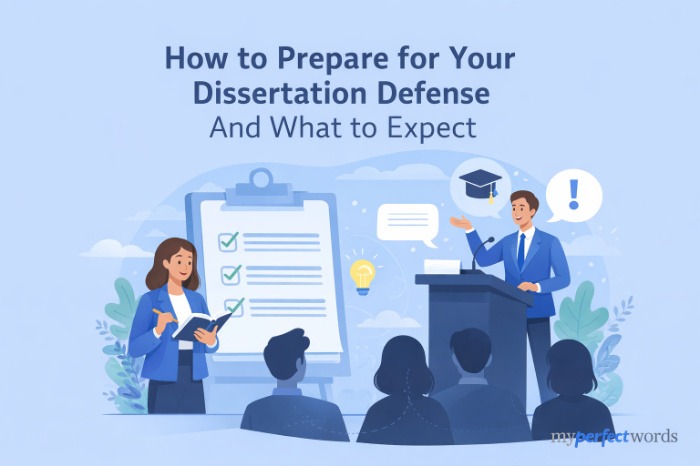
How to Prepare for Your Dissertation Defense
The single best thing you can do to prepare is re-read your entire dissertation from start to finish. Not to find problems. Just to re-engage with the work. You'll be surprised how much comes back to you, and how naturally you'll start anticipating questions as you move through each chapter.
As you re-read, build a running list of potential questions. Every time you notice a gap in your argument, a methodological decision that could be questioned, or a limitation you acknowledged, write it down. That list is the beginning of your Q&A prep.
Know the weaknesses in your work. This isn't pessimism, it's strategy. Committees almost always ask about limitations, precisely because you should be the one explaining them. Walking in with a clear, confident answer to "what are the limitations of your study?" signals exactly the kind of intellectual maturity a committee wants to see.
Research your committee members. Look at their recent publications and areas of expertise. A committee member who specializes in qualitative methods will likely have different questions than one who focuses on theory. Anticipating their angles helps you prepare more targeted answers.
For your presentation, aim for roughly 10 slides for a 20-minute slot. Use your Chapter 1 framework as the backbone: problem statement, research questions, methodology overview. The slides are a visual anchor, not a script. Your spoken words carry the presentation.
Do a mock defense before the real one. Present to a fellow doctoral student, a peer group, or even a trusted friend willing to ask hard questions. Record yourself if you can. Most students discover their pacing is off the first time they do it out loud.
The best preparation for a dissertation defense isn't cramming, it's re-reading the document you already wrote with fresh eyes.
Preparation Timeline
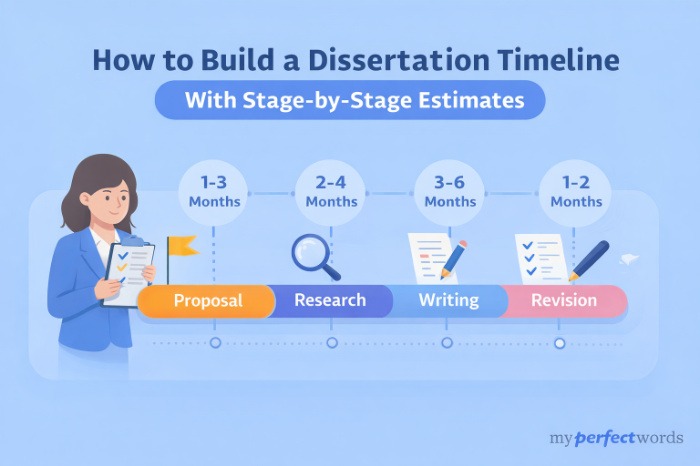
If you're looking at the full picture from start to finish, the dissertation timeline covers the whole journey. For the defense specifically, here's a focused breakdown of the final stretch:
1–2 weeks out: Re-read the dissertation, build your question list, confirm room and format with your advisor, start building slides. 1 week out: Complete your slides, do your first mock defense, refine your answers to the toughest anticipated questions. Day before: Do one final run-through of your presentation. Don't overdo it. Confirm your technology, print a backup copy of your slides. Sleep. Morning of: Light movement, a real breakfast, arrive early enough to test your equipment and settle in before anyone arrives. |
What Kinds of Questions Will You Be Asked?
This is where most preparation guides fall short. Understanding the types of questions your committee will ask, and knowing how to approach each one, is what separates a confident defense from a shaky one.
Here's a breakdown of the main question categories, with examples and how to handle them:
Question Type | Example Question | How to Handle It |
Clarification | "Can you explain what you meant by X in Chapter 3?" | Be precise and calm. This is just seeking clarity, not a challenge. Take a breath and restate the idea more clearly. |
Methodological | "Why did you choose this approach over [alternative]?" | Justify your design choices directly. You made them deliberately, so explain the reasoning behind each one. |
Theoretical | "How does your work relate to [existing theory]?" | Position your contribution explicitly. What does your research add, confirm, or complicate? |
Implication | "What are the real-world applications of your findings?" | Show broader relevance without overstating. Be honest about what your findings do and don't support. |
Challenge | "Isn't your sample size too small?" | Acknowledge the limitation, explain how you mitigated it, and point to what future research could do to extend the work. |
Unknown | Something you genuinely can't answer | Say you don't know, then reason through what you do know. Committees value intellectual honesty far more than guessing. |
Running Out of Time Before Your Defense? Get expert dissertation help delivered fast. Your defense date isn't moving. Get the help you need now.
When a committee member challenges your methodology, they're not trying to fail you. They're asking you to demonstrate that you chose your approach deliberately.
If you need a refresher on how to explain your choices, the dissertation methodology guide walks through common design decisions and how to justify them.
For more on what to expect in the room, thesis defense preparation tips from Paperpile is worth a read.
One more thing: if you didn't hear a question clearly, ask for it to be repeated. If you need a moment to think, take it. Pausing to gather your thoughts is not a weakness; it's how good researchers actually think.
How to Structure Your Dissertation Defense Presentation
Your slides should tell the story of your research, not transcribe it. The committee doesn't need to read your dissertation on a screen; they've already read it. They need a visual framework that helps them follow along as you speak.
A solid 10-slide structure for a 20-minute defense might look like this: the problem and context, your research questions, a brief literature positioning, your methodology, your key findings (usually two to three slides), the implications, limitations, and future directions. Close with a brief summary slide.
Keep the design clean. Text-heavy slides are a defense killer: the committee ends up reading instead of listening. Use bullet points sparingly, and let your spoken words carry the substance.
Your slides are a visual anchor for the committee, not a script; the real presentation is what you say between them.
Practice until you consistently hit your time target without rushing. Most students need at least three full run-throughs to find their natural pacing. When you practice, speak out loud, because mental rehearsal doesn't work the same way.
For the day itself: always bring a PDF backup of your slides on a USB drive, and print a hard copy as a last resort. Technology fails at the worst possible times. Having a backup ready is the kind of professional preparation that committees notice. |
If you want help structuring the dissertation itself before the defense, the dissertation structure guide covers the full chapter-by-chapter breakdown.
Managing Dissertation Defense Anxiety
Here's a reframe that actually helps: your committee scheduled your defense because they believe you're ready, and they've read your dissertation. If they had serious concerns, the defense wouldn't have been approved. Getting to this stage means you've already cleared a significant bar.
Practical tactics that work: mock defenses (the single most effective anxiety reducer), getting genuinely good sleep the night before, light movement in the morning, and arriving early enough to check your technology and settle your nerves before anyone else walks in.
Don't over-prepare the night before. If you're not ready by the evening before your defense, a sleepless cramming session won't fix it, and it will make everything harder on the day. Trust the preparation you've already done.
During the defense itself, give yourself permission to pause before answering questions. Ask for clarification if you didn't fully hear or understand something. Take water if it's available. These aren't signs of uncertainty; they're signs of someone who takes the question seriously.
And don't forget: there's a real celebration on the other side of this. Plan something for after the defense. Having something to look forward to is a surprisingly effective anchor when anxiety spikes. |
One thing that trips students up is conflating nerves with unreadiness. They're not the same thing. You can feel anxious and still know your material cold. The committee will see through the nerves to the competence behind them.
What Happens After Your Dissertation Defense?
After the Q&A wraps up, you'll be asked to wait outside while your committee deliberates. This usually takes between 15 and 30 minutes. It can feel like the longest 20 minutes of your academic life.
When you're called back in, the outcome will fall into one of a few categories:
The rarest result is a clean pass with no revisions required. It does happen, and when it does, you're done. Congratulations.
Pass with minor revisions is the most common outcome. Your committee will give you a list of corrections: clarifications, additional citations, and tightening of arguments. These are usually addressed within a few weeks with oversight from your chair.
Pass with major revisions is less common and requires more substantial rework, often over several months. It's not the end of the road; it's more work, but the path forward is clear, and your committee will help you navigate it.
Postponement or outright failure is rare to the point of being exceptional. If you've been in regular contact with your advisor throughout the process, an outright fail is very unlikely.
Most candidates pass their defense, often with minor revisions, because the committee has been guiding the work throughout the entire process. By the time you sit down in that room, they're invested in your success just as much as you are.
Once you've addressed any revisions and received committee sign-off, you'll submit the final dissertation to your institution's graduate school for formal approval. After that, you've earned the right to use the title. That's worth taking a moment to sit with.
Ready to Submit a Dissertation Worth Defending?
Expert writers. Human-written. Fast turnaround.
- Dissertation writing from PhD-qualified, subject-specialist writers
- Zero AI: every order passes Turnitin checks
- Rush orders accepted, with 3-hour turnaround available
- Free revisions included with every order
MyPerfectWords has helped countless students since 2010.
Order Now