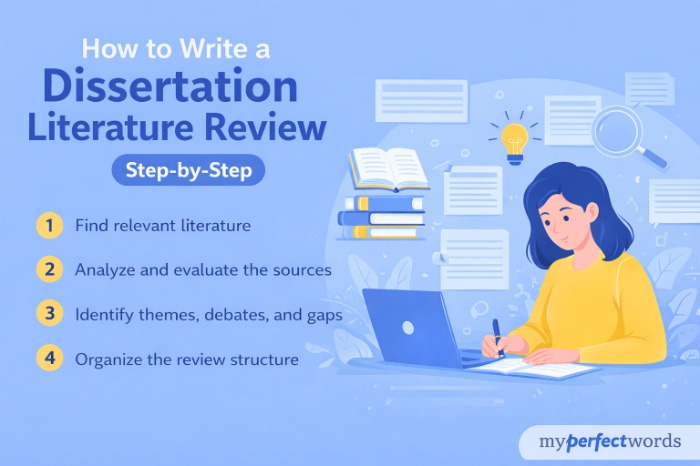
What Is a Dissertation Literature Review?
A dissertation literature review is Chapter 2 in a standard dissertation; it comes after your introduction and before your methodology. But there's an important distinction worth knowing: "literature review" actually refers to two things. There's the process (searching, reading, and evaluating sources) and the written chapter that presents what you found. Students often mix these up, treating the process and the product as the same thing; they're not.
The job of the written chapter is threefold. First, it demonstrates that you understand what's already known about your topic. Second, it identifies what's missing, unclear, or contested in the existing research. Third, it uses that gap to justify why your own research needs to happen.
Here's the thing most students miss: a literature review is not a list of summaries. It's a synthesis. You're not reporting on each source individually; you're weaving them together to tell a story about the state of knowledge in your field.
"A literature review doesn't just show you've read widely, it shows you can think critically about what those sources mean together." |
Why Does the Literature Review Matter?
Your marker is not reading your literature review to see how many sources you found. They're using it to assess your critical thinking, your ability to evaluate evidence, identify contradictions, and build a reasoned argument about what the research does and doesn't tell us.
Beyond the marks, the literature review does crucial structural work for your whole dissertation. It builds the justification for your research project. If you can't clearly identify a gap in the existing literature, your marker has no logical reason to believe your study is needed to happen. The research question becomes arbitrary.
It also informs the choices you make in the next chapter. Your dissertation methodology, your research design, should flow directly from what the literature review reveals. The gap you identify shapes the approach you take.
"If your literature review fails to identify a genuine gap, your marker has no reason to believe your research needed to happen." |
How to Find Sources for Your Dissertation Literature Review
Start with Google Scholar, it's free, comprehensive, and lets you filter by date and citations. Your university library will also give you access to databases like JSTOR, EBSCOhost, and ProQuest, which are worth using for peer-reviewed articles behind paywalls. For guidance on synthesis and organizational approaches, the Purdue OWL literature review guide is a reliable free reference.
One technique that consistently turns up strong sources is snowballing: when you find a relevant article, check its reference list. The studies it cites are likely relevant to your topic too. Work backwards through a few key papers, and you'll find the foundational works in your area quickly.
For source quality, prioritize peer-reviewed journal articles and academic books. Avoid websites, news articles, and non-academic sources unless your institution specifically allows them for limited contextual purposes.
How many sources do you need? It depends on your level:
Academic Level | Approximate Source Range |
Undergraduate | 15–25 sources |
Master's | 25–50 sources |
PhD | 50+ sources |
As a general rule, prioritize sources from the last ten years, but include seminal older works where they're foundational to your topic. And use a reference manager: Mendeley or Zotero will keep everything organized from the start. Reorganizing 40 sources near submission is not an experience you want.
"A strong literature search isn't about finding the most sources, it's about finding the right sources and knowing why each one belongs." |
How to Structure Your Dissertation Literature Review
Like any other academic chapter, your literature review has three parts: an introduction, a body, and a conclusion. Don't skip or rush any of them.
Your introduction sets the scope of your review. Tell the reader what territory you're covering, introduce any key terminology, and give them a roadmap for what's coming. It's typically one or two short paragraphs.
The scope you establish here should connect directly to the work you did in your dissertation introduction; consistency between chapters matters.
Body paragraphs are where you organize and discuss your sources. There are three common approaches:
- Thematic (most common): Group sources by topic, argument, or theme regardless of when they were published. Most dissertation literature reviews use this approach.
- Chronological: Trace how your understanding of your topic has evolved over time. Works well when the development of thinking is itself significant.
- Methodological: Compare studies based on how they were conducted rather than what they found. More common in science and social science dissertations.
Most dissertations use thematic structure with a chronological thread woven through the themes, so you're grouping by topic but also noting how ideas have shifted over time.
Your conclusion pulls everything together. Summarize the state of the literature, name the gap your research addresses, and introduce your research question. This is the payoff of the entire chapter.
For a full overview of how all chapters connect, see our guide to dissertation structure.
Length guidance by level:
Academic Level | Approximate Length |
Undergraduate | 1,500–3,000 words |
Master's | 3,000–8,000 words |
PhD | 8,000–20,000+ words |
"Your lit review structure should tell a story, starting from the broad landscape of your topic and narrowing to the specific gap your research will fill." |
Your Dissertation, Done Right
MyPerfectWords has helped countless students complete their dissertations.
Place your order today and get started.
How to Synthesize Sources (Not Just Summarize Them)
This is the section that separates students who lose marks from students who don't. The most common mistake in dissertation literature reviews, at every level, is writing what's called a "string of pearls": you describe source after source, one by one, each in its own little paragraph, with no connection between them.
It reads like a reading list, not an argument.
Synthesis means showing what sources agree on, where they disagree, and what that means for understanding your topic. Your paragraph's organizing principle should be an idea, not a source.
Here's the clearest way to see the difference:
Summarizing (What you Don't Want):
"Jones (2021) found that self-directed learning improves student outcomes. Smith (2020) found that self-directed learning increases engagement. Robinson (2019) found that the relationship between self-direction and outcomes is complex."
Synthesizing (What You're Aiming For):
"Research consistently finds that self-directed learning improves both outcomes and engagement (Jones 2021; Smith 2020), though Robinson (2019) challenges this in low-resource contexts, suggesting the relationship may be more conditional than the earlier literature assumed."
See the difference? That synthesized version makes an argument. It connects the sources, shows where they agree, and then surfaces a complication. That's critical thinking, and that's what markers are looking for.
Use linking language to hold your synthesis together: similarly, in contrast, building on this, these challenges, taken together, while X argues... Y suggests. These phrases do the connective work that turns a list into an analysis.
"Synthesis shows your marker how sources fit together, not just that you read them." |
How Long Should a Dissertation Literature Review Be?
Word count targets matter, but they only tell part of the story. The length table in the structure section covers the basics, but a few additional points are worth knowing before you set your own target.
Some doctoral programs specify 30 to 50 pages as a minimum for the literature review chapter alone. At the master's level, 5,000 to 6,000 words is a common target. At the undergraduate level, 2,000 to 2,500 words is typical. Your institution's guidelines and your supervisor's direction take precedence; always confirm.
More importantly, length without depth won't impress. Writing 8,000 words that superficially summarize 60 sources is considerably weaker than writing 5,000 words that critically analyze 30 sources with genuine synthesis. Markers notice thin coverage.
If you've already written your dissertation proposal, your initial source list gives you a head start; the reading you did there carries directly into Chapter 2.
"Length without depth won't impress your markers; they'd rather see you critically analyze 25 sources than superficially summarize 50." |
Common Mistakes to Avoid in Your Dissertation Literature Review
Knowing what goes wrong makes it much easier to avoid:
Starting to write before you've read enough. Your chapter suffers badly when you're working from a thin foundation. Get your core sources solid first.
Writing a string of pearls. Covered above, but worth repeating, this is the single most common reason lit reviews lose marks.
Only including sources that support your argument. Ignoring contradictory or complicating evidence reads as selective and undermines your credibility. Acknowledge the tensions in the literature.
Forgetting to link back to your research question. Your entire chapter should be building toward the gap that your study addresses. If a reader can't see how the chapter connects to your question, something's missing.
Treating older sources without context. If you include a study from 1998, acknowledge that it's a foundational work, don't just cite it as if it carries the same weight as recent research.
Searching only one database. Different databases index different journals. Limiting yourself to Google Scholar alone will leave gaps in your coverage.
Ending without a clear gap statement. A literature review that doesn't close with a clearly identified research gap isn't finished: it's a reading list with a conclusion paragraph.
"A literature review that doesn't end with a clear research gap isn't finished, it's just a reading list." |
Dissertation Literature Review Checklist
Before you submit your chapter, run through this list. If you can tick every box, your literature review is doing its job.
- [ ] Have I defined the scope of my review clearly?
- [ ] Have I searched multiple databases and used a systematic search strategy?
- [ ] Have I included seminal works AND recent research (last 10 years priority)?
- [ ] Have I synthesized sources, showing agreements, disagreements, and connections, not just listed them?
- [ ] Does each paragraph have a controlling idea (not just a controlling source)?
- [ ] Have I identified a clear research gap?
- [ ] Have I linked the gap to my own research question?
- [ ] Have I used a thematic (or appropriate) organizational structure?
- [ ] Is my introduction, body, and conclusion clearly separated?
- [ ] Does my conclusion set up my methodology chapter?
- [ ] Have I cited all sources correctly and consistently?
"Run through this checklist before you submit, if you can tick every box, your literature review is doing its job." |
Let a Professional Handle Your Literature Review
Expert writers ready to tackle your dissertation chapter, any subject, any level.
- Writers hold advanced degrees in your subject area
- Every order screened with Turnitin
- Free revisions until you're satisfied
- Trusted by students since 2010
Get your literature review done, stress-free.
Place an Order