Why You Need a Dissertation Timeline Before You Write a Word
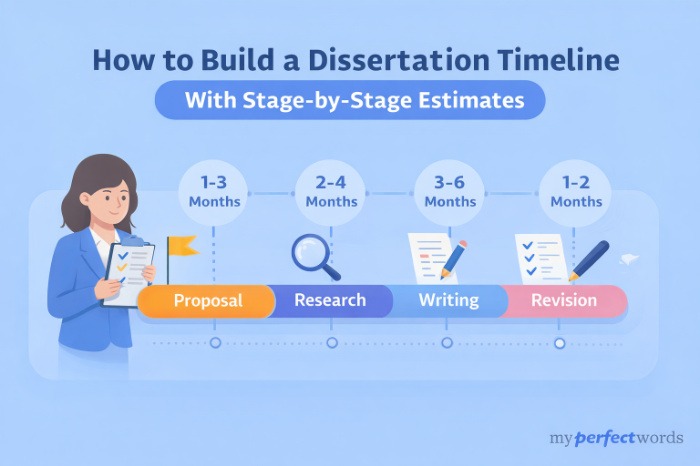
A dissertation isn't one big writing project. It's a sequence of smaller projects: research, design, data collection, drafting, revision, and submission. Each one feeds the next, and each one takes longer than most students expect.
Without a timeline, students tend to hit the same bottlenecks at the same points. They spend too long on the literature review because they're not sure when they're "done." They underestimate data collection and run out of runway before the writing even starts. They leave editing to the final week, which is never enough.
A timeline surfaces these problems early, when you can still do something about them. Supervisor feedback rounds, ethics approval waits, data access delays: a timeline makes these visible as gaps in your schedule, not surprises the night before a deadline. It also keeps your supervisor relationship structured. They know when to expect drafts and when you'll need feedback, which means fewer awkward "where are things at?" check-ins.
"A dissertation timeline doesn't predict the future. It gives you a reference point so you know when you're off track and can course-correct before it's too late." |
The Key Stages of a Dissertation (And How Long Each Takes)
Most dissertations move through seven core stages regardless of level. The time each stage takes varies depending on whether you're completing an undergraduate, master's, or PhD dissertation, and whether you're writing full-time or fitting it around a job or other commitments.
Part-time writers should roughly double the estimates below. That's not a rough guess: it reflects the reality that you're getting fewer focused hours per week, and context-switching adds overhead that pure full-time writing doesn't.
Stage | Full-Time Estimate | Part-Time Estimate |
Topic Confirmation + Proposal | 2–6 weeks | 4–10 weeks |
Literature Review | 3–5 weeks | 6–8 weeks |
Methodology Design | 2–3 weeks | 4–5 weeks |
Data Collection | 4–8 weeks | 8–14 weeks |
Writing Chapters | 2–3 weeks each | 4–5 weeks each |
Revisions + Supervisor Feedback | 2–4 weeks | 4–6 weeks |
Final Formatting + Submission | 1 week | 1–2 weeks |
A few notes on these ranges:
Stage 1: Topic Confirmation + Proposal (2–6 weeks). If you already have a strong topic, you're at the shorter end. If your supervisor asks for significant revisions to your dissertation proposal, budget for two or three rounds before it's approved. Don't rush this stage: a weak proposal creates problems that echo through every chapter.
Stage 2: Literature Review (3–5 weeks). Most students underestimate how long it takes to actually read, synthesise, and write up the literature. Not just find it. Budget at least a week for database searches and source shortlisting before you write a single word.
See our dissertation literature review chapter guide for a full breakdown of how to approach this stage.
Stage 3: Methodology Design (2–3 weeks). If your research involves human participants, add 2–6 weeks for ethics/IRB approval before you can start collecting data. This is one of the most commonly overlooked timeline gaps.
Stage 4: Data Collection (4–8 weeks). This stage is the most variable and the hardest to compress. Survey response rates, interview scheduling, archival access, and lab time: none of these are fully in your control. Plan for the high end of this range.
Review your approach with the dissertation methodology chapter guide to spot any logistical risks early.
Stages 5–6: Writing and Revision. Writing each chapter typically takes 2–3 weeks full-time, but revision rounds depend heavily on your supervisor's feedback cycle. Budget 1–2 weeks per chapter for feedback turnaround, not just your own revision time.
"Most students underestimate data collection and editing: these two stages consistently run longer than planned." |
How to Build Your Dissertation Timeline (Step by Step)
Building a timeline that actually holds up takes about an hour and saves you months of confusion. Here's how to do it.
Step 1: Start with your submission deadline, not your start date.
Reverse scheduling is the most effective approach to dissertation planning. Lock in your endpoint first, then work backwards. Mark your department's hard deadlines: final submission, dissertation committee review, and any required milestones, before you assign time to anything else.
Step 2: Map out your stages in reverse order.
Starting from your submission date, work backwards through each stage using the estimates in the table above. Assign realistic durations, not optimistic ones. Remember that supervisor feedback rounds add time to every chapter. Build them into each writing stage, not as a separate phase at the end.
Step 3: Add buffer weeks.
Build in at least 2–3 buffer weeks across the full project. Don't spread them evenly. Concentrate buffer time around data collection (the most unpredictable stage) and revisions (the most commonly underestimated). If you don't need the buffer, you'll finish early. If you do need it, you won't miss your deadline.
Step 4: Break stages into weekly milestones.
"Complete the literature review" is a goal. "Complete database search and shortlist 40 sources" is a milestone. Weekly milestones are specific enough to tell you whether you're on track. Vague goals just move the goalpost. For each stage, identify two or three concrete deliverables you can check off each week.
Step 5: Choose a tracking tool you'll actually use.
A spreadsheet works for most students. If you're working on a longer PhD dissertation with overlapping stages, a Gantt chart tool can make dependencies clearer. Some students use Trello or Notion for milestone tracking. The format matters less than whether you'll check it weekly. A Gantt chart template can be a useful starting point for longer projects.
"Reverse scheduling, starting from your submission date and working backwards, is the single most effective way to build a realistic dissertation timeline." |
Your Timeline Is Tight. We Can Help.
Get professional dissertation writing support and hit your deadline.
Countless students helped since 2010. Your turn.
Sample Dissertation Timeline (12-Month Master's Version)
Here's what a realistic 12-month master's dissertation timeline looks like for a full-time student. This is a general template. Your program may have different submission windows or milestone requirements, so check with your supervisor before locking in dates.
Month | Focus |
Month 1–2 | Topic confirmation, proposal drafting, supervisor meetings, initial literature scoping |
Month 3–4 | Full literature review research and drafting, methodology design begins |
Month 5 | Methodology finalised, ethics/IRB application submitted (if required) |
Month 6–8 | Data collection |
Month 9–10 | Writing chapters: introduction, results, discussion, conclusion |
Month 11 | Revisions, supervisor feedback rounds, peer review |
Month 12 | Final formatting, proofreading, submission |
For PhD candidates, the same structure applies across a longer timeframe, typically 3–5 years. Years 1–2 generally cover coursework, proposal, and data collection; years 2–4 focus on writing; the final year is revisions, submission, and dissertation defense prep.
For undergraduate dissertations, compress the timeline to 6–9 months, with a shorter literature review (2–3 weeks) and a data collection phase that's typically less intensive than a master's project.
Pay attention to the dissertation structure as you write: knowing what each chapter needs to accomplish makes it easier to estimate how long it'll take.
"A 12-month master's dissertation timeline works if you treat it like a job. Consistent daily or weekly time blocks, not cramming." |
Common Dissertation Timeline Mistakes to Avoid
Even students who build a timeline often make the same predictable errors. Here's what to watch for.
Underestimating editing time. Most students budget a week for editing. Most dissertations need two or three. Editing isn't just fixing typos. It's checking argument flow, citation accuracy, chapter coherence, and formatting. Give it the time it deserves.
Ignoring supervisor feedback lead times. Your supervisor won't always turn around feedback in 24 hours. A week or two per feedback round is realistic for most supervisors. If your timeline doesn't account for this, your schedule collapses at the first chapter review.
Missing IRB/ethics approval windows. If your research involves human participants, ethics approval can take 2–6 weeks, depending on your institution and the complexity of your study. Many students treat this as an afterthought. It should be a fixed stage in your timeline with a realistic start date.
Waiting for chapters to be perfect before moving on. Perfecting a chapter before you've written what comes after is a trap. You'll revise everything during the editing stage anyway. Keep moving forward and let each chapter be "good enough for now."
Building a timeline you never look at again. A timeline only works if you check in with it weekly. Set a recurring reminder to review your milestones every Sunday or Monday morning.
"The two most common timeline killers are editorial underestimation and supervisor lead times. Both are predictable, so plan for them." |
What To Do When Your Timeline Slips
Your timeline will slip at some point, and that's not a sign that something is wrong with your project or your approach. What matters is how you respond.
The first step is an honest assessment: how far off are you? One week? One stage? One month? The size of the slip determines your response.
For small slips of one to two weeks, absorb the time into your buffer weeks. That's what a buffer is for. Use it without guilt and adjust upcoming milestones accordingly.
For bigger slips, the goal is to reschedule the work ahead of you, not push back your submission deadline. Adjust how long you spend on remaining stages, cut anything that isn't essential to the final argument, and identify whether any stages can overlap slightly.
The most important thing is to tell your supervisor early. Most supervisors are understanding when students communicate ahead of a deadline. They're far less understanding when the problem lands in their inbox the night before a chapter is due. An honest conversation now is almost always better than a crisis conversation later.
If a stage is genuinely stuck (data collection issues, access problems, supervisor availability), get support before the problem compounds. That might mean talking to a graduate advisor, peer writing group, or professional writing support. Letting a stuck stage sit quietly doesn't make it smaller.
"Most timeline slippage is recoverable if you act early. The students who struggle most are those who ignore the slip and hope it resolves." |
Still Behind? Get Professional Help Today.
Our writers handle dissertations at every stage, from proposal to final chapter.
- Starting from a reasonable price
- Rated 4.8/5 from verified student reviews
- Rush orders available from 3 hours
- Plagiarism-free with AI detection reports
Order now and get your dissertation back on track.
Order Now