The Short Answer: Same Format, Very Different Scale
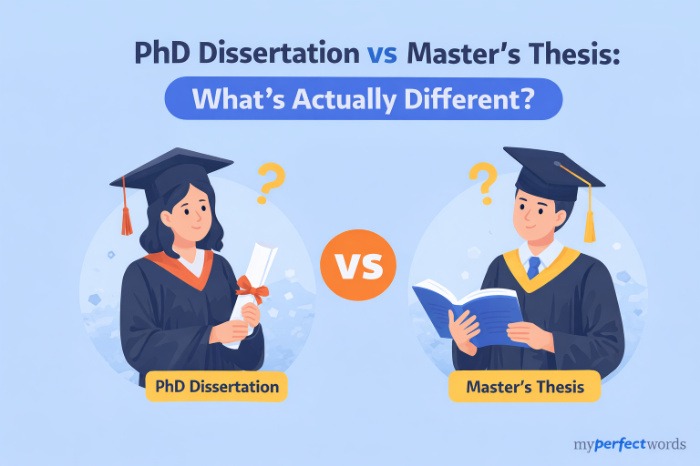
Both a thesis and a dissertation are long research papers required for graduation. Both involve a committee, both need to demonstrate academic competence, and both go through a formal review process. That's where the similarity largely ends.
The core purpose is different. A master's thesis asks you to synthesize and critically engage with existing knowledge in your field. A PhD dissertation asks you to generate new knowledge: something the field doesn't already know. Everything else that differs between the two flows from that fundamental distinction.
Here's how they compare at a glance:
Feature | Master's Thesis | PhD Dissertation |
Degree | Master's | Doctorate (PhD) |
Purpose | Synthesize existing research | Generate original knowledge |
Typical Length | 40–100 pages / ~20,000 words | 200–400+ pages / 40,000–80,000 words |
Research Type | Secondary (existing literature) | Primary (original data collection) |
Oral Defense | Not always required | Almost always required |
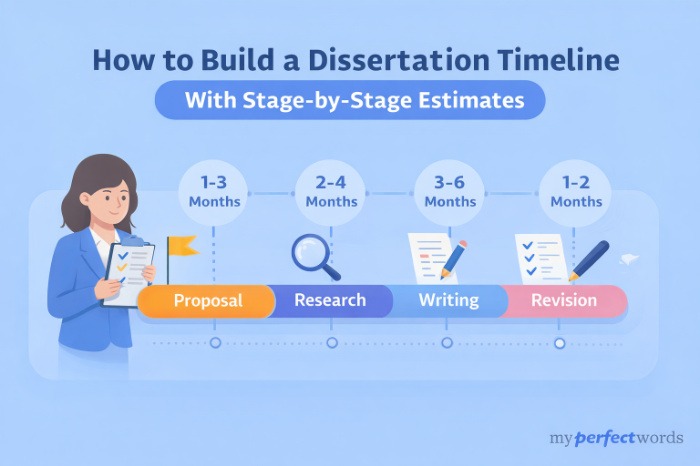
Time to Complete | 1–2 years | 3–7 years |
Regional Naming (US) | Thesis | Dissertation |
Regional Naming (UK) | Dissertation | Thesis |
"A master's thesis asks you to show what you know; a PhD dissertation asks you to discover something the field doesn't know yet." |
Scope and Purpose: The Fundamental Difference
A master's thesis proves you've mastered your field. You review the relevant literature, identify a gap or question, and construct a well-reasoned argument using existing research as your foundation. Your job is to show that you can engage with academic sources critically and synthesize them into something coherent and meaningful.
A PhD dissertation does something harder. You're not just engaging with existing knowledge; you're contributing to it. Your research needs to be original, your findings need to add to the academic record, and your conclusions need to be defensible to a committee of experts in your field. Analyzing what others have found isn't enough. You have to go find something yourself.
Worth noting for STEM students: many master's programs in STEM fields already expect original research at the thesis level. Check your program's specific requirements before assuming your thesis only needs secondary research.
"The thesis proves you understand your field. The dissertation proves you can advance it." |
Length: How Different Are We Talking?
Page count tells part of the story. A master's thesis typically runs 40–100 pages, or roughly 15,000–25,000 words, depending on your program and field. A PhD dissertation usually sits in the range of 200–400 pages, or 40,000–80,000 words, and some programs run considerably longer. For context, Harvard's Graduate School of Arts and Sciences archives thousands of dissertations in the ProQuest Dissertations & Theses database, where length variation across fields is striking.
But page count isn't the real point. A dissertation includes more extensive literature reviews, more chapters, more rigorous analysis, and a much deeper bibliography. The writing is just the visible surface of years of research, data collection, and revision.
These figures are general benchmarks. Always check your specific program's requirements, because variation across institutions and fields is significant.
"The page count difference isn't the point. It's the depth of analysis behind every page that changes." |
Dissertation Feeling Overwhelming? We Can Help
Our dissertation writers handle everything from research to final draft.
Countless students helped since 2010. Rated 4.8/5.
Research Requirements: Where the Work Really Differs
At the master's level, you're typically working with secondary research. That means reviewing, synthesizing, and analyzing work that's already been published. You're building an argument from the existing literature, not going out to collect your own data.
At the doctoral level, that changes entirely. A PhD dissertation requires primary research: you design your own study, collect original data, run your own analysis, and defend the validity of your methods. Depending on your field, that can mean running experiments, conducting interviews, doing field work, or gathering a dataset no one has compiled before.
Research involving human subjects also requires IRB approval before you can collect a single data point. Style and citation requirements will typically follow the APA Publication Manual or your discipline's equivalent standard.
This is the main reason dissertations take so much longer. It's not just writing more pages. It's designing and executing an entire research study, then writing it up in a way that can withstand expert scrutiny. The dissertation is designed to produce findings that are publishable and add to the field's knowledge base in a lasting way.
"At master's level, you synthesize. At doctoral level, you discover." |
The Oral Defense: One Usually Requires It, One Usually Doesn't
For a PhD dissertation, an oral defense (sometimes called a viva or dissertation defense) is almost always required. You present your research to a faculty committee and defend your methods, findings, and conclusions under direct questioning. It can last two to three hours, and the committee can ask about anything in your work. This is where your dissertation either stands up or doesn't.
For a master's thesis, requirements vary by program. Some require an oral defense, many don't. Often, a written submission is all that's needed, or a brief presentation to a small committee without the full scrutiny of a dissertation defense.
Preparing for a doctoral defense takes more than reviewing your own work. See our full guide on dissertation defense preparation for everything you need to know about the process, format, and how to handle challenging questions.
"A dissertation defense isn't just a formality. It's where you prove your research can stand up to expert scrutiny." |
US vs UK: Why the Terms Get Swapped
This is the most common source of confusion, and it's completely understandable. In the US, "thesis" refers to the master's-level document, and "dissertation" refers to the doctoral-level document. In the UK, Australia, and much of Europe, it's often the opposite: "thesis" is the doctoral document and "dissertation" is used for undergraduate or master's work.
So a US student reading advice from a UK academic source will find the words mean the inverse of what they'd expect. Neither tradition is right or wrong. It's just a naming convention that differs by region, and sometimes even by institution within the same country.
International students researching graduate programs are particularly prone to this confusion when mixing sources from different academic traditions. The safest approach is always to check your institution's specific terminology rather than assuming one convention applies everywhere.
"If you're reading advice from a UK source while studying in the US, the words mean the opposite of what you think." |
Which Is Right for You? Master's Thesis vs. PhD Dissertation
No competitor article actually answers this question, and it's the one that actually matters if you're deciding between programs.
Choose a master's thesis path if:
- You want to develop research skills without committing to a multi-year original research project
- You're applying your degree to a professional field where the credential matters more than the research contribution
- You want to test the waters of academic research before deciding whether a PhD is right for you
- Your field or program offers a thesis as the standard completion route
Choose a PhD dissertation path if:
- You want to conduct original research and make a genuine contribution to your field
- You're aiming for an academic career; faculty positions at research universities typically require a doctorate
- You're interested in a research-led professional role in areas like government, think tanks, or R&D
- You're ready for a 3–7 year commitment with the depth that entails
There's no objectively better path. A master's thesis and a PhD dissertation serve different goals and lead to different careers. The right choice depends on what you're building toward, not on which one sounds more prestigious.
Leaning toward a PhD? Your first major milestone will be your dissertation proposal, a formal argument for why your research is worth doing. From there, your dissertation timeline and overall dissertation structure will shape how the next several years unfold.
"The right choice isn't about which is harder. It's about which career you're building." |
Ready to Start? We're Ready to Help
We write both master's theses and PhD dissertations, start to finish.
- Human-written, not AI-generated, guaranteed
- Every writer holds a master's or PhD
- Strict confidentiality, your order stays private
- Unlimited revisions until you're satisfied
Get started today. Your deadline won't wait.
Order Now