


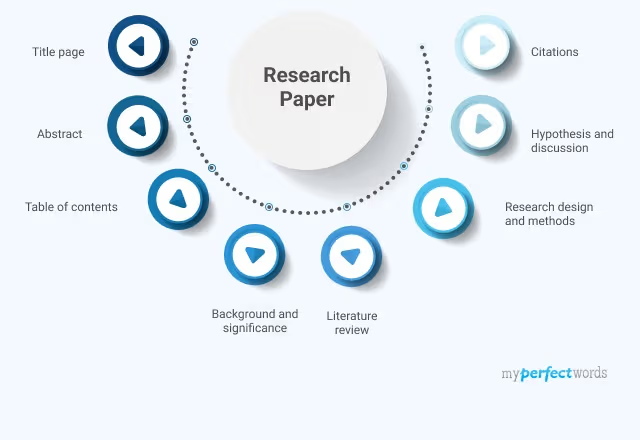
Research Paper Length by Academic Level
Here's what you should expect based on where you are in your academic career:
| Academic Level | Page Range (double-spaced) | Word Count Range |
| High school | 3-7 pages | 750-1,750 words |
| Undergraduate (lower-level) | 5-10 pages | 1,250-2,500 words |
| Undergraduate (upper-level) | 8-15 pages | 2,000-3,750 words |
| Graduate (Master's) | 15-30 pages | 3,750-7,500 words |
| Doctoral/Dissertation | 50-300+ pages | 12,500-75,000+ words |
A standard undergraduate research paper is 8 to 15 pages double-spaced, while graduate papers often run 15 to 30 pages. These ranges assume standard formatting: double-spaced, 12-point Times New Roman font, and 1-inch margins.
Keep in mind that subject area affects length. STEM papers tend to be shorter and more data-focused, while humanities papers often run longer with more analysis and interpretation. Your assignment guidelines always take priority over these general ranges.
The standard formatting mentioned above yields roughly 250 words per page. If your professor requires different spacing or margins, your page count will shift even if your word count stays the same.
How Long Should Each Section of a Research Paper Be?
The way you divide your paper matters as much as the total length. Here's how to allocate space across sections:
| Section | % of Total Length | Words (for 5,000-word paper) | Pages (double-spaced) |
| Abstract | N/A (separate) | 150-250 words | ~1 page |
| Introduction | 10-15% | 500-750 words | 2-3 pages |
| Literature Review | 15-25% | 750-1,250 words | 3-5 pages |
| Methodology | 15-20% | 750-1,000 words | 3-4 pages |
| Results | 15-20% | 750-1,000 words | 3-4 pages |
| Discussion | 15-25% | 750-1,250 words | 3-5 pages |
| Conclusion | 5-10% | 250-500 words | 1-2 pages |
Your introduction should take up about 10 to 15% of your total paper length, while the body sections carry the remaining 75 to 80%.
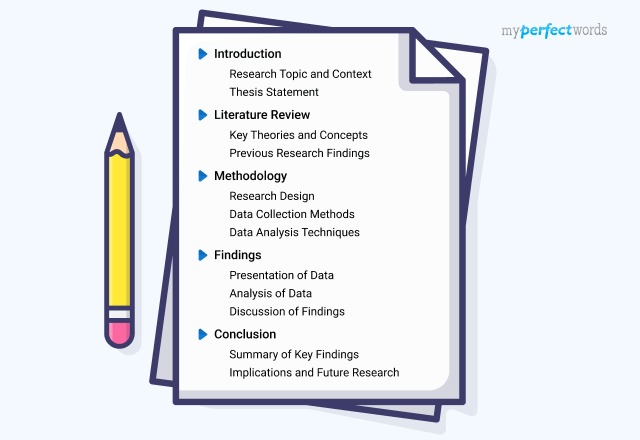
Not all research papers use every section listed above. Many student papers follow a simpler Introduction-Body-Conclusion format instead of the full IMRAD structure (Introduction, Methods, Results, and Discussion). If you're writing a shorter student paper of 5 to 10 pages, aim for 10% introduction, 80% body paragraphs, and 10% conclusion.
For detailed guidance on research paper introduction, writing a literature review, writing a research paper conclusion, or writing an abstract, check out our dedicated guides. This article focuses on length proportions only.
When you're planning your research paper outline, use these percentages to assign word counts to each section before you start writing. It's much easier to hit your target length when you know exactly how much space each part should occupy.
Page Count vs. Word Count: A Quick Conversion
If your professor assigns a page count but you're tracking word count (or vice versa), here's your conversion chart:
| Pages (double-spaced, 12pt) | Approximate Word Count |
| 3 pages | 750 words |
| 5 pages | 1,250 words |
| 8 pages | 2,000 words |
| 10 pages | 2,500 words |
| 15 pages | 3,750 words |
| 20 pages | 5,000 words |
| 25 pages | 6,250 words |
| 30 pages | 7,500 words |
One double-spaced page in 12-point Times New Roman with 1-inch margins holds roughly 250 words.
This conversion assumes standard academic formatting. Several factors can shift the numbers:
Font size: 12-point is standard, but some professors allow 11-point (more words per page) or require 14-point for accessibility (fewer words per page)
Spacing: Double-spacing is most common, but 1.5 spacing packs in about 50% more words per page
Margins: 1-inch margins are standard; wider margins reduce word count per page
Citation style: APA formatting guidelines and MLA formatting have slightly different spacing requirements for references and block quotes
Word count is a more reliable measure than page count because formatting changes can dramatically affect how many pages your paper fills. If you're given both a page count and a word count requirement, aim for the word count and let the pages fall where they may.
LET EXPERTS HANDLE THE HEAVY LIFTING
Your Research Paper Written by Professionals With Advanced Degrees
Free plagiarism report, 3-hour rush, and unlimited revisions.
What Affects the Length of Your Research Paper?
Your professor's guidelines always take priority over general length recommendations. Beyond that, several factors influence how long your paper should be:
Assignment requirements
These are the number one factor. Check your syllabus or assignment sheet for specific page or word count targets. If none are given, ask your professor before you start writing.
Academic level
This plays a major role. High school papers run shorter because they're introducing you to research writing. Undergraduate papers build complexity gradually. Graduate work demands deep engagement with scholarly sources and original analysis, which naturally requires more space.
Subject area matters too.
Humanities papers in literature, history, or philosophy tend to run longer because they require extensive interpretation and argumentation. STEM papers in biology, chemistry, or engineering are often shorter and more focused on data presentation and analysis.
Research scope
This determines length as well. A paper examining one specific experiment will be shorter than a paper synthesizing decades of research on a broad topic. If you're writing about the causes of World War I, you'll need more space than if you're analyzing one specific battle.
Citation style can shift your page count slightly. APA formatting guidelines require different spacing for references than MLA formatting. Block quotes also take up different amounts of space depending on the style guide you're following.
Standalone vs. Integrated Literature Review
Whether your literature review is standalone or integrated into your introduction can also affect how you structure your length. Some papers separate the literature review into its own section, while others weave it throughout the introduction.
How to Hit the Right Length (Without Padding)
Start with a solid research paper outline to plan your content allocation. Before you write a single sentence of your draft, assign word counts to each section based on the percentages in the section breakdown table above.
Focus on depth over filler. Adding specific evidence, detailed analysis, and concrete examples adds legitimate length to your paper. These elements make your argument stronger, not just longer.
If you're 500 words short, don't pad. Add another piece of evidence or expand your analysis of existing sources. Look for places where you've made a claim without fully supporting it. Can you add a counter-argument and then refute it? Can you include another scholar's perspective? Can you explain the implications of your findings more thoroughly?
Common padding traps to avoid: repeating the same point in different words, over-quoting sources instead of paraphrasing and analyzing, and including unnecessary background information that doesn't directly support your thesis.
If you're running long, tighten your thesis. A focused argument naturally produces a more concise paper. Cut sections that don't directly support your main point. Reduce block quotes and paraphrase instead. An analysis of over 61,000 published research papers found that concise, well-edited papers perform better than verbose ones.
When you're ready to polish your draft, editing your research paper with a critical eye helps you cut filler while preserving substance. Before you submit, run through a research paper checklist to make sure you've hit all the required elements.
Looking at research paper examples from your academic level can also help you gauge appropriate length and depth for your assignment.
Your Paper, Your Length, Our Writers
Tell us the page count and deadline. We'll handle the rest.
- 100% human-written
- Any academic level from high school to doctoral
- Formatting in APA, MLA, Chicago, or any style you need
- 4.9-star rating from verified student reviews
Content verified by Turnitin
Order Now
-20615.png)

-20655.png)
-20737.png)
-9374.jpg)


-20592.png)
 (1))
-20591.png)

-20668.png)
-20612.png)
-20657.png)


-20577.png)
-20575.png)


-20578.png)




 (2))
)
 (1))
 (1))
 (1))
 (1))
 (1))
 (1))
-20419.png)
-20426.png)
-20431.png)
-20738.png)
-20739.png)
-20745.png)
-20755.png)