MyPerfectWords - Essay Writing Service
  • Writers
  • Services

      Essays

    • College Essay
    • Argumentative Essay
    • Expository Essay
    • Narrative Essay
    • Descriptive Essay
    • Scholarship Essay
    • Admission Essay
    • Reflective Essay
    • Nursing Essay
    • Law Essay
    • Economics Essay
    • … and more!

      Assignments

    • Term Papers
    • Reports
    • Coursework
    • Speeches
    • Research Papers
    • Case Studies
    • Dissertation
    • Presentation
    • Write My Assignment

      Other

    • Editing Help
    • Buy Essays
    • Cheap Essay Writing
  • About Us
  • Pricing
  • Samples
  • Blog
Place an Order
  • Login
  • Signup
MyPerfectWords - Essay Writing Service
MPW Logo
  • Writers IconWriters
  • Services IconServices

      Essays

    • College Essay
    • Argumentative Essay
    • Expository Essay
    • Narrative Essay
    • Descriptive Essay
    • Scholarship Essay
    • Admission Essay
    • Reflective Essay
    • Nursing Essay
    • Law Essay
    • Economics Essay
    • … and more!

      Assignments

    • Term Papers
    • Reports
    • Coursework
    • Speeches
    • Research Papers
    • Case Studies
    • Dissertation
    • Presentation
    • Write My Assignment
    • Other

    • Editing Help
    • Buy Essays
    • Cheap Essay Writing
  • About Us IconAbout Us
  • Pricing IconPricing
  • Blog IconBlog
  • Account IconAccount
    • Login
    • Sign Up
Place an Order
Email Iconinfo@myperfectwords.comPhone Icon(+1) 888 687 4420

Home

>

Blog

>

Descriptive Essay

>

Descriptive Essay About A Person

How to Write a Descriptive Essay About a Person (2025 Guide)

CS

Written ByCaleb S.

Reviewed By Daniel K.

26 min read

Published: Dec 11, 2025

Last Updated: Dec 11, 2025

Descriptive Essay About a Person

A descriptive essay about a person uses specific physical details, mannerisms, actions, and dialogue to create a vivid portrait that reveals both appearance and character. Unlike biography, which focuses on life events, character description captures the essence of who someone is through carefully observed details that show rather than tell.

Common Questions About Describing People: 

  • How do you start a descriptive essay about a person?
  • What should you include when describing someone's appearance?
  • How do you show personality without just stating traits?
  • What's the difference between describing people vs. places?

If you need hands-on help applying these techniques, explore our descriptive essay writing service for expert guidance and polished, original essays tailored to your needs.

What Makes Describing People Different

Writing about people presents unique challenges that don't exist when describing places or objects. People are complex, contradictory, and constantly changing. They have internal lives you can't directly observe, yet you must convey their personality through external details.

  • The fundamental challenge: You can see what someone looks like and observe what they do, but you must infer who they are from these observations. This requires moving beyond physical description to capture character, personality, and essence.

Why Generic Character Description Fails

Most amateur character descriptions fall into predictable traps:

  • Physical feature lists without meaning:
    "She had blue eyes, blonde hair, and stood about 5'6" tall."
    This tells readers nothing meaningful about the person. Eye color and height are data points, not character revelation.
  • Personality trait statements without evidence:
    "He was kind, generous, and funny."
    Stating traits is telling, not showing. Readers need to see kindness in action, observe generosity through specific behavior, witness humor through actual examples.
  • Clichéd comparisons:
    "Her eyes sparkled like diamonds. His smile lit up the room."
    These overused phrases have lost all descriptive power. They're automatic phrases that communicate nothing specific about your particular subject.

Effective character description shows who someone is through specific, observable details that reveal character rather than stating it directly. For a deeper understanding of these principles and how they apply across all forms of descriptive writing, see our complete descriptive essay guide for techniques, examples, and practical strategies.

ANY STAGE, ANY HELP

Full Essays, Outlines, or Editing—We've Got You Covered

Give it to a Professional

Flexible options from $11.99/page to match your needs.

Generic vs. Effective Character Description

Weak ApproachStrong ApproachWhy It Works
"She had blue eyes""Her eyes were the pale blue of winter sky, always scanning the room as if cataloging exits"Connects appearance to character trait (wariness)
"He was generous""He kept a twenty in his wallet specifically for whoever needed it more than he did"Shows generosity through specific action
"She was nervous""Her hands twisted the paper napkin into shreds while she talked, leaving confetti across the table"Reveals emotion through observable behavior
"He was funny""His jokes came rapid-fire, one after another, never pausing long enough for silence to settle"Shows personality through speech pattern

Understanding Your Subject: Who Are You Describing?

The approach you take depends on your relationship to the person and the type of character you're describing.
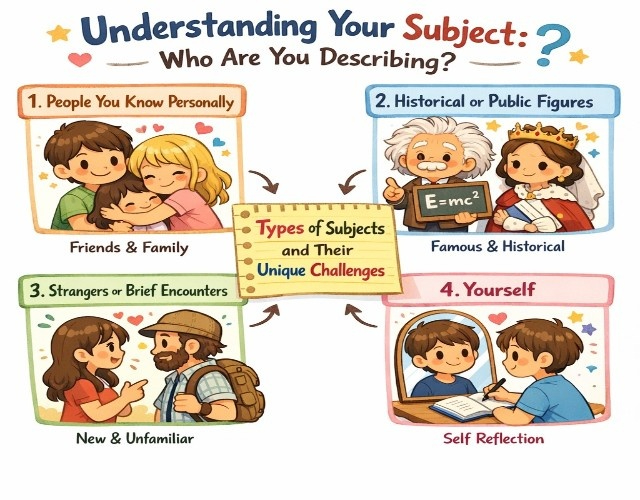
Types of Subjects and Their Challenges

  • People You Know Personally
    Direct access to private moments, mannerisms, and character quirks. Challenge: maintaining objectivity while respecting privacy boundaries.
    Describing admired figures requires balancing genuine admiration with specific observation (see "Writing About Someone You Admire" section below). Family descriptions benefit from intimate knowledge but require careful detail selection (see "Writing About Family Members" section below).
  • Historical or Public Figures
    Research-based description using photographs, video footage, written accounts, and biographical details. Limitation: working from documented sources rather than direct observation.
  • Strangers or Brief Encounters
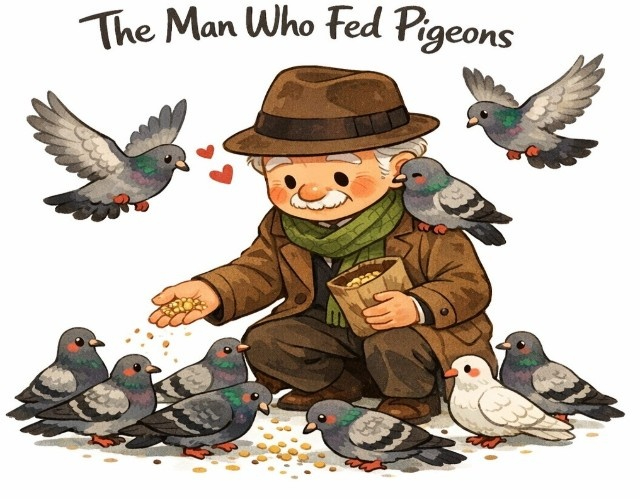
    Compelling character sketches from people observed briefly—the barista who remembers orders, the street musician, the elderly man feeding pigeons. These rely entirely on external observation, which sharpens attention to meaningful details.
  • Yourself
    Requires stepping outside your own perspective and observing appearance, behavior, and impact as if you were a stranger. The most difficult type of character description. 

Essential Techniques for Describing People

Master these core techniques to create vivid, authentic character portraits that go beyond surface description.

Expert Tip
  • The 3-to-1 Rule

For every physical description, include at least three behavioral observations. Character reveals itself through action more than appearance. A crooked smile matters less than what makes someone smile.

1. Physical Description That Reveals Character
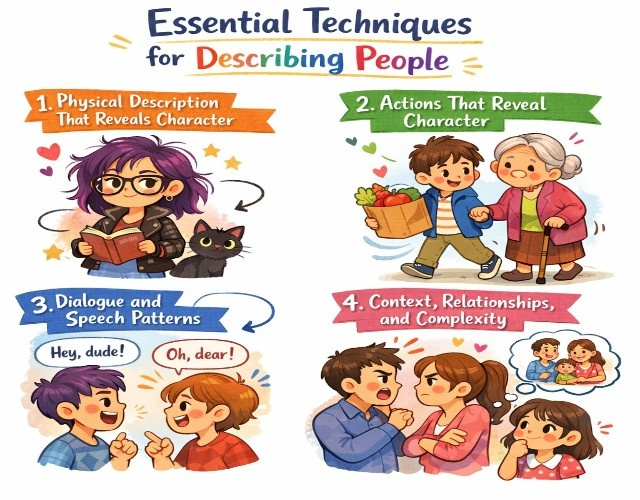
Physical details matter, but not as isolated facts. Effective physical description connects appearance to character, showing how someone looks in ways that reveal who they are.

Beyond Basic Features
Don't catalog physical features—"brown eyes, dark hair, medium height." Instead, describe how those features come together to create an impression, or how they change based on mood and context.

  • Weak: "He had brown eyes and dark hair."
  • Strong: "His eyes were the color of strong coffee, constantly moving, never quite settling on one thing for more than a moment—as if he were cataloging everything around him for some future use."

Clothing as Character Revelation
What people wear and how they wear it reveals personality, values, and self-perception. Don't just list clothing items—show what those choices communicate.

  • Weak: "She wore a blue dress."
  • Strong: "She wore a vintage dress from the 1940s, carefully mended at the hem—the kind of thing she'd spent hours finding at estate sales, preferring clothes with history to anything straight off a rack."

For more inspiration and real-world applications of these techniques, explore our descriptive essay examples showcasing strong character-driven writing in action.

Physical Description Before/After Comparison

Generic Description (Weak)Character-Revealing Description (Strong)
"He was tall with dark hair and brown eyes""He had to duck through doorways, a habit so automatic he did it even when the frame was high enough, as if the world had taught him early to make himself smaller"
"She was pretty with blonde hair""Her hair caught light like spun gold, but she kept it pulled back in a severe ponytail, as if beauty were something to apologize for rather than display"
"He had wrinkled hands""His hands were roadmaps of manual labor—knuckles scarred from years of engine work, nails permanently stained despite scrubbing, fingers that moved with the confidence of someone who'd fixed a thousand broken things"
"She wore glasses""Her glasses were perpetually smudged, fingerprints obscuring the lower left lens—she pushed them up her nose every few minutes but never actually cleaned them"

Physical Presence and Movement
How someone moves through space reveals as much as static appearance. Posture, gait, gestures, and physical habits all contribute to character impression.

Examples of movement revealing character:

  • "She moved through the crowded hallway like she owned it, never adjusting her path for anyone, assuming they would move for her—and they always did."
  • "His hands were never still. While he talked, his fingers drummed rhythms on his thigh, twisted his wedding ring, traced patterns in the air."
  • "She had the posture of someone who'd spent years being told to sit up straight—spine rigid, shoulders back, chin level—but her eyes always darted to the exits, as if she were calculating escape routes."

2. Actions That Reveal Character

"Show, don't tell" is nowhere more critical than in character description. Don't tell readers someone is kind or ambitious or anxious—show them through specific actions and behaviors.

Expert Tip
  • The Habit Test

What does this person do repeatedly? Habitual actions reveal character more reliably than one-time events. The person who always arrives exactly 10 minutes early, who saves the last bite for others, who interrupts constantly—these patterns show who they are at their core.

Significant Actions
Major actions reveal character in obvious ways, but small habitual behaviors often reveal more. The person who always arrives exactly on time, who saves the last piece for someone else, who interrupts constantly—these patterns tell you who they are.

Micro-expressions and Gestures
Pay attention to fleeting facial expressions, habitual gestures, and unconscious physical tics. These small details create authenticity and reveal character in subtle ways.

Examples:

  • "When he was nervous, he touched his collar—a quick adjustment that happened so often I don't think he was even aware of it."
  • "Every time someone interrupted her, her jaw tightened almost imperceptibly, and she'd pause for a half-second before continuing as if nothing had happened."

ANY STAGE, ANY HELP

Full Essays, Outlines, or Editing—We've Got You Covered

Give it to a Professional

Flexible options from $11.99/page to match your needs.

3. Dialogue and Speech Patterns

How someone speaks—their word choice, rhythm, tone, and speech habits—reveals personality, background, education, and values.

Capturing Voice
Don't write generic dialogue. Each person has distinctive speech patterns:

  • Vocabulary choice (formal vs. casual, technical vs. simple)
  • Sentence structure (complete sentences vs. fragments, long vs. short)
  • Verbal tics or repeated phrases
  • Regional accent or dialect markers
  • Tone (sarcastic, earnest, hesitant, commanding)

Examples of voice revealing character:

"My grandmother never said 'yes' or 'no'—she said 'mm-hmm' and 'mm-mm,' a whole vocabulary of hummed sounds that could convey approval, skepticism, warning, or dismissal depending on pitch and duration. I learned to read those sounds before I learned to read words."

"He spoke in questions, even when making statements. 'So we need to finish this by Friday?' 'The client wants the red design?' As if he were constantly seeking confirmation, unable to assert anything with certainty."

4. Context, Relationships, and Complexity

People behave differently in different contexts and contain contradictions. Both reveal authentic character.

Describe people in their element where they're most themselves:

  • The teacher who transforms in front of a classroom
  • The grandmother who becomes commanding in her kitchen
  • The musician who loses self-consciousness on stage
  • The mechanic whose confidence emerges in the shop

Show relationship dynamics. How someone interacts with others—waiters, children, authority figures, strangers—reveals character powerfully.

Highlight contradictions. Real people contain contradictions that create depth:

  • Tough exterior with unexpected gentleness
  • Confident public speaker with private insecurity
  • Stated values that contrast with actual actions
  • Appearance that contradicts reality

Don't smooth away contradictions—they make characters feel authentic rather than one-dimensional.

To organize these layers of context and complexity effectively, follow a clear structure using our descriptive essay outline, designed to help you arrange setting, relationships, and character depth seamlessly.

Special Considerations for Specific Types of People

Depending on who you're describing, certain approaches and considerations become particularly important.

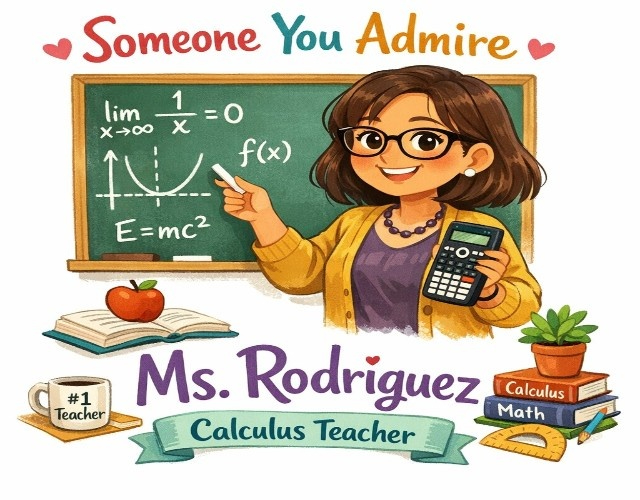
Writing About Someone You Admire

Describing admired figures—teachers, mentors, role models, or public figures—requires balancing genuine admiration with honest, specific observation. The challenge is avoiding generic praise that fails to capture what makes them remarkable.

Avoid the admiration trap:
Generic statements like "she was inspiring" or "he was amazing" communicate nothing specific. These adjectives could describe anyone. Replace superlatives with concrete examples that show rather than tell.

  • Weak: "My teacher was inspiring and changed my perspective on learning."
  • Strong: "Mr. Harrison never stood at the front lecturing. He'd perch on the edge of a desk, ask a question that seemed simple—'Why does water freeze?'—and then wait. Not the performative wait teachers do before answering themselves, but actual silence. Five seconds. Ten. Until someone brave enough or uncomfortable enough would venture an answer, and he'd lean forward, genuinely interested, and ask 'Why?' again. He taught me that questions mattered more than answers."

Show the specific impact:
What did this person do that affected you? What moment revealed their character? What specific advice or action changed your trajectory?

Include the human details:
Admired people aren't perfect. Including their quirks, habits, or even minor flaws makes them real rather than idealized. The mentor who always arrived late but gave you their full attention. The coach who cursed too much but never gave up on struggling athletes.

Three approaches for authentic admiration:

  1. Before/After - Show transformation rather than stating inspiration
  2. Defining Moment - One story beats listing qualities
  3. Unexpected Detail - The intimidating professor who keeps granola bars for students

Writing About Family Members

Family descriptions carry unique challenges: intimate knowledge that can make objectivity difficult, emotional closeness that affects tone, and privacy considerations that don't exist with public figures.

  • The intimacy paradox:

You know family members so well that their distinctive traits might seem ordinary to you. Your mother's specific humming while cooking, your father's particular thinking gesture—these details that seem mundane to you are precisely what outsiders need to understand them.

What seems normal to you is revealing to readers. Make the familiar strange by describing it as if for someone who's never met your subject.

  • Privacy and boundaries:

Even in academic essays, consider what your family member would want shared. Focus on observations from shared or public contexts rather than deeply private moments. Some things are yours to remember, not necessarily to publish.

  • The objectivity challenge:

Emotional closeness makes "show, don't tell" harder. You might write "my grandmother was kind" because kindness is so fundamental to your experience of her. Push yourself to show specific moments of that kindness instead.

Family-specific techniques:

1. Sensory memory anchors

Family members carry specific sensory associations. What did they smell like? Sound like? What textures do you associate with them? These sensory details create powerful recognition.

Example: "My grandfather smelled like sawdust and cherry tobacco, even though he never actually lit the pipe he carried—'Just like having it there,' he'd say."

2. Characteristic phrases or speech patterns

Family members often have repeated phrases, distinctive speech rhythms, or unique ways of expressing themselves. Capturing these makes them immediately recognizable.

3. The role they inhabited

Describe them in their element—where they were most themselves. Your father in his workshop. Your mother in her garden. Your grandmother at the stove. Context reveals character.

  • Emotional balance:

It's okay to love your subject, but let the specific details demonstrate that love rather than stating it repeatedly. One vivid memory of your mother's sacrifice teaches readers more than "I love her so much" repeated five times.

  • Common family description pitfall:

Starting too broad. "My mother is the most important person in my life" might be true but doesn't show readers who she is. Begin with a specific detail, moment, or characteristic instead.

Step-by-Step Process for Writing About a Person
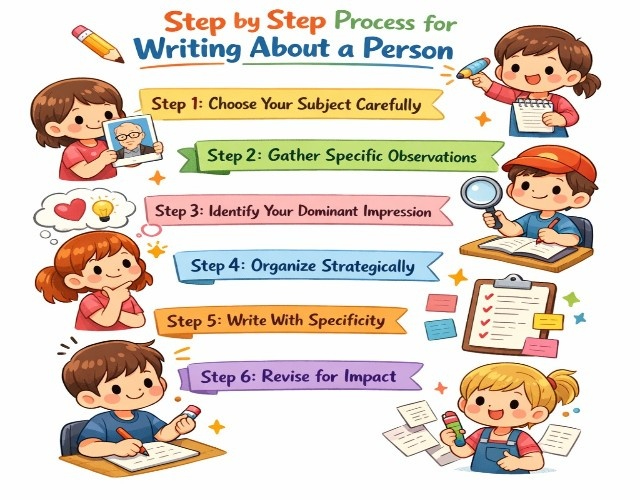
Follow this 6-step systematic approach to craft a compelling descriptive essay about someone.

Step 1: Choose Your Subject Carefully

Select someone you can describe with specific, authentic details through direct personal experience or rich documented information.

Strong subject characteristics:

  • You've observed them extensively in multiple contexts
  • They have distinctive mannerisms, speech patterns, or behaviors
  • You have specific memories or anecdotes that reveal character
  • You can identify what makes them unique or significant

Avoid:

  • People you barely know or can't observe closely
  • Subjects chosen only because they're "important"
  • Anyone without distinctive characteristics to describe

For guidance on specific types of people, see our sections on "Writing About Someone You Admire" and "Writing About Family Members" above.

TIGHT BUDGET?

Affordable Descriptive Essay Help Starting at $11.99/Page

Place My Order

Quality writing assistance that fits student budgets.

Step 2: Gather Specific Observations

Before writing, collect detailed observations. Create an inventory of specific details across multiple categories.

Character observation inventory:

1. Physical Appearance:

  • Distinctive features (not generic "brown eyes" but specific details)
  • How they carry themselves (posture, movement, energy)
  • Clothing choices and what they reveal
  • Physical habits or tics
  • How their appearance changes based on mood or context

2. Behavior Patterns:

  • Habitual actions or routines
  • How they interact with objects (careful, careless, deliberate)
  • Response to stress or surprise
  • Treatment of others in different contexts
  • Unconscious behaviors that reveal character

3. Speech and Communication:

  • Distinctive vocabulary or phrases
  • Speech rhythm and patterns
  • Tone variations
  • Topics they gravitate toward
  • How they listen (or don't)

4. Specific Memories:

  • Particular moments that exemplify who they are
  • Situations where their character was revealed
  • Interactions that stuck with you
  • Stories others tell about them

[Free Download] Character Observation Worksheet PDF

Step 3: Identify Your Dominant Impression

Every detail should support a central impression or theme. What's the essential truth about this person that you want readers to understand?

Formula: [Person] embodies [dominant impression] through [how it manifests]

Examples of strong dominant impressions:

Resilience: "My grandmother embodied quiet strength—she never complained about hardship, but her hands told stories of survival through the Depression, immigration, and widowhood."

Contradiction: "My grandfather was the walking contradiction of immigrant experience—carrying the weight of his past while building a future for his children in a country that never quite felt like home."

Impact: "Coach Williams transformed teenage athletes into confident adults not through motivation speeches but through the small daily disciplines he modeled without fanfare."

  • Weak thesis: "I will describe my grandfather."
  • Strong thesis: "My grandfather embodied the contradiction of immigrant experience—carrying the weight of his past while building a future for his children in a country that never quite felt like home."

Step 4: Organize Your Description Strategically

Choose an organizational pattern that best reveals your subject's character:

Organization PatternBest ForStructure
First Impression ? DepthPeople you've gotten to know over timePara 1: Initial appearance
Para 2-3: Deeper character traits
Para 4: Core values/impact
Chronological/DevelopmentalShowing how someone changedPara 1: Early period
Para 2: Turning point
Para 3: Current state
ThematicComplex personalities with multiple facetsPara 1: Public persona
Para 2: Private character
Para 3: Contradiction/synthesis
ContextualPeople who shine in specific settingsPara 1: At work
Para 2: At home
Para 3: Essential character across contexts

For detailed organizational templates and structures, our descriptive essay outline guide provides person-specific frameworks you can adapt.

Step 5: Write With Specificity and Authenticity

During drafting, prioritize specific details over generic descriptions. Every sentence should add something meaningful to the character portrait.

Expert Tip
  • The Specificity Test

If your sentence could describe 100 different people, it's too generic. "She was kind" could be anyone. "She kept granola bars in her car specifically for the homeless man she passed on her commute" is specific to this person.

5 drafting strategies:

1. Start with the most vivid memory or detail
Don't ease into description—open with something striking that immediately establishes character.

2. Use concrete sensory details
What did they smell like? What was the texture of their hand when you held it? What sounds did they make when they laughed? These sensory details create authenticity.

3. Include imperfect, contradictory details
Real people have bad habits, contradictory behaviors, and unflattering moments. Including these makes your description believable rather than idealized.

4. Let dialogue reveal character
Include actual things they said, capturing their specific voice and speech patterns. Even short quotes can powerfully reveal personality.

5. Show change and movement
Static description gets boring. Show the person moving, reacting, interacting. Action reveals character more effectively than description of permanent features.

Step 6: Revise for Impact and Authenticity

During revision, strengthen your character portrait by cutting weak description and enhancing strong details.

Revision checklist (complete all 9 items):

  • Show vs. Tell: Have you shown rather than told throughout?
  • Meaningful Details: Does every physical detail reveal something about character?
  • Specific Examples: Have you included at least one specific anecdote or moment?
  • Authentic Voice: Does dialogue sound authentic to this specific person?
  • Sensory Engagement: Have you engaged multiple senses in your description?
  • Real Complexity: Do contradictions or complexities make the person feel real?
  • Reflection: Does your conclusion reflect on significance without generic statements?
  • Fresh Language: Have you eliminated clichés and overused descriptions?
  • Dominant Impression: Is your dominant impression clear and supported by all details?

Common Mistakes When Describing People

Avoid these predictable pitfalls that weaken character description.

Expert Tip
  • The "Could Be Anyone" Test

Read your description and ask: Could this describe 50 different people, or is it specific to THIS person? Generic descriptions fail. Unique, specific details succeed.

Show vs. Tell: Common Mistakes

Telling (Weak) Showing (Strong) 
"She was generous""She always took the smallest piece of cake, leaving the larger slices for others"
"He was nervous""His hands twisted the paper napkin into shreds, leaving confetti across the table"
"She was confident""She walked into the conference room last, took the head chair without asking, and waited for everyone else to settle before speaking"
"He was funny""His jokes arrived rapid-fire, three punchlines before you'd finished laughing at the first, never pausing long enough for awkward silence"
"She was kind""She learned everyone's name by the second meeting—not just names, but how they took their coffee and which projects kept them up at night"

NEED HELP RIGHT NOW?

Round-the-Clock Support for Your Descriptive Essay Needs

Get My Descriptive Essay Done

Expert writers and support team available anytime, anywhere.

1. Physical Feature Lists Without Meaning

Cataloging appearance without connecting features to character creates flat, forgettable description.

  • Weak: "She had blonde hair, blue eyes, fair skin, and stood about 5'4" tall. She usually wore jeans and t-shirts."
    This gives readers data but no impression of who this person is. Connect physical details to personality, mood, or character.
  • Strong: "Her blonde hair never quite obeyed the ponytail she pulled it into each morning, strands escaping to frame a face that flushed easily—from cold, from laughter, from embarrassment, from anger. You always knew what she was feeling because her face couldn't hide it."

2. Telling Traits Instead of Showing Actions

Stating personality traits tells readers about character but doesn't make them experience it.

  • Weak: "He was generous and kind, always helping others."
    Show generosity through specific actions. Let readers draw their own conclusions.
  • Strong: "He kept a twenty-dollar bill in his wallet that wasn't for spending—it was for whoever needed it more than he did. I saw him give it away three times that semester: to the student whose card got declined at the register, to the homeless veteran on Fourth Street, to the single mother whose son forgot his lunch money."

3. Overusing Physical Appearance Clichés

"Eyes like diamonds," "skin like porcelain," "hair like silk"—these phrases communicate nothing specific about your subject.

Find fresh, original comparisons based on careful observation of your specific person.

  • Weak: "Her eyes sparkled like diamonds."
  • Strong: "Her eyes were the pale gray of rain clouds, and when she was angry, they turned nearly silver."

4. Ignoring Speech Patterns and Voice

Many character descriptions focus entirely on appearance and behavior while ignoring how someone speaks. Voice is one of the most powerful tools for revealing personality.

Include distinctive speech patterns, repeated phrases, vocabulary choices, or verbal tics that make this person's voice recognizable.

5. Writing Idealized Versions

When describing people you admire or love, there's a temptation to smooth away flaws and imperfections. This creates unrealistic, one-dimensional portraits.

Real people have annoying habits, bad days, contradictions, and flaws. Including these makes your description authentic and relatable.

6. Neglecting Context and Relationships

Describing someone in isolation, without showing how they interact with their environment or other people, misses opportunities for character revelation.

Show your subject in conversation, in conflict, in collaboration. Their behavior toward others reveals character powerfully.

For more ideas on subjects and situations to explore in your writing, check out our descriptive essay topics guide.

7. Generic Emotional Statements

"I love my grandmother" or "My mentor meant everything to me" states your feelings but doesn't make readers feel them.

Show why you love them, what they meant to you, through specific memories and authentic details. Let readers experience the relationship rather than being told about it.

Complete Example: Descriptive Essay About a Person

Title: Sunday Morning Rituals

I always knew where to find my grandfather on Sunday mornings. While the rest of the house slept, he'd be in his garage workshop, bent over his latest model ship under the bright circle of his work lamp. The space smelled like sawdust, mineral spirits, and the cherry tobacco he packed into his pipe but rarely lit—"Just like having it there," he'd explain if you asked, which I learned not to.

His hands told his history before he spoke a word. Broad and thick-fingered, with knuckles swollen from arthritis and nails permanently stained with engine grease from fifty years in the factory, they looked like hands built for rough work. But watch him manipulate tiny pieces of wood no thicker than matchsticks, threading rigging line through holes barely visible to the naked eye, and you'd see something else entirely—the precision of a surgeon, the patience of a monk.

Classical music played from a paint-splattered radio on the shelf. I'd hear it from the driveway—Beethoven, Mozart, composers whose names I didn't learn until years later when I realized he'd been teaching me all along. He never said, "Listen to this, it's important." He just played it, letting it fill the space while he worked, assuming I'd absorb it through proximity.

He didn't talk much during these sessions. Words weren't his medium. But he'd gesture—a subtle tilt of his head, a barely perceptible motion of his hand—for me to pull up the stool beside him. Then I'd watch as those scarred, stained hands demonstrated techniques: how to sand with the grain, how to apply glue in thin lines, how to test a joint before the adhesive dried.

If I tried to rush or cut corners, he'd stop. Slowly, he'd remove his reading glasses—always smudged, always perched at the end of his nose—and look at me with those pale blue eyes that had seen the Depression, the war, and half a century on the factory floor. He never said "slow down" or "be careful." That look said everything: Patience. Precision. Pride in craft.

His workshirt hung on him loosely, the same blue denim worn thin at the elbows. He'd shrunk with age, his broad shoulders narrowing, but he still moved with the deliberate efficiency of someone who'd spent his life in motion. When he reached for a tool, his hand went straight to it—no fumbling or searching. Forty years in the factory had taught him to know where everything belonged.

What I remember most vividly is the sound of his breathing. Steady and measured, with a slight wheeze from years of industrial dust, each breath audible in the quiet garage. It was the sound of contentment, of a man at peace in his element. On Sundays, away from the factory floor where he'd spent five decades, in this space that smelled of sawdust and possibility, he was exactly where he wanted to be.

He spoke exactly once that particular morning. I'd been watching him attach rigging to a three-masted schooner for twenty minutes, the radio playing something slow and complex, when he paused and said, "Your grandmother thinks I'm wasting time out here."

His voice was rough from years of shouting over factory machinery—you had to listen carefully to catch the dry humor underneath. "I told her, 'I spent fifty years making parts for other people's machines. Now I'm making something complete.'"

He died when I was twelve. Heart attack, sudden, no warning—the kind of death he would have preferred over a slow decline. I still have the model ships he built. They sit on my bookshelf, tiny sailing vessels with perfect rigging and hand-painted details no bigger than a pinhead. Each one represents dozens of Sunday mornings, hundreds of hours of meticulous work.

When I hold them now, I can still smell the sawdust. I can hear Beethoven playing on that paint-splattered radio. I can feel his presence in those scarred, gentle hands guiding mine, teaching me that the work itself matters, that patience and care transform raw materials into something beautiful, and that the greatest lessons are often learned in silence.

Analysis of This Example:

  • Physical description reveals character:

Rather than listing features ("he was tall with gray hair"), the description shows hands that reveal his history—factory work visible in scarred, stained fingers, but gentleness visible in how those hands work.

  • Actions over statements:

Instead of saying "he was patient," the essay shows him removing glasses and giving a meaningful look. Instead of stating "he was skilled," the description shows tiny, precise work.

  • Specific sensory details:

The smell of sawdust and tobacco, the sound of classical music and steady breathing, the visual of paint-splattered radio and smudged glasses—these specific details create authenticity.

  • Dialogue reveals voice:

The single quote captures his personality perfectly—dry humor, factory background, pride in his work—more effectively than paragraphs of description.

  • Context matters:

Describing him in his workshop, in his element, on Sunday mornings reveals more than describing him at random or in multiple settings would.

  • Contradictions create depth:

Rough hands doing delicate work. Factory worker who loves classical music. Man of few words whose silence teaches volumes.

  • Emotional impact without sentimentality:

The essay clearly conveys love and loss without overwrought declarations. The details do the emotional work.

Visual Element: Weak vs. Strong Description (Annotated Breakdown)

Use the table below to see how specific choices in the example essay transform basic description into vivid character portrayal.

TechniqueWeak / Generic Version Strong Version from the Example Why the Strong Version Works
Opening description“My grandfather worked in his garage on Sundays.”“While the rest of the house slept, he'd be in his garage workshop, bent over his latest model ship under the bright circle of his work lamp.”Establishes routine, setting, and mood immediately. The visual focus (light, posture) creates intimacy and atmosphere.
Physical details“He had rough hands from working in a factory.”“Broad and thick-fingered, with knuckles swollen from arthritis and nails permanently stained with engine grease from fifty years in the factory…”Moves from vague to specific, historically grounded detail that shows age, labor, and life experience.
Character trait: patience“He was very patient.”“He threaded rigging line through holes barely visible to the naked eye… the patience of a monk.”Shows patience through precise action, allowing readers to infer the trait naturally.
Teaching style“He taught me many things.”“He never said, ‘Listen to this, it’s important.’ He just played it, letting it fill the space while he worked.”Demonstrates teaching through behavior, not explanation—subtle and emotionally believable.
Dialogue use“He joked about wasting time.”“I spent fifty years making parts for other people’s machines. Now I’m making something complete.”One concise quote reveals voice, values, humor, and regret all at once.
Emotional tone“I miss my grandfather very much.”“When I hold them now, I can still smell the sawdust. I can hear Beethoven…”Emotion emerges through sensory memory, avoiding sentimentality while deepening impact.
Setting & context“He relaxed in his garage.”“Away from the factory floor… in this space that smelled of sawdust and possibility, he was exactly where he wanted to be.”Connects place to identity and fulfillment, giving context emotional weight.
Contradictions(Not shown)“Scarred, stained hands” doing “delicate work no thicker than matchsticks.”Contradictions create depth and realism, making the subject memorable and human.

Expert Tip

Most Common Question: "How do I make my description interesting?"

Answer: Specificity. Replace every generic statement with a unique, observable detail.

"Nice smile" becomes "gap-toothed grin that made one eye squint more than the other."

Key Takeaways: 7 Essential Rules for Describing People

Before you start writing, remember these core principles:

  1. Show character through action, not statements: Observable behaviors reveal more than trait descriptions

  2. Use the 3-to-1 rule: For every physical description, include three behavioral observations

  3. Make every detail character-revealing: Connect physical features to personality, values, or behavior

  4. Include contradictions and complexity: Real people contain contradictions that create authenticity

  5. Let dialogue reveal voice: Capture vocabulary, rhythm, and repeated phrases

  6. Test for specificity: If your sentence could describe 100 people, make it unique to THIS person

  7. Embrace imperfection: Flaws and unflattering moments make characters believable, not idealized

Downloadable Template and Checklist

[Person Description Outline Template]

[Free Download] Person Description Outline Template PDF


[Show vs. Tell Self-Assessment Checklist]

[Free Download] Show vs. Tell Self-Assessment Checklist PDF

Practice Exercises

Exercise 1: Observation Practice

Observe someone for 10 minutes. Note 3 physical details, 3 behaviors, and 1 personality-revealing action.

Exercise 2: Dialogue Capture

Transcribe 3-4 sentences exactly as someone speaks, then analyze what their patterns reveal about personality.

Exercise 3: Revision Challenge

Find telling statements ("He was nervous") and rewrite as showing details (observable behaviors).

For more structured support and personalized feedback on these exercises, you can rely on our descriptive essay writing service to help refine your observations, dialogue, and showing-not-telling techniques.

Quick Reference: Character Description Checklist

Use this checklist while writing and revising your descriptive essay about a person:

Planning Phase

  • Subject chosen: Someone I can describe with specific, authentic details
  • Dominant impression identified: Clear theme/central truth about this person
  • Observations gathered: Physical appearance, behaviors, speech patterns, memories
  • Organization pattern selected: Best structure for revealing character

Writing Phase

  • Opening: Started with vivid detail or striking moment (not generic introduction)
  • Physical details: Connected to character, not just appearance catalog
  • Actions included: Showed character through specific behaviors and habits
  • Dialogue used: Captured distinctive voice and speech patterns
  • Sensory details: Engaged multiple senses beyond just visual
  • Contradictions shown: Included complexity, flaws, and real human traits

Revision Phase

  • Show vs. tell: Replaced all trait statements with observable details
  • Specificity test: Every description unique to THIS person, not generic
  • Cliché check: Eliminated overused phrases and comparisons
  • Context included: Showed person in meaningful settings/relationships
  • Significance clear: Conclusion reflects on importance without generic statements
  • Authenticity verified: Honest, realistic portrait—not idealized version

Final Thoughts

Describing people effectively requires more than listing physical features or stating personality traits. It demands careful observation, selection of meaningful details, and the patience to show character through specific examples rather than taking shortcuts with generic descriptions. For a complete step-by-step approach to crafting vivid and effective essays, explore our descriptive essay guide.

The most compelling character portraits emerge from authentic observation and genuine connection. When you've paid attention to how someone moves, speaks, and interacts with the world—when you've noticed the small details that make them distinctively themselves—you have the raw material for vivid description.

Your goal isn't to create a comprehensive inventory of every characteristic. It's to capture the essential quality that makes this person memorable, using specific details that allow readers to see, hear, and understand who they are. When you accomplish this, you've created more than description—you've preserved someone's essence in words.

Want an A-Grade Descriptive Essay?

Our professional writers create high-quality descriptive essays with rich sensory details and engaging language that earn top grades.

  • Place your order with specific grade expectations
  • Work with a top-rated creative writer
  • Review and request revisions if needed
  • Submit your essay with confidence

98% customer satisfaction rate with free unlimited revisions until you're completely happy.

Hire an Expert Writer

Frequently Asked Questions

How long should a descriptive essay about a person be?

Standard length: 500-800 words (2-3 pages double-spaced) for most academic assignments. Extended essays: 1,000-1,500 words for college-level work. Always check your specific assignment requirements.

Can I write about someone I don't know personally?

Yes, but approach it differently. Use photographs, video footage, written accounts, and biographical information. Focus on documented observations and acknowledge limitations—you cannot know their internal thoughts. Avoid inventing details not supported by evidence.

Should I include negative traits or flaws?

Absolutely yes. Real people have flaws and contradictions—including these makes descriptions authentic rather than one-dimensional. Even admired people have annoying habits. Honest observation beats perfection.

How do I describe someone without invading their privacy?

Consider context and audience. Academic essays allow more freedom than public writing. Focus on public or semi-public observations. Avoid sharing private information, and consider using pseudonyms when appropriate.

What if I can't remember specific details about someone?

Focus on details that did stick with you—those are often the most meaningful. For current relationships, spend time observing before writing and take notes on mannerisms, speech patterns, and behaviors you want to capture.

How many physical details should I include?

Quality over quantity. 2-3 distinctive details that reveal character beat exhaustive cataloging. Choose details that connect to personality, avoid generic features (brown eyes, 5'8 tall), and focus on what makes THIS person distinctive. Connect appearance to character whenever possible.

Can I use dialogue in descriptive essays about people?

Yes, and you should. Dialogue powerfully reveals personality, background, values, and distinctive voice. Include direct quotes when they capture distinctive speech patterns. Keep quotes brief but meaningful—capture actual patterns (fragments, pauses, repeated phrases) rather than conversation filler.

How do I write about someone I admire without sounding generic?

Replace general praise with specific examples. Show the moment she changed your perspective rather than stating (she was inspiring). Describe his particular way of showing generosity rather than calling him (generous). Authentic details convey admiration more powerfully than superlatives.

What's the difference between describing a person and writing a biography?

Descriptive essays capture the essence of who someone is through vivid details and specific observations.
Biography chronicles life events in chronological order.

Descriptive Essay Biography
Focus: Character and impression Focus: Facts and timeline
Goal: Show who they ARE Goal: Document what they DID
Length: Usually 500-1,500 words Length: Can be book-length
Organization: Thematic or impressionistic Organization: Chronological
Details: Sensory, behavioral, revealing Details: Events, dates, accomplishments

Example:
Descriptive essay: (Her hands moved through the garden with practiced confidence, pulling weeds without checking, knowing by touch and timing which plants needed what.)
Biography: (She started her garden in 1987 and maintained it for 35 years, growing over 40 varieties of heirloom tomatoes).

Caleb S.

Caleb S.Verified

Caleb S. has been providing writing services for over five years and has a Masters degree from Oxford University. He is an expert in his craft and takes great pride in helping students achieve their academic goals. Caleb is a dedicated professional who always puts his clients first.

Specializes in:

MarketingTerm PaperFinance EssayMedical school essayPersuasive EssayNursing EssayLawReflective EssayAnnotated Bibliography EssayEducationLiteratureArtsScience EssayLinguisticsGraduate School EssayUndergraduate EssayNarrative EssayExpository Essay
Read All Articles by Caleb S.

Keep Reading

23 min read

How to Write a Descriptive Essay: Complete Guide With Examples (2025)

descriptive essay
Essay Writing20 min read

Descriptive Essay Examples - Learn from Real Samples (2025)

descriptive essay examples
Essay Writing14 min read

250+ Descriptive Essay Topics for Students (2025)

descriptive essay topics
Essay Writing12 min read

Descriptive Essay Outline - Complete Guide with Templates

descriptive essay outline
Essay Writing10 min read

Descriptive Essay About Myself - Complete Writing Guide 2025

descriptive essay about myself
Essay Writing11 min read

Descriptive Essay About a Place - Complete Guide with Examples

Descriptive Essay About A Place
How to Write6 min read

How to Craft the Perfect Descriptive Essay About A Person You Admire

Descriptive Essay About A Person You Admire
8 min read

Descriptive Essay About My Mother - A Guide to Writing

descriptive essay about my mother
Essay Writing12 min read

Descriptive Essay About Food - Complete Guide

descriptive essay about food
Essay Writing14 min read

Descriptive Essay About Nature - Complete Guide

Descriptive Essay About Nature
14 min read

Descriptive Essay About Autumn - Complete Guide

Descriptive Essay about Autumn

Was This Blog Helpful?

On this Page

    MPW Logo White
    • Phone Icon(+1) 888 687 4420
    • Email Iconinfo@myperfectwords.com
    facebook Iconinstagram Icontwitter Iconpinterest Iconyoutube Icontiktok Iconlinkedin Icongoogle Icon

    Company

    • About
    • Samples
    • FAQs
    • Reviews
    • Pricing
    • Referral Program
    • Jobs
    • Contact Us

    Legal & Policies

    • Terms
    • Privacy Policy
    • Cookies Policy
    • Refund Policy
    • Academic Integrity

    Resources

    • Blog
    • EssayBot
    • AI Detector & Humanizer
    • All Services

    We Accept

    MasterCardVisaExpressDiscover

    Created and promoted by Skyscrapers LLC © 2025 - All rights reserved

    Disclaimer: The materials provided by our experts are meant solely for research and educational purposes, and should not be submitted as completed assignments. MyPerfectWords.com firmly opposes and does not support any form of plagiarism.

    dmca Imagesitelock Imagepci Imagesecure Image