



Why Autumn Works So Well for Descriptive Essays
Autumn presents nature's most dramatic visual transformation. Trees that held identical green chlorophyll all summer suddenly reveal brilliant yellows, oranges, and reds as that chlorophyll breaks down. This chemical process creates a visual spectacle unmatched in other seasons, and gives you a built in contrast to describe.
The season's transitional character provides natural narrative structure. Autumn moves steadily toward winter, creating tension between present beauty and approaching dormancy. This progression from abundance to scarcity, warmth to cold, light to darkness creates emotional depth beyond simple description.
Autumn engages all five senses distinctively. You've got the visual color displays, rustling leaves, earthy scents, cooling temperatures, and harvest tastes. Most seasonal topics don't give you this much sensory material to work with.
Cultural associations enrich autumn descriptions automatically. Harvest traditions, Halloween imagery, Thanksgiving celebrations, and school year beginnings all embed autumn with shared meanings readers recognize immediately. You can tap into these associations without lengthy explanations.
Autumn weather varies dramatically within the season itself. Early autumn resembles late summer, while late autumn approaches winter. This internal variety within a single season provides diverse opportunities for observation and description.
If you're looking for more seasonal or nature-focused ideas, explore our complete guide to descriptive essay topics
Essential Autumn Description Elements
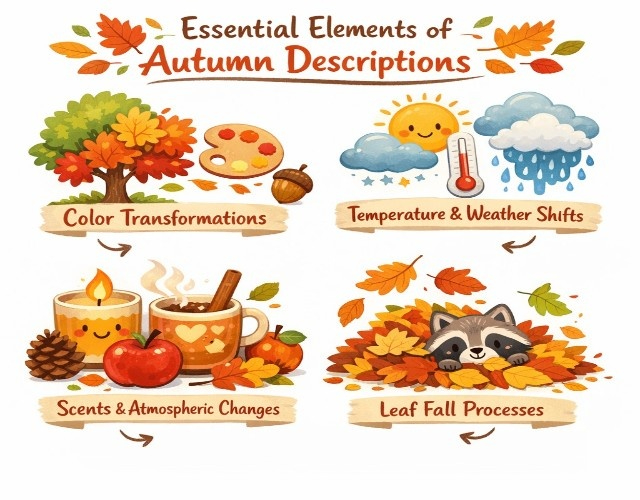
1. Color Transformations
Autumn's signature element is chromatic change. Don't describe "fall colors" generally; specify exact hues and their distribution across landscapes. Maples turn brilliant scarlet while oaks shift to russet brown. Aspens become golden yellow. Hickories develop bronze tones. Each tree species displays characteristic autumn colors.
2. Temperature and Weather Shifts
Autumn temperature transitions define physical experiences of the season. Morning frosts disappear by afternoon. Early autumn retains summer warmth while late autumn approaches winter cold. These temperature contrasts create distinctive autumn atmospheres.
Describe temperature effects on the environment beyond personal comfort. Frost crystals coat leaves and grass in morning sunlight. Breath becomes visible in cooler air. Cold mornings and warm afternoons create temperature inversions that affect fog and mist formation.
Wind gains prominence in autumn as leaf fall progresses. Describe wind's visual effects:
|
3. Scents and Atmospheric Changes
Autumn smells distinctive. Leaves undergoing decay create earthy, slightly sweet scents. Smoke from wood-burning stoves and bonfires perfumes the autumn air. Ripening apples, grapes, and other harvest fruits adds sweetness. These scents announce autumn as powerfully as visual changes.
Morning dew and frost create moisture conditions absent during summer. Describe dampness, wet grass soaking shoes, moisture condensing on windows, and fog settling in valleys overnight. Autumn humidity levels differ from summer mugginess and winter dryness.
4. Leaf Fall Processes
Leaf fall isn't instantaneous; it's a gradual process happening differently by species, location, and weather. Early falling trees drop leaves in September while late-holding species retain foliage into December. Describe this staggered timing rather than assuming uniform leaf drop.
Falling leaves create sound, rustling descent through branches, pattering on roofs, crunching underfoot on paths. Dead leaves behave differently from living foliage. They're brittle, crackly, and lightweight.
Organizing Autumn Descriptions
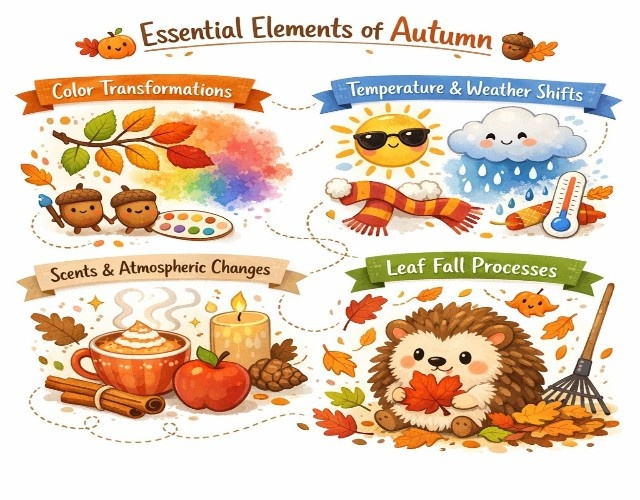
1. Chronological Organization
Organize autumn descriptions temporally, early, mid, and late autumn, tracking seasonal progression. This organization emphasizes autumn's transitional character naturally. Start with summer's ending (early autumn), proceed through peak transformation (mid autumn), and conclude with winter's approach (late autumn).
|
2. Spatial Organization for Fall Landscapes
Use spatial patterns appropriate for autumn locations. Forests benefit from ground to canopy organization, showing leaf litter accumulation, understory changes, and canopy color transformations vertically.
Orchards and agricultural settings work well with near to far organization, showing immediate harvest activities, mid-distance crop fields, and distant landscape colors creating depth.
Mountain landscapes in autumn benefit from elevation based organization. Describe how autumn progresses from higher elevations downward, with mountaintops showing color first, and valleys retaining green longer. This creates natural progression through descriptions.
3. Contrast Organization
Organize autumn descriptions around contrasts: warm/cool, vibrant/subdued, growing/declining, full/empty. These binary structures emphasize autumn's transitional nature effectively.
Contrast summer's fullness with autumn's gradual emptying. Contrast early autumn warmth with late autumn cold. Contrast colorful foliage with bare branches. These juxtapositions highlight changes defining the season.
Describing Specific Autumn Settings
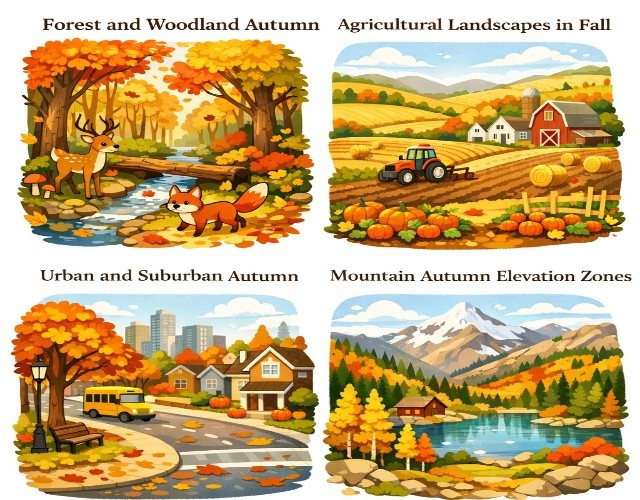
1. Forest and Woodland Autumn
2. Agricultural Landscapes in Fall
Harvest season transforms farmland as fields shift from growing crops to bare soil or stubble. Depict combines harvesting wheat, apple pickers in orchards, and pumpkin patches open to visitors. Distinctive scents, cut hay, fermenting apples, and grain dust define the agricultural autumn.
Human activity dominates: farmers working in changing weather, markets selling fresh produce, and storage facilities filling with the harvest, setting agricultural autumn apart from wilderness autumn.
3. Urban and Suburban Autumn
Urban autumn differs from rural or wilderness settings. Trees in parks and streets create structured color patterns rather than natural mosaics. Human responses, leaf blowers, street sweepers, and bagged leaves shape the season, while cultural activities like Halloween decorations, pumpkins, and school routines add a distinct urban layer to the natural changes.
4. Mountain Autumn Elevation Zones
Mountain autumn progresses by elevation. Alpine zones experience autumn first, late August often, while valley floors retain summer into October. Describe these elevation-based progressions creating vertical autumn patterns across slopes.
Treeline areas show autumn colors concentrated in bands. Above treeline, alpine plants brown and die back. At treeline, stunted trees display color. Below the treeline, full forests undergo transformation. These vertical zones create striped autumn appearances on mountain slopes.
Mountain weather becomes increasingly unpredictable in autumn. Early snows can arrive unexpectedly. Clear days alternate with storms. Temperature ranges expand dramatically. These conditions create autumn's transitional character more intensely in the mountains than in the lowlands.
Views from mountains in autumn reveal distant landscape transformations impossible to see at ground level. Describe vast forest expanses displaying mixed colors, valleys filled with morning fog, or weather systems moving across ranges.
If you are confused, you can always have a look at various autmn related descriptive essay topics for guidance.
Capturing Autumn's Sensory Details
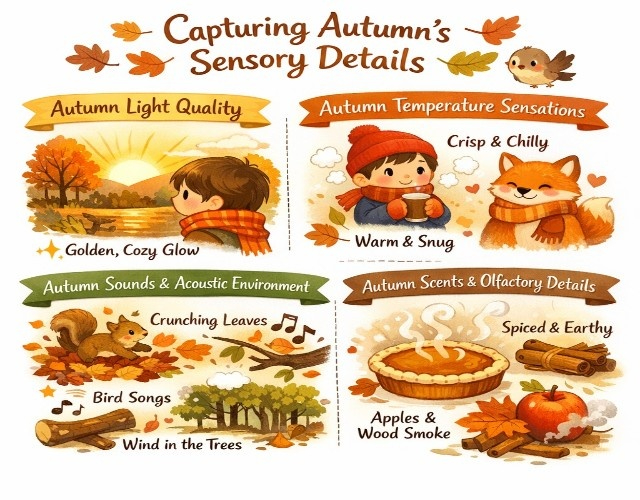
Autumn Light Quality
Autumn light slants increasingly as the sun angle drops toward the winter solstice. This creates longer shadows, different color temperatures, and characteristic golden hours. Describe how light behaves, raking across landscapes, illuminating leaves from behind, creating dramatic contrasts between lit and shadowed areas.
- Morning light in autumn often encounters fog or mist absent in summer. Describe diffuse light filtering through haze, or sudden illumination as morning fog burns off. These atmospheric effects characterize autumn mornings distinctively.
- Afternoon autumn light creates warm tones, enhancing red and orange foliage. Backlighting makes leaves glow translucently. This illumination matters enormously for foliage photography and for descriptive writing; the same trees look completely different in morning versus afternoon light.
- Shorter daylight hours affect autumn descriptions. Include how earlier darkness arrives, how twilight extends in cool autumn air, how stars become visible earlier than in summer. These temporal changes matter as much as light quality itself.
Autumn Temperature Sensations
Autumn temperature describes a focus on transitions and contrasts more than absolute cold. Morning chill giving way to afternoon warmth characterizes autumn's temperature personality. Describe these diurnal swings: frost at dawn, t-shirt weather by noon, sweater needed again by sunset.
First frosts create dramatic temperature markers. Describe frost's appearance on surfaces, white crystals coating grass, rime ice forming on car windows, and frozen condensation outlining leaves. Frost transforms familiar landscapes temporarily, creating distinctive autumn morning scenes.
Temperature drop sensations matter physically. Breath becoming visible, hands going numb, ears stinging in the wind, these bodily responses to cooling characterize autumn experiences. Include physical responses rather than just thermometer readings.
Indian summer warm periods interrupt autumn cooling unpredictably. Describe these unseasonable warmth episodes, how they feel jarring after cooler weather, how they accelerate remaining foliage changes, and how they create last opportunities for summer activities.
STRUGGLING WITH VIVID DESCRIPTIONS?
Professional Writers Create Rich, Sensory-Driven Essays
Bring your subject to life with expert descriptive writing.
Autumn Sounds and Acoustic Environment
Autumn soundscapes differ dramatically from summer. Insect choruses diminish as cold nights reduce populations. Bird activity changes as summer residents depart and winter species arrive. These acoustic shifts signal seasons as effectively as visual changes.
- Leaf sounds dominate autumn acoustics. Leaves rustling in trees before falling, leaves crunching underfoot after falling, leaves skittering across pavement in the wind. These characteristic sounds appear nowhere except in autumn.
- Wind sounds change as foliage thins. Wind through bare branches creates whistling, creaking sounds absent when trees carry full leaf loads. Describe these acoustic transformations as defoliation progresses.
- Human autumn activities create distinctive sounds, lawn mowers giving way to leaf blowers, school buses resuming routes, football game crowds, and Halloween fireworks. These cultural sounds characterize autumn's acoustic environment in populated areas.
Autumn Scents and Olfactory Details
Decaying leaves create autumn's signature scent: earthy, slightly sweet, distinctive. This smell announces autumn powerfully. Different tree species' leaves smell subtly different as they decompose; oak leaves smell different than maple leaves.
Woodsmoke becomes prevalent as the heating season begins. Describe this scent appearing in the evening air, morning neighborhoods, or forest campfires. Smoke scent connects to autumn culturally and practically, people burn the summer's accumulated brush or start wood stoves.
Harvest scents characterize agricultural autumn: fermenting apples beneath orchard trees, cut hay curing in fields, ripe grapes in vineyards. These productive smells differ from purely natural autumn scents.
When describing harvest activities, engage multiple senses just as you would when writing a descriptive essay about food; the visual abundance, tactile textures, and aromatic richness all matter.
Cool autumn air carries scents differently from warm summer air. Smells don't travel as far but remain sharper, clearer. Cold increases scent intensity somehow; describe how apple orchards smell more intensely on crisp autumn mornings than warm afternoons.
Organizing Your Autumn Descriptions
Organize your autumn descriptions by combining visual changes, sounds, scents, and human or natural activities to create a vivid, cohesive scene. Below are a few techniques that will help you with your autumn descriptions
Chronological Organization
Organize autumn descriptions temporally, early, mid, and late autumn, tracking seasonal progression. This organization emphasizes autumn's transitional character naturally. Start with summer's ending (early autumn), proceed through peak transformation (mid-autumn), and conclude with winter's approach (late autumn).
Early autumn descriptions focus on anticipation and beginning changes. First cool nights, earliest color hints, summer crops giving way to autumn harvest. This period blends seasons, still warm but gaining autumn characteristics. You're showing the transition, not just the destination.
Mid-autumn features peak color displays, comfortable temperatures, and maximum harvest activity. This period represents autumn's climax, the moment most people visualize when imagining fall. Your descriptions here can be most vivid and expansive.
Late autumn emphasizes transition completion. Most leaves fallen, temperatures are dropping toward freezing, and landscapes are preparing for winter dormancy. This period creates melancholy tones absent earlier in autumn; use them to deepen your essay's emotional range.
Spatial Organization for Fall Landscapes
Use spatial patterns appropriate for autumn locations. Forests benefit from ground-to-canopy organization showing leaf litter accumulation, understory changes, and canopy color transformations vertically. This creates a complete picture of how autumn affects different forest layers.
Orchards and agricultural settings work well with near to far organization, showing immediate harvest activities, mid-distance crop fields, and distant landscape colors creating depth. You're building a three-dimensional autumn scene readers can mentally walk through.
Mountain landscapes in autumn benefit from elevation-based organization. Describe how autumn progresses from higher elevations downward, with mountaintops showing color first, and valleys retaining green longer. This creates natural progression through descriptions while showing autumn's temporal dynamics.
Contrast Organization
Organize autumn descriptions around contrasts: warm/cool, vibrant/subdued, growing/declining, full/empty. These binary structures emphasize autumn's transitional nature effectively while giving readers clear frameworks for understanding your observations.
Contrast summer's fullness with autumn's gradual emptying. Contrast early autumn warmth with late autumn cold. Contrast colorful foliage with bare branches. These juxtapositions highlight changes defining the season more effectively than static descriptions alone.
Free Descriptive Essay About Autumn Downloadable Resources
Common Autumn Description Mistakes
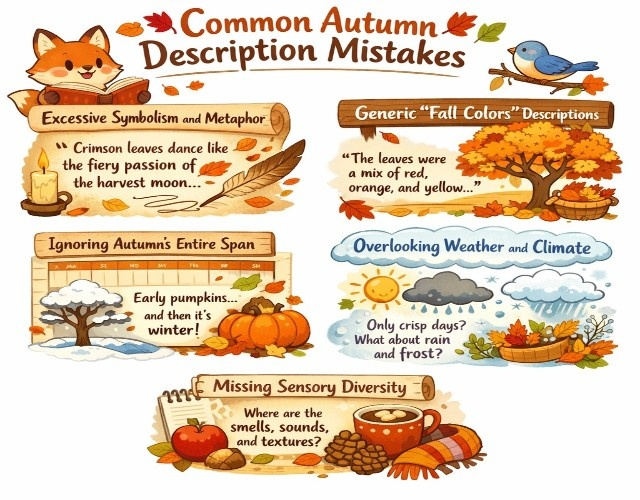
Excessive Symbolism and Metaphor
Autumn attracts symbolic interpretations, life cycles, aging, mortality, and change. While these associations exist legitimately, prioritizing symbolism over concrete observation produces abstract essays disconnected from actual autumn experiences.
Describe observable autumn phenomena first: color changes, temperature drops, and daylight shortening. Let symbolic meanings emerge from detailed observation rather than imposing philosophical frameworks onto nature. Readers recognize autumn symbolism without heavy-handed explanation.
Generic "Fall Colors" Descriptions
"Beautiful fall colors" communicates nothing specific. Which colors specifically? Where do they appear? How do they distribute across landscapes? What causes them? Generic color references fail to create vivid mental images that readers can visualize.
Specify actual hues: crimson, scarlet, burgundy, rust, copper, bronze, gold, amber, saffron. Des:cribe color patterns and distributions. Explain which tree species display which colors. These specifics create authentic autumn color descriptions rather than vague prettiness.
Ignoring Autumn's Entire Span
Many autumn essays focus exclusively on peak foliage while ignoring early and late autumn. This creates incomplete seasonal portraits missing autumn's transitional character, the season's defining quality.
Include autumn's full progression from summer's ending through winter's beginning. Early autumn anticipation, mid-autumn climax, and late autumn conclusion all contribute to complete seasonal descriptions. The entire seasonal arc matters, not just October's prettiest week.
Overlooking Weather and Climate
Autumn weather varies tremendously by location and year. New England autumn differs completely from Southern California autumn. Warm years produce a different autumn than cool years. Regional variations matter enormously.
Describe specific autumn weather you've experienced rather than assuming universal autumn conditions. Your location's autumn characteristics, when frost comes, which trees dominate, and typical weather patterns, create authentic descriptions rather than generic autumn stereotypes.
Missing Sensory Diversity
Vision dominates autumn descriptions, understandably given spectacular color displays. However, autumn engages all senses distinctively. Overemphasizing visual elements while neglecting sounds, scents, temperatures, and tactile sensations creates incomplete autumn portraits.
Balance sensory details across all five senses. Autumn sounds, smells, and physical sensations characterize the season as definitively as colors do. Complete autumn descriptions engage readers through multiple sensory channels simultaneously.
A good way to avoid common mistakes is to have a look at some descriptive essay examples.
Creating Your Autumn Description
egin by observing specific autumn settings multiple times across the season's progression. Take notes during early, mid, and late autumn visits to the same location, capturing how transformations occur rather than just final states. Notice which changes happen gradually versus suddenly, which species transform first, and how weather affects autumn's pace.
Create outlines emphasizing autumn's transitional nature. Use chronological, spatial, or comparative organization, highlighting how autumn differs from other seasons and how autumn itself changes internally. Your descriptive essay outline should accommodate autumn's dynamic quality rather than treating it statically.
Draft using precise sensory details across all five senses. Revise by removing generic "fall colors" references, seasonal clichés, and excessive symbolism. Verify scientific accuracy regarding tree species, biological processes, and weather phenomena. Strong autumn descriptions balance natural and cultural elements, creating complete seasonal portraits through specific, vivid observations.
Ready to write but need more guidance? Our descriptive essay guide covers techniques applicable beyond autumn, helping you master descriptive writing for any subject.
Get Expert Help With Your Autumn Descriptive Essay
Capture the beauty of fall with vivid descriptions and professionally crafted writing that stands out academically.
- Personalized autumn essays tailored to your academic level and requirements
- Rich sensory descriptions that bring fall colors, sounds, and atmosphere to life
- Proper structure, strong imagery, and engaging narrative flow
- 100% original, plagiarism free content delivered on time
Work with our professional essay writing service to create an autumn descriptive essay that impresses your readers and earns top grades.
Order Now
-20161.jpg)





-20188.jpg)




-20358.jpg)
-20173.jpg)