


The Unique Nature of Food Essay Writing
Food writing stands apart from other descriptive essays because it engages all five senses simultaneously. When you describe a person or place, you might focus on visual details and sounds. But with food, you're working with taste, smell, texture, appearance, and even the sounds of cooking or eating.
This multi sensory approach creates a more immersive reading experience. Your readers can almost taste what you're describing if you do it right. That's why food essays are some of the most memorable pieces of descriptive writing.
The best food essays also tell a story. They're not just ingredient lists or cooking instructions. They capture a moment, a memory, or a cultural experience tied to the food. Maybe you're writing about your first attempt at making pasta from scratch, or the curry that reminds you of family gatherings, or the coffee shop pastry that got you through finals week.
Why Sensory Details Matter in Food Description
Generic descriptions like 'delicious' or 'tasty' tell readers nothing. These words are empty because they don't create a specific image or sensation. Instead, you need to show exactly what makes the food delicious.
Compare these two sentences:
|
The second version puts readers right there with you. They can hear the crackle, smell the oregano, and feel the heat from the steam. That's what sensory details do.
Choosing the Right Food Essay Topic
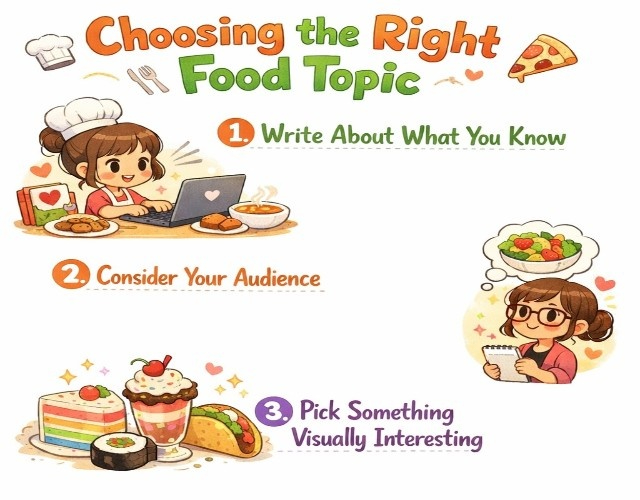
Picking the right food to write about makes everything easier. You want something you can describe in rich detail, something that matters to you, and something readers can connect with.
Write About What You Know
The most authentic food essays come from personal experience. Don't write about molecular gastronomy if you've never tried it. Don't describe homemade pasta if you've only eaten it from a box. Stick with foods you've actually tasted, cooked, or experienced in a meaningful way.
Your personal connection to the food will shine through in your writing. If you're describing your mother's biryani, you'll naturally include details about the aroma filling the kitchen, the way she toasts the spices, and how the rice grains separate perfectly on your plate. Those details come from observation and memory, not imagination.
Consider Your Audience
Think about who'll read your essay. If you're writing for a class assignment, your audience is probably your instructor and classmates. You can assume basic food knowledge but should explain unusual ingredients or cooking techniques.
If you're writing for a broader audience, choose foods that are either widely known or easy to explain. A descriptive essay about durian might need more context than one about chocolate chip cookies.
Pick Something Visually Interesting
Some foods are naturally easier to describe than others. A layered cake with frosting, fruit, and decorations gives you more to work with than a bowl of oatmeal. A sizzling fajita platter arriving at your table creates a scene. Plain toast doesn't.
That doesn't mean you can't write about simple foods. But if you choose something visually plain, you'll need to dig deeper into other sensory details, the context, or your emotional connection to it.
Need Food topics ideas? Explore our descriptive essay topics.
Using the Five Senses in Describing Food
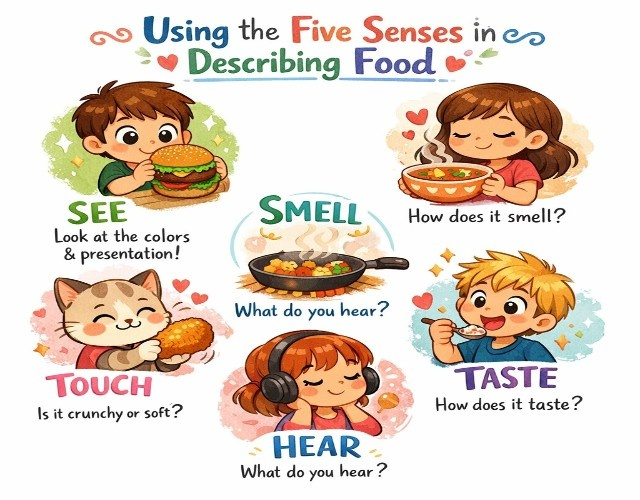
Good food writing engages all five senses, but not all senses carry equal weight. Taste, smell, and texture usually matter more than sight and sound. Here's how to use each sense effectively.
Taste: Beyond Sweet, Salty, Sour, Bitter
Describing taste is tricky because we only have a few basic taste categories. The real flavor comes from combining taste with smell, texture, and temperature.
Don't just say something tastes sweet. Describe what kind of sweet. Is it:
|
The same goes for the other basic tastes. 'Salty' could be sea salt crystals that burst on your tongue, or it could be the deep, savory saltiness of aged Parmesan. Be specific.
Smell: The Memory Trigger
Smell is powerfully linked to memory and emotion. That's why describing aromas can make your food writing more personal and evocative.
When you describe a smell, try to connect it to something familiar or use comparative language:
|
Notice how these descriptions use comparisons (peppery, nutty, chocolatey) and context (grandmother's garden, kitchen) to make the smell more vivid.
Texture: The Overlooked Sense
Texture often gets ignored in food writing, but it's crucial. The way food feels in your mouth can make or break the eating experience.
Think about contrast: crispy skin on tender chicken, creamy cheese on crunchy crackers, smooth chocolate with crunchy nuts. These contrasts make food interesting.
Here are texture words you can use:
|
Combine texture with action: 'The bread tore apart to reveal a soft, airy interior that absorbed the butter instantly.'
Sight: Colors and Presentation
Visual description sets the scene, but it shouldn't be your only focus. Use specific color words instead of basic ones:
|
Also, describe the arrangement and presentation. A salad tossed in a bowl looks different from one with ingredients arranged in neat rows. A burger assembled carefully looks different from one that's been squashed.
Sound: The Bonus Sense
Sound plays a smaller role in food writing, but it can be powerful when used right. Think about:
|
Sound descriptions work best when they're part of a larger scene or narrative moment.
Essential Food Description Vocabulary
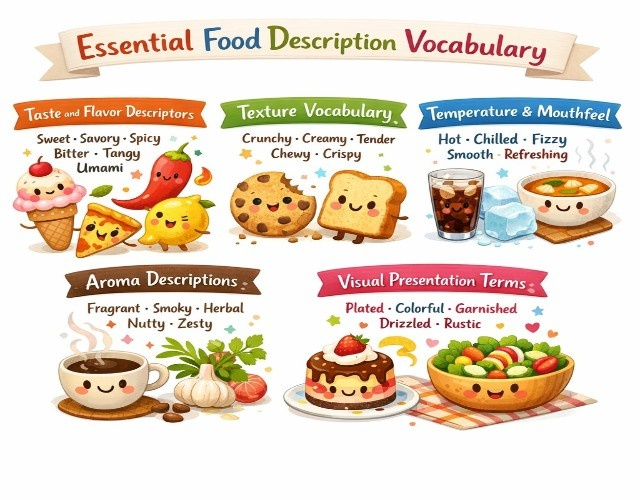
Taste and Flavor Descriptors
Taste operates through five basic receptors: sweet, salty, sour, bitter, and umami (savoury). Use these fundamental categories precisely. Don't say food "tastes good", specify which taste sensations dominate and how they combine.
Beyond basic tastes, foods possess complex flavours.
- Tangy describes acidic brightness.
- Rich indicates deep, concentrated flavors.
- Mild suggests a subtle taste.
- Robust means strong, full flavour.
- Delicate implies a refined, easily overwhelmed taste.
- Bold describes assertive, prominent flavours.
| Specific flavour profiles add precision: nutty, earthy, floral, fruity, spicy, smoky, herbal, buttery, citrusy. These descriptors communicate actual flavour characteristics rather than generic "tastes good" assessments. |
Texture Vocabulary
Texture deserves equal attention to taste in food descriptions.
- Crispy and crunchy describe different textures, crispy suggests delicate breaking, crunchy implies substantial resistance.
- Tender means easily chewed, tough requires effort.
- Smooth lacks graininess, creamy adds richness to smoothness.
- Flaky describes layered texture (pastries, fish)
- Crumbly indicates dry fragility (cookies, cornbread)
- Chewy means resistant texture (bagels, caramel)
- Silky suggests refined smoothness (chocolate mousse, hollandaise).
Temperature and Mouthfeel Descriptions
Temperature descriptions extend beyond hot/cold.
Piping hot, lukewarm, ice cold, and room temperature each communicate specific thermal states. Include how temperature affects eating experience, hot soup warming from inside, ice cream cooling the mouth, tepid soup disappointing compared to expectations.
Mouthfeel describes physical sensations beyond taste and texture.
These sensations contribute significantly to food experiences. |
Aroma Descriptions
Smell profoundly influences taste, much of what we perceive as taste actually comes from aroma.
Describe food smells specifically: pungent, aromatic, fragrant, acrid, musty, fresh, yeasty, garlicky, buttery
caramelized.
Include when aromas appear. Some foods smell different raw versus cooked. Aromas intensify during cooking, then change when served. Describe these aromatic progressions rather than treating smell as a single static impression.
Visual Presentation Terms
Food appearance sets expectations before tasting.
Describe colours precisely, not "brown meat" but "mahogany glazed duck" or "golden brown crust."
Plating matters: garnished, drizzled, dusted, artfully arranged, rustic, minimalist.
Include textural visual cues:
Visual texture predictions often match actual mouthfeel. |
Organizing a Descriptive Essay About Food
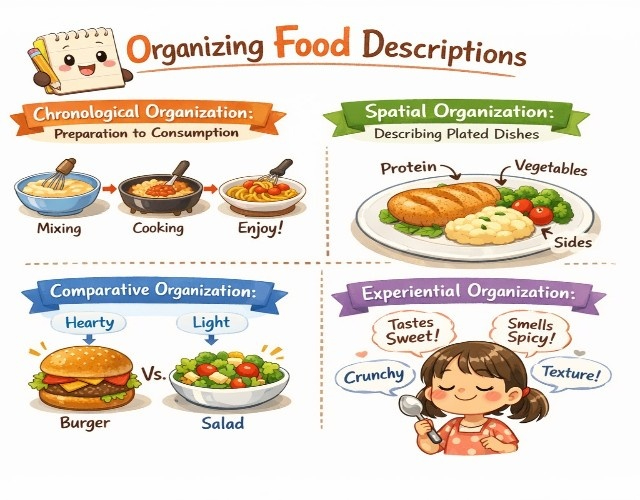
Chronological Organization: Preparation to Consumption
Organize food descriptions chronologically from preparation through eating. This structure naturally incorporates multiple sensory stages: raw ingredients, cooking smells and sounds, plating and presentation, first bite impressions, eating experience, and aftertaste.
- Start with ingredient selection or preparation. Describe raw components, preparation sounds (chopping, sizzling), cooking aromas, and visual transformations. This builds anticipation before actual eating descriptions begin.
- Progress to serving presentation. Describe how food appears on plates, with steam rising, garnishes, colours, and arrangements. This visual stage transitions from preparation to consumption.
- Conclude with an eating experience. Describe first bite impressions, how flavours develop while chewing, temperature changes, textural variations, and finishing impressions. This progression naturally mirrors actual eating experiences.
Spatial Organization: Describing Plated Dishes
Spatial organization works well for complex dishes with multiple components. Describe elements systematically, left to right, outside to inside, bottom to top. This guides readers through visual composition before discussing taste.
For example, describe a plated entrée: "At the plate's center, a pan seared duck breast rests on wilted spinach. To the left, roasted fingerling potatoes glisten with herb butter. Cherry gastrique pools to the right, its ruby color contrasting golden duck skin."
This organisation helps readers visualise presentations before they describe eating. Complex dishes with multiple elements benefit from spatial structure, preventing confusion about which elements you're discussing.
Comparative Organization
Compare and contrast food elements, dishes, or cuisines. This organization helps readers understand unfamiliar foods by relating them to known references. "Natto tastes like aged cheese mixed with fermented soybeans" gives readers familiar reference points for exotic food.
Cultural cuisine comparisons: "Japanese ramen differs from pho primarily in broth concentration; ramen broths are thicker, richer, while pho features lighter, more aromatic broths." These comparisons educate while describing.
Experiential Organization
Some food descriptions benefit from structuring around the eating experience itself. Start with anticipation before eating, progress through first impressions, describe how flavours develop, and conclude with a satisfying conclusion or disappointment.
This organization emphasises the temporal, experiential nature of eating rather than treating food as a static object. Include how food changes, temperature dropping, flavours mellowing, and textures softening. These dynamic elements characterize actual eating experiences.
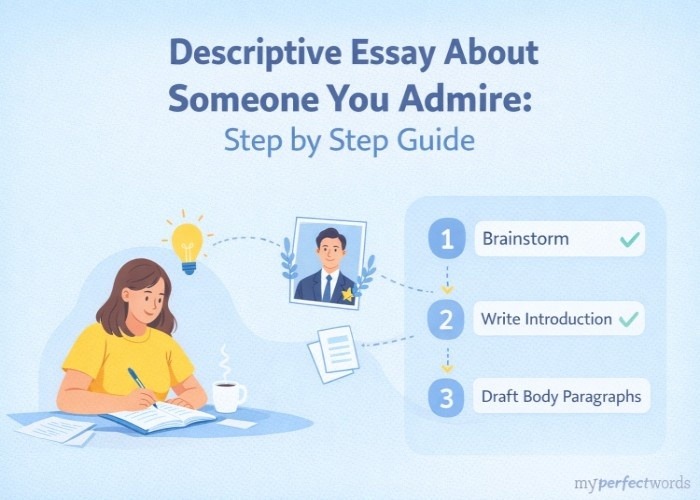
Want step by step organizing tips? A descriptive essay outline helps organize your ideas effectively by structuring sensory details, maintaining logical flow, and ensuring your description stays clear, focused, and engaging for readers.
Professional Essay Writing Starts Here
Get your essay written by experts who understand academic standards
Join thousands of students who've improved their grades with our help
Writing Tips for Describing Different Food Categories
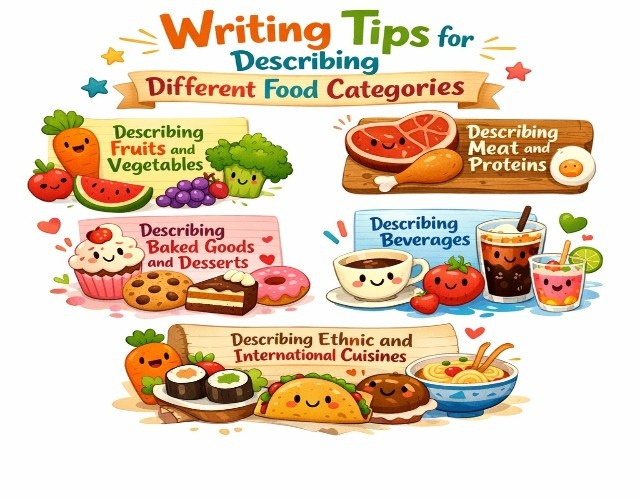
Describing Fruits and Vegetables
Fresh produce descriptions emphasise ripeness indicators, seasonal variations, and raw versus cooked transformations. Describe fruit precisely: "The mango yielded slightly to gentle pressure, indicating peak ripeness. Its skin showed orange red blush over a golden yellow base."
Include ripeness effects on taste and texture. Underripe fruit tastes tart and feels firm. Overripe fruit becomes mushy and overly sweet. Perfectly ripe fruit balances sweetness, acidity, and texture ideally. These variations matter significantly in product descriptions.
Cooking transforms vegetables dramatically. Raw carrots taste different than roasted, roasting concentrates sugars and creates caramelization. Describe these transformations when relevant to your food experience.
Describing Meat and Proteins
Protein descriptions require attention to the effects of cooking methods. Grilling creates char and smoke flavours. Braising produces tender, rich results. Pan searing develops crust while maintaining juicy interiors. Each method affects taste and texture distinctively.
Doneness matters enormously. Rare steak differs completely from well done. Include specific doneness descriptions, pink centre, brown throughout, seared exterior, juicy interior. These details communicate precisely what you experienced.
Describing Baked Goods and Desserts
Baked goods descriptions emphasize textural contrasts and technical achievement.
Sweet descriptions require specificity beyond "tastes sweet." Honey sweet differs from caramel sweet, which differs from berry sweet. Include the sweetness level, cloying versus balanced. Describe how sweetness interacts with other flavours.
Temperature dramatically affects desserts. Ice cream melting on the tongue, warm chocolate lava cake oozing, room temperature cake versus chilled, these temperature variations create completely different experiences with identical items.
Describing Beverages
Beverage descriptions include appearance (clarity, color, foam, bubbles), aroma (often more prominent than food aromas), taste (often more subtle than solid foods), and mouthfeel (viscosity, carbonation, temperature effects).
Include preparation effects, how brewing time affects strength, and how temperature affects extraction.
Alcoholic beverages have complex descriptor systems. Wine tasting vocabulary, beer terminology, spirits descriptions, each category has specialized language. Use technical terms accurately when appropriate, but translate into accessible language for general audiences.
Describing Ethnic and International Cuisines
International cuisine descriptions should respect cultural context while remaining accessible. Include authentic preparation methods, traditional ingredients, and cultural significance without exoticizing or making unfamiliar foods seem bizarre.
Compare unfamiliar foods carefully to familiar references. "Tastes like [familiar food]" helps readers understand but can oversimplify complex flavours. Balance accessibility with authenticity.
Include cultural eating practices when relevant, such as eating with hands, sharing communal dishes, and traditional pairings. These artistic elements enrich food descriptions beyond pure taste and texture.
Integrating Personal and Cultural Context
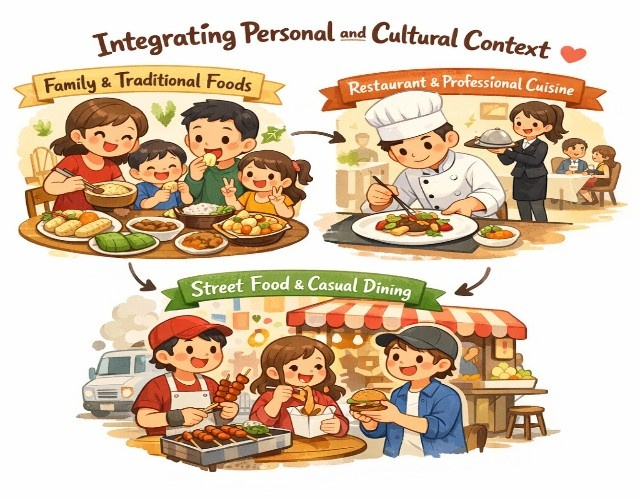
Family and Traditional Foods
Family recipes carry emotional weight beyond their ingredients. Grandmother's cooking often tastes different from technically identical dishes because memory and association flavour the experience. Include these personal connections when relevant.
Describe traditional preparation methods, ingredient sourcing, and family stories surrounding dishes. These details add depth, transforming food descriptions from isolated sensory experiences into culturally embedded memories.
Restaurant and Professional Cuisine
Restaurant descriptions should balance food quality with ambience, service, and overall dining experience. Describe plating presentation, portion sizes, and how dishes arrive at tables. Include relevant service elements, table settings, pacing, and wine pairings.
Professional cuisine often involves technical sophistication worth acknowledging. Sous vide cooking, spherification, and foam techniques, these methods affect the final results. Include technical elements when they enhance understanding without becoming overly instructional.
Street Food and Casual Dining
Street food descriptions benefit from integration with the setting. Include vendor interactions, preparation observations, and the surrounding atmosphere. Street food rarely exists in isolation; it's part of larger sensory environments worth describing.
Casual dining allows focus purely on food without formal service elements. This simplicity enables detailed descriptions of taste and texture without distraction. However, don't ignore the setting completely; casual environments contribute to overall food experiences.
Example: Descriptive Paragraph About Food
Here's a complete example showing these techniques in action:
My Grandmother's Apple Pie The first indication that my grandmother was baking came long before I saw the pie. Cinnamon and nutmeg drifted through the house, mixing with the butter and sugar smell of pastry. By the time I reached the kitchen, the pie sat cooling on the counter, its lattice crust golden-brown with darker edges where the sugar had caramelized. She'd slice into it while it was still warm, and the apples inside steamed slightly, releasing more of that spiced aroma. The apples themselves had turned translucent and soft, but they still held their shape instead of dissolving into mush. That was her trick, she used Granny Smith apples because they kept their structure. The first bite hit you with contrasts. The crust shattered into buttery flakes that melted on your tongue. Then came the apples: tender but not mushy, sweet but with a tart edge that prevented the dessert from becoming cloying. The cinnamon wasn't overpowering; it complemented the apple flavor instead of drowning it. And underneath everything was that buttery richness from the crust, which had absorbed some of the apple juices and turned slightly gooey where it met the filling.
Liked the above example? Explore our descriptive essay examples to find a wide range of samples that can help you understand structure, style, and effective descriptive techniques.
Free Downloadable Resources For a Descriptive Essay About Food
Common Food Description Mistakes
Even experienced writers fall into these traps when writing about food. Watch out for them.
1. Relying on Generic Adjectives
Words like 'delicious,' 'tasty,' 'yummy,' and 'good' tell readers nothing. They're placeholders for a real description.
Every time you write one of these words, stop and ask yourself: What specific qualities make this food delicious? Then describe those qualities instead.
2. Listing Ingredients Instead of Describing
Your essay isn't a recipe. Readers don't need to know every ingredient in the dish unless those ingredients contribute to the sensory experience you're describing.
- Bad: 'The salad contained lettuce, tomatoes, cucumbers, carrots, and ranch dressing.'
- Better: 'Crisp romaine leaves crunched between my teeth, while cherry tomatoes burst with acidic sweetness and cool cucumber provided relief from the sharp bite of red onion.'
3. Focusing Only on Taste
Beginning writers often describe only how food tastes, ignoring the other four senses. This creates flat, one dimensional descriptions.
Challenge yourself to include at least three senses in every food description. If you're struggling, think about the context: What did you see, hear, or smell while eating?
4. Using Clichés
'Melts in your mouth,' 'heavenly,' 'out of this world,' 'to die for', these phrases are overused and meaningless. They're lazy shortcuts that replace actual descriptions.
If you catch yourself using a food cliché, delete it and write something specific about that particular dish instead.
5. Overdoing It
You can have too much of a good thing. If every sentence is packed with five adjectives and three metaphors, your writing becomes exhausting to read.
Balance detailed descriptions with simpler sentences. Give readers room to breathe. Not every bite needs its own paragraph.
Creating Your Food Description
Begin by eating and experiencing food while taking detailed notes. Describe immediately rather than relying on memory; flavors fade quickly from recollection. Note first impressions, how flavors develop, texture changes, temperature effects, and lasting impressions.
Start with organizing sensory details logically. Choose organisational patterns that match your food subject, chronological for cooking experiences, spatial for plated presentations, or comparative for unfamiliar cuisines. Ensure your outline balances all five senses rather than overemphasizing taste alone.
Draft using specific sensory vocabulary. Avoid generic praise and vague adjectives. Include texture, temperature, and appearance alongside taste descriptions. Revise by removing clichés, adding cultural context where relevant, and verifying technical terminology accuracy. Strong food descriptions make readers hungry by creating complete, vivid eating experiences through precise, multi sensory language.
For guidance on descriptive techniques applicable beyond food subjects, explore our comprehensive descriptive essay guide.
Struggling to Create Vivid, Engaging Descriptions?
Our expert writers craft descriptive essays rich with sensory details, vivid imagery, and compelling language that captivates readers.
- Tell us about your subject and descriptive requirements
- Get matched with a creative writing expert
- Receive drafts with rich sensory language
- Get your final essay with powerful descriptive techniques
Every essay is crafted with careful word choice, figurative language, and immersive descriptions that engage all five senses.
Order Now
-20161.jpg)



-20188.jpg)

-20358.jpg)
-20173.jpg)