MyPerfectWords - Essay Writing Service
  • Writers
  • Services
    • Descriptive Essay
    • Argumentative Essay
    • Nursing Essay
    • History Essay
    • Research Paper
    • Term Paper
    • Thesis
    • Dissertation
    • Admission Essay
    • View All Services
  • About Us
  • Pricing
  • Samples
  • Blog
Place an Order
  • Login
  • Signup
MyPerfectWords - Essay Writing Service
MPW Logo
  • Writers IconWriters
  • Services IconServices
    • Descriptive Essay
    • Argumentative Essay
    • Nursing Essay
    • History Essay
    • Research Paper
    • Term Paper
    • Thesis
    • Dissertation
    • Admission Essay
    • View All Services
  • About Us IconAbout Us
  • Pricing IconPricing
  • Blog IconBlog
  • Account IconAccount
    • Login
    • Sign Up
Place an Order
Email Iconinfo@myperfectwords.comPhone Icon(+1) 888 687 4420

Home

>

Blog

>

Descriptive Essay

>

Descriptive Essay Outline

Descriptive Essay Outline - Complete Guide with Templates

CS

Written ByCaleb S.

Reviewed By Jennifer M.

12 min read

Published: Dec 11, 2025

Last Updated: Dec 11, 2025

descriptive essay outline

How Do You Structure a Descriptive Essay Outline?

A descriptive essay outline organizes sensory details and observations into a clear framework before writing begins. The standard structure includes an introduction establishing your subject and dominant impression, body paragraphs organized by specific aspects or senses, and a conclusion that reinforces the overall picture you've created.

Effective outlines prevent random detail dumps by giving each sensory observation a strategic placement. You decide beforehand whether to organize spatially (describing a room left to right), chronologically (describing an event minute by minute), or by importance (leading with the most striking details). This pre-planning transforms scattered observations into cohesive description.

Your outline also identifies where to place specific sensory language. Rather than hoping descriptions emerge during drafting, you note exactly which paragraph will cover visual details, which will emphasize sounds, and which will layer multiple senses together. For comprehensive guidance on the entire descriptive writing process, explore our complete descriptive essay guide covering every technique from brainstorming through revision.

FIRST DESCRIPTIVE ESSAY?

Step-by-Step Guidance From Experienced Writers

Order an Original Essay

Learn the fundamentals while getting your essay done right.

Why Outlines Improve Descriptive Writing

Outlines solve the most common descriptive essay problem: overwhelming readers with unorganized sensory details. Without structure, you might describe a person's clothing, then their personality, then back to physical features, then their voice—creating confusion rather than clarity. An outline ensures related details stay grouped and ideas flow logically.

Pre-planning also reveals coverage gaps before you've written 500 words. Your outline might show three paragraphs about visual appearance but nothing about how your subject sounds, moves, or affects their environment. You fix these imbalances during planning rather than during revision. If you want expert help applying these outlining strategies to your own paper, a professional descriptive essay writing service can ensure your ideas are structured clearly while preserving vivid, engaging detail.

Outlines create accountability for thesis promises. If your thesis claims "The abandoned theater combines architectural grandeur with haunting decay," your outline must show paragraphs covering both grandeur AND decay equally. Without an outline, you might accidentally write 80% about decay, failing to deliver on your thesis's complete vision.

Finally, outlines reduce writing anxiety. Staring at a blank page wondering "what should I write next?" disappears when you follow your roadmap. Each paragraph has a clear purpose already determined, letting you focus entirely on crafting vivid language rather than simultaneously deciding structure and description. To see how professional writers apply these principles, study our annotated descriptive essay examples demonstrating successful outlining in action.

The Standard 5-Paragraph Descriptive Essay Outline

The five-paragraph structure provides the most reliable framework for academic descriptive essays. This format includes one introduction paragraph, three body paragraphs, and one conclusion—sufficient length to develop rich description without overwhelming scope. Most high school and early college assignments expect this structure.

Introduction (1 paragraph): Begin with a hook statement that immediately engages attention—a striking sensory detail, surprising comparison, or intriguing question. Follow with 2-3 sentences providing context about your subject. Conclude with a thesis statement establishing your dominant impression—the overall feeling or main quality you're capturing. Your thesis answers "What's the essential nature of what I'm describing?"

Body Paragraphs (3 paragraphs): Each body paragraph explores one specific aspect of your subject. Start every paragraph with a topic sentence announcing that section's focus. Layer sensory details in 4-6 supporting sentences, using specific concrete language rather than vague adjectives. End each paragraph connecting back to your dominant impression, showing how these details contribute to your thesis vision.

Conclusion (1 paragraph): Open by restating your thesis in fresh language, not word-for-word repetition. Synthesize your most powerful details in 2-3 sentences, reinforcing the complete picture you've created. Close with a final observation or reflection that leaves readers with a lasting impression. Avoid introducing new descriptive details or using clichéd phrases like "in conclusion."

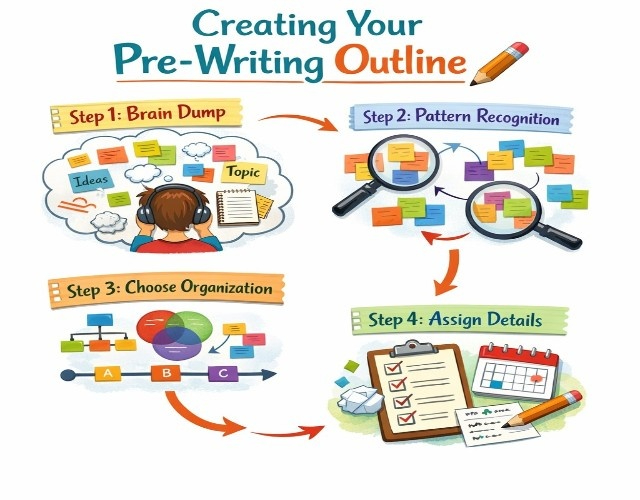
Creating Your Pre-Writing Outline

Start by listing every sensory detail you've observed about your subject. Don't organize yet—just capture everything you've noticed through sight, sound, smell, taste, and touch. Include both obvious features (a person's height, a place's size) and subtle characteristics (how sunlight affects colors, how temperature changes throughout a space). Aim for 20-30 raw observations.

Next, identify patterns in your details. Group observations that relate to the same aspect: all personality traits together, all architectural features together, all sounds together. These natural groupings become body paragraph topics. You need three distinct groups for a five-paragraph essay, so combine smaller categories or separate large ones as needed.

Now determine the best organizational pattern. Spatial organization works for places and objects—describe systematically from one point to another. Chronological organization fits events or experiences—follow time sequence. Order of importance suits people or complex subjects—start with striking features that define your dominant impression, then add supporting details.

Finally, assign specific details to specific paragraphs in your outline. Write topic sentences for each body paragraph. Note which sensory language will appear where. Mark transitions between paragraphs. This complete roadmap means drafting becomes execution rather than exploration. When you're ready to transform your outline into compelling prose, follow our step-by-step descriptive essay writing process.

ESSAY NEEDS IMPROVEMENT?

Professional Editing Makes Your Descriptions Come Alive

Get Expert Help

Polish your essay with expert feedback on language and imagery.

Outline Template: Describing a Person

I. Introduction

  • Hook: Most striking characteristic that captures attention
  • Context: Relationship to this person, where/when you encounter them
  • Thesis: Dominant impression (e.g., "Sarah embodies quiet confidence through her composed demeanor and deliberate choices")

II. Body Paragraph 1: Physical Appearance

  • Topic Sentence: Overall physical presence
  • Supporting Details: Height, build, distinctive features, typical clothing style, habitual postures or gestures
  • Connection: How appearance reflects or contradicts personality

III. Body Paragraph 2: Characteristic Behaviors

  • Topic Sentence: Typical actions and mannerisms
  • Supporting Details: How they move, speak, react to situations, interact with environment, habitual patterns
  • Connection: What these behaviors reveal about character

IV. Body Paragraph 3: Effect on Others

  • Topic Sentence: Impact on people and surroundings
  • Supporting Details: How others respond, atmosphere they create, what changes when they arrive/leave
  • Connection: Why these effects demonstrate your thesis

V. Conclusion

  • Restate thesis with different wording
  • Synthesize most memorable details
  • Final reflection on significance

Need more specific examples? Check our guide to descriptive essays about people for complete annotated essays demonstrating this structure.

Outline Template: Describing a Place

I. Introduction

  • Hook: Most striking sensory detail of location
  • Context: Where this place is, your connection to it
  • Thesis: Dominant impression (e.g., "The farmer's market buzzes with vibrant energy where commerce and community intertwine")

II. Body Paragraph 1: Visual Overview

  • Topic Sentence: General visual landscape
  • Supporting Details: Layout, colors, lighting, architectural features, movement and activity
  • Connection: How appearance establishes atmosphere

III. Body Paragraph 2: Sounds and Smells

  • Topic Sentence: Auditory and olfactory characteristics
  • Supporting Details: Specific sounds (volume, rhythm, sources), specific smells (intensity, sources, changes)
  • Connection: How these senses deepen the experience

IV. Body Paragraph 3: Atmosphere and Feel

  • Topic Sentence: Emotional quality and tactile elements
  • Supporting Details: Temperature, textures, crowding, pace, mood, what activities happen here
  • Connection: Why this atmosphere matters or what it reveals

V. Conclusion

  • Restate thesis about place's essential nature
  • Recall most powerful sensory moments
  • Reflect on place's meaning or significance

For detailed examples showing this structure in action, explore descriptive essays about places with complete sample essays.

UNSURE WHAT TO DESCRIBE?

Get Help Choosing and Developing Your Perfect Topic

Order Essay With Confidence

Expert guidance from topic selection to final draft.

Outline Example: "My Grandmother's Kitchen"

I. Introduction

  • Hook: "Cinnamon and cardamom clouds announced my arrival before I'd even removed my coat"
  • Context: Visited every Sunday afternoon throughout childhood, grandmother cooked while sharing family stories
  • Thesis: My grandmother's kitchen was a sanctuary where warmth came from both the oven and her presence

Much like other descriptive essay topics that rely on vivid sensory detail, this memory of my grandmother’s kitchen comes alive through the sights, smells, and emotions that shaped my childhood.

II. Body Paragraph 1: Physical Space

  • Topic Sentence: The kitchen occupied the house's heart—literally and figuratively
  • Details: Yellow wallpaper with small flowers, cracked linoleum worn smooth near the stove, mismatched chairs around a Formica table, afternoon sunlight through lace curtains, spice jars lining the windowsill
  • Connection: This modest space felt abundant through use and love rather than decoration

III. Body Paragraph 2: Sensory Atmosphere

  • Topic Sentence: The kitchen engaged every sense simultaneously
  • Details: Bubbling pots on gas burners (sound), steam fogging windows (sight), flour dust coating surfaces (touch), cardamom pods crushing under mortar (smell), tasting cookie batter from wooden spoons (taste)
  • Connection: These layered sensations created complete immersion in the moment

IV. Body Paragraph 3: Emotional Significance

  • Topic Sentence: This kitchen taught lessons beyond cooking
  • Details: Grandmother's patient hands demonstrating techniques, her stories accompanying each recipe's origins, the wooden spoon she'd tap on counter for emphasis, how she'd taste-test and adjust with confidence
  • Connection: The warmth I remember came more from her attention and tradition than from the stove

V. Conclusion

  • Restate: That yellow kitchen remains my definition of home
  • Synthesize: The specific smell of cardamom, the particular slant of Sunday afternoon light, her flour-dusted hands shaping dough
  • Reflect: I recreate her recipes now, but I'm really trying to recreate that feeling of being completely present and loved

Outline Example: "The Marathon Finish Line"

I. Introduction

  • Hook: At mile 26, my legs stopped following commands
  • Context: First marathon attempt after six months training, Boston course notorious for difficulty
  • Thesis: The final mile compressed exhaustion, determination, and triumph into the longest minutes of my life

II. Body Paragraph 1: Physical State

  • Topic Sentence: My body had reached its absolute limit
  • Details: Legs burning and trembling, lungs screaming for air, heart pounding visibly in chest, sweat stinging eyes, mouth tasting like copper, every muscle protesting continued movement
  • Connection: This physical collapse made the mental fight more urgent

III. Body Paragraph 2: Sensory Environment

  • Topic Sentence: The world narrowed to immediate sensations
  • Details: Crowd noise becoming white noise then surging loud, feet slapping pavement in rhythm, other runners' ragged breathing nearby, glimpses of mile markers and finish line banner, camera flashes blinding momentarily
  • Connection: These external stimuli kept pulling me forward when internal motivation failed

IV. Body Paragraph 3: Emotional Journey

  • Topic Sentence: Pride and doubt battled through every final step
  • Details: Remembering early morning training runs, hearing training partner's encouraging voice in memory, feeling medal's weight already around neck, doubting if I could actually finish, seeing family in crowd screaming my name
  • Connection: Finishing became about honoring all the preparation, not just crossing a line

V. Conclusion

  • Restate: Those final minutes taught me more about persistence than the previous 26 miles
  • Synthesize: The burning muscles, the roaring crowd, the distant finish banner growing closer
  • Reflect: I carry that lesson now—when everything hurts and quitting seems logical, you can still choose to continue

Looking for more experience-based outline examples? Visit our descriptive essay examples collection for diverse samples across all topics.

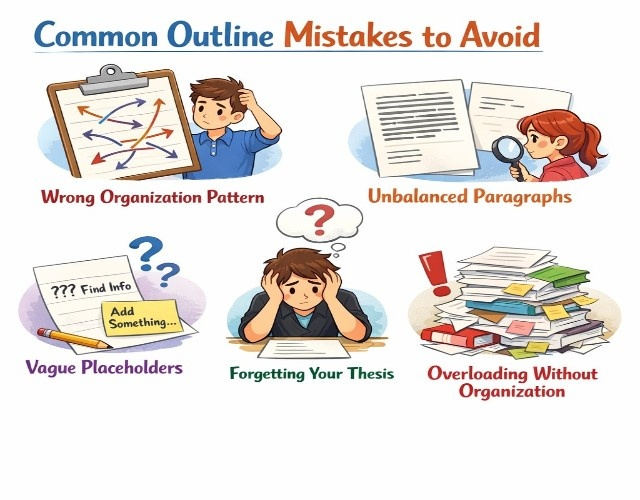
Common Outline Mistakes to Avoid

Organizing chronologically when spatial makes more sense: If you're describing a place, moving through time ("first I noticed... then I saw...") creates weaker structure than moving through space ("entering the room, the left wall displayed... while the right side contained..."). Match organization to subject type—places use spatial, events use chronological, people use importance.

Creating unbalanced paragraphs: Your outline shows one body paragraph with twelve details and another with three details—this imbalance will carry into your essay. Distribute observations evenly across paragraphs. If one aspect has many details, split it into two paragraphs. If another aspect has few details, combine it with a related aspect.

Using vague outline placeholders: Writing "describe appearance" in your outline doesn't help during drafting. Specify exactly which appearance details go where: "sandy blonde hair with gray streaks, wire-rimmed glasses constantly sliding down nose, weathered hands with paint-stained fingernails." Your outline should contain actual content, not just categories.

Forgetting your thesis: Every body paragraph outline entry should explicitly connect to your dominant impression. If your thesis claims "The art studio thrives with creative chaos," but a paragraph describes how organized the supply shelves are, you've outlined content that contradicts your thesis. Use your outline to verify thesis alignment before writing.

Overloading sensory details without organization: Listing seventeen different sounds without grouping them creates noise, not description. Your outline should show which senses appear in which paragraphs and why. Maybe paragraph one focuses on sight, paragraph two on sound and smell together, paragraph three on how touch and sight combine. Strategic sensory distribution prevents overwhelming readers.

Outline Variations for Different Essay Lengths

Short essays (500-750 words): Use the three-paragraph structure—introduction, one comprehensive body paragraph covering all aspects, conclusion. Your outline identifies the three most essential characteristics only. Everything else gets cut. This forces ruthless prioritization, keeping only details that directly support your dominant impression. For guidance on managing tight word counts or having trouble structuring your descriptive essay? Get our professional descriptive essay help now!

Standard essays (800-1,200 words): The five-paragraph outline works perfectly here, providing sufficient development without excessive length. Three body paragraphs allow exploring your subject from three distinct angles—physical characteristics, behaviors, and effects, or visual details, auditory details, and atmosphere. This length accommodates 4-6 supporting sentences per paragraph plus smooth transitions.

Extended essays (1,500-2,500 words): Expand to seven or more paragraphs by splitting broad categories into specific focuses. Instead of one "physical appearance" paragraph, create separate paragraphs for facial features, body language, and clothing style. Instead of one "kitchen atmosphere" paragraph, separate visual layout, sensory characteristics, and emotional significance. Your outline becomes more detailed with sub-categories under each main category.

Research-based descriptive essays: Add a literature review or background section before body paragraphs. Your outline includes where you'll cite sources supporting your observations or providing historical context. For example, describing a historical building requires outlining both your sensory description AND factual information about architectural style, construction date, and cultural significance. For more detailed guidance and examples on crafting descriptive essays, explore our Descriptive Essay Guide to see outlines and annotated essays in action.

Downloadable Outline Templates

Available Resources:

Basic 5-Paragraph Template 

[Free Download] Basic 5-Paragraph Descriptive Essay Outline Template PDF

Person Description Template 

[Free Download] Person Description Essay Template PDF

Place Description Template 

[Free Download] Place Description Essay Template PDF

Event/Experience Template 

[Free Download] Event / Experience Description Essay Template PDF

Advanced Outline Worksheet 

[Free Download] Advanced Descriptive Essay Outline Worksheet PDF

Need Help Mastering Descriptive Writing Techniques?

Get more than just an essay—work with expert writers who'll help you understand how to show, not tell, and create memorable descriptions.

  • Submit your essay topic and learning goals
  • Collaborate with a writer-educator
  • Learn descriptive writing techniques through the process
  • Receive a model essay showcasing effective description

Improve your descriptive writing skills while getting the assignment done—learn how to use sensory details, figurative language, and precise word choice.

Order My Descriptive Essay

Frequently Asked Questions

How detailed should my outline be before I start writing?

Your outline should contain actual content snippets, not just topic labels. Instead of writing (paragraph about appearance), list the specific details you'll include: (wire-rimmed glasses, paint-stained fingernails, gray-streaked hair). Include your exact thesis statement, complete topic sentences, and at least 3-4 specific details per paragraph. This level of detail means drafting becomes expanding and connecting outline points rather than generating content from scratch.

Can I change my outline after I start writing?

Yes, outlines guide writing but don't imprison it. If drafting reveals a better organizational pattern, adjust accordingly. If you discover important details you'd missed during outlining, add them to appropriate paragraphs. If a planned detail doesn't work when you write it, replace it with something stronger. The outline prevents structural chaos but allows tactical flexibility within that structure.

Should different subject types use different outline structures?

Absolutely. Describing a person works best with importance-based organization (most striking features first), while describing a place demands spatial organization (systematic movement through space). Events and experiences need chronological organization (following time sequence). Your outline structure should match how readers naturally process your subject type—don't force chronological organization onto static subjects like objects or places.

How do I avoid my outline becoming a rigid list?

Add transition phrases to your outline showing how paragraphs connect. Note where you'll use comparison (Unlike the exterior's formality, the interior felt welcoming), contrast (While her words stayed gentle, her tone turned sharp), or cause-effect (This constant activity created an energizing atmosphere). Planning these connections during outlining prevents choppy, disconnected paragraphs in your essay.

What if I have more observations than my outline structure allows?

Prioritize ruthlessly. Keep only details directly supporting your dominant impression—cut everything else regardless of how interesting it seems. If you're describing a grandmother as (patient and nurturing), eliminate observations about her height or clothing unless they specifically demonstrate patience or nurturing. Quality of detail matters more than quantity. Alternatively, if you have genuinely too much material, expand your outline to accommodate additional body paragraphs.

How does outlining improve my final essay grade?

Strong outlines eliminate the most common essay problems: unclear focus (your thesis and outline ensure every detail serves one purpose), poor organization (outline establishes logical flow before writing), thin development (outline reveals insufficient detail before you've drafted three pages), and weak conclusions (outline plans synthesis before you're exhausted from writing). Teachers immediately recognize the coherence and purposefulness that comes from proper pre-planning.

Should I outline even for short in-class essays?

Especially for timed essays. Spend the first 5-10 minutes creating a rough outline: thesis statement, three main points, 2-3 supporting details per point. This brief planning prevents the panicked halfway realization that your essay has no clear direction. Even a skeletal outline keeps timed writing focused and organized when stress clouds thinking.

Can I use the same outline structure for different descriptive essays?

The general framework (introduction with thesis, body paragraphs with topic sentences, conclusion) transfers across essays, but specific organizational patterns vary by subject. The outline structure for describing a person differs from describing a place differs from describing an event. Learn the appropriate pattern for each subject type rather than applying one generic template to everything. Our comprehensive descriptive essay writing guide covers subject-specific strategies in depth.

How do outlines prevent (telling) instead of (showing)?

Outlines reveal telling before it becomes drafted text. If your outline says (she was kind), that's telling—you catch it and replace with showing details: (she kept emergency snacks in her desk for students who missed breakfast). If an outline entry states (the room felt cozy), replace with specific observations: (afternoon sunlight warming the reading chair, shelves stuffed with worn paperbacks, the persistent smell of coffee). Outlining exposes abstract language when it's still easy to fix.

What's the difference between a descriptive essay outline and other essay outlines?

Descriptive outlines emphasize sensory detail placement and organizational patterns (spatial, chronological, importance) more than argument outlines emphasize logical progression and evidence. Where argumentative outlines focus on claim, evidence, and reasoning, descriptive outlines focus on observation, detail, and atmosphere. The structure serves immersion and imagery rather than persuasion and proof. Both use topic sentences and transitions, but the content and purpose differ fundamentally.

Caleb S.

Caleb S.Verified

Caleb S. has been providing writing services for over five years and has a Masters degree from Oxford University. He is an expert in his craft and takes great pride in helping students achieve their academic goals. Caleb is a dedicated professional who always puts his clients first.

Specializes in:

MarketingTerm PaperFinance EssayMedical school essayPersuasive EssayNursing EssayLawReflective EssayAnnotated Bibliography EssayEducationLiteratureArtsScience EssayLinguisticsGraduate School EssayUndergraduate EssayNarrative EssayExpository Essay
Read All Articles by Caleb S.

Keep Reading

23 min read

How to Write a Descriptive Essay: Complete Guide With Examples (2025)

descriptive essay
Essay Writing20 min read

Descriptive Essay Examples - Learn from Real Samples (2025)

descriptive essay examples
Essay Writing14 min read

250+ Descriptive Essay Topics for Students (2025)

descriptive essay topics
Essay Writing26 min read

How to Write a Descriptive Essay About a Person (2025 Guide)

Descriptive Essay About a Person
Essay Writing10 min read

Descriptive Essay About Myself - Complete Writing Guide 2025

descriptive essay about myself
Essay Writing11 min read

Descriptive Essay About a Place - Complete Guide with Examples

Descriptive Essay About A Place
How to Write6 min read

How to Craft the Perfect Descriptive Essay About A Person You Admire

Descriptive Essay About A Person You Admire
8 min read

Descriptive Essay About My Mother - A Guide to Writing

descriptive essay about my mother
Essay Writing12 min read

Descriptive Essay About Food - Complete Guide

descriptive essay about food
Essay Writing14 min read

Descriptive Essay About Nature - Complete Guide

Descriptive Essay About Nature
14 min read

Descriptive Essay About Autumn - Complete Guide

Descriptive Essay about Autumn

Was This Blog Helpful?

On this Page

    MPW Logo White
    • Phone Icon(+1) 888 687 4420
    • Email Iconinfo@myperfectwords.com
    facebook Iconinstagram Icontwitter Iconpinterest Iconyoutube Icontiktok Iconlinkedin Icongoogle Icon

    Company

    • About
    • Samples
    • FAQs
    • Reviews
    • Pricing
    • Referral Program
    • Jobs
    • Contact Us

    Legal & Policies

    • Terms
    • Privacy Policy
    • Cookies Policy
    • Refund Policy
    • Academic Integrity

    Resources

    • Blog
    • EssayBot
    • AI Detector & Humanizer
    • All Services

    We Accept

    MasterCardVisaExpressDiscover

    Created and promoted by Skyscrapers LLC © 2025 - All rights reserved

    Disclaimer: The materials provided by our experts are meant solely for research and educational purposes, and should not be submitted as completed assignments. MyPerfectWords.com firmly opposes and does not support any form of plagiarism.

    dmca Imagesitelock Imagepci Imagesecure Image