


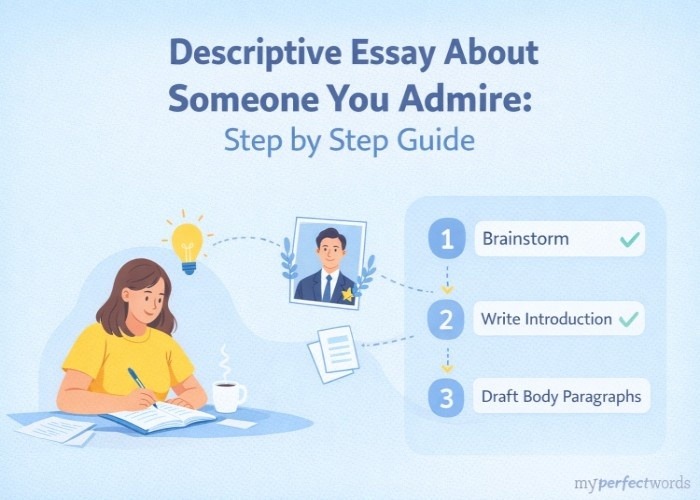
Understanding a Descriptive Essay About a Person
A descriptive essay about a person focuses on creating a vivid portrait using sensory details, specific examples, and concrete moments. When you're writing about a person, you're not just reporting facts like a biography would. You're not telling a story with a beginning, middle, and end like a narrative essay. Instead, you're zooming in on specific details, how they look, sound, move, and interact with the world, to help readers understand who this person is and why they matter to you.
The key difference is in the details you choose. While a narrative essay might tell the story of your grandfather's life, a descriptive essay captures the smell of his workshop, the way his hands shake slightly when he threads a needle, and how his voice drops to a whisper when he's teaching you something important.
This type of essay requires you to observe carefully and remember details most people overlook. It's what makes the writing feel real and personal rather than generic.
Why This Type of Essay Is Challenging (and How to Overcome It)
Here's the truth: writing about someone you deeply admire is harder than writing about a stranger or fictional character. The closer you are to the person, the more difficult it becomes.
The hardest part isn't finding something to say; it's translating your feelings into descriptions that make readers understand why this person matters.
You know your grandmother is wise, but when you try to explain it, you end up with vague statements like "She gives good advice" or "She's been through a lot." These feel flat because they're telling, not showing. Your teacher assigned a descriptive essay specifically because they want you to learn the difference.
Many students also struggle with avoiding clichés. We've all read essays that start with "My mother is the most important person in my life" or describe someone as "kind, caring, and compassionate." These phrases are overused because they're easy, but they don't capture what's unique about your person. Another challenge is choosing what to include. When you admire someone, you have dozens of reasons why. You could write about their laugh, their cooking, the time they helped you through a breakup, their work ethic, their sense of humor, and their integrity, but cramming everything in creates a messy, unfocused essay. The solution to all these challenges is the same: get specific. Instead of "She's kind," write about the morning she noticed the new kid eating lunch alone and invited him to sit with your family. Instead of "He's hardworking," describe his calloused hands and the way he falls asleep in his recliner, still wearing his work boots. |
6 Steps for Writing a Descriptive Essay About Someone You Admire
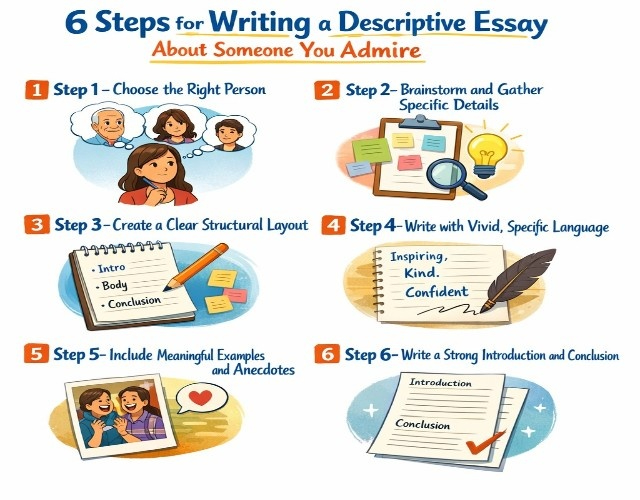
Here are some steps that will help you create an effective and engaging essay:
Step 1: Choose the Right Person
Your first decision matters more than you might think. The best person to write about isn't necessarily the one you admire most, it's the one you can describe most vividly.;
You need someone you know well or can research thoroughly. If you're writing about a parent or grandparent, you have years of memories and observations to draw from. If you're writing about a historical figure or celebrity, you'll need access to biographical information, interviews, and detailed accounts of their life.
Don't choose someone just because you feel like you "should" write about them. If your mom is wonderful but you're drawing a blank on specific details, you'll struggle. Maybe your soccer coach, whom you've known for two years, gave you more concrete moments to describe.
Consider these options:
- Parent or grandparent: Rich material, but you might be too close to see them objectively. Works best if you can focus on specific qualities or time periods.
- Teacher or mentor: Often easier to write about because the relationship has clear boundaries and memorable moments (lessons, advice, turning points).
- Friend: Can work well if you focus on what makes them different from other friends. Avoid generic "best friend" descriptions.
- Public figure: Requires research, but gives you distance and often dramatic life stories to draw from. Historical figures (Nelson Mandela, Marie Curie) work better than current celebrities because there's more substantial material available.
If you admire your grandmother but can only say "she's wise," dig deeper. What did she say when you failed your test? How did she react when your grandfather got sick? What does her house smell like? What does she do every single morning without fail? These concrete details reveal wisdom better than the word itself ever could.
The test: Can you picture at least three specific moments or details about this person right now? If yes, they're a good choice. If you're struggling, pick someone else or spend time observing and remembering before you start writing.
The test: Can you picture at least three specific moments or details about this person right now? If yes, they're a good choice. If you're struggling, pick someone else or spend time observing and remembering before you start writing.
Step 2: Brainstorm and Gather Specific Details
This is where most students skip ahead too quickly, and it shows in their writing. Before you outline or write, you need to collect raw material.
Don't write "kind", write the moment they showed kindness. Your brain stores memories in scenes, not adjectives. When you remember your teacher being inspiring, you're probably remembering a specific class, a specific conversation, or the look on their face when they explained something they loved.
Start by writing down moments, not traits:
- The time they stayed up all night to help you finish your science project
- How they reacted when you told them you didn't get into your first-choice college
- The sound of their laugh when they're really amused versus when they're being polite
- What they do when they think no one's watching
For physical details, go beyond the basics. Not "tall" but "had to duck through doorways and always stood slightly hunched, like he was trying to take up less space." Not "wrinkled hands" but "hands mapped with blue veins, knuckles swollen from arthritis, but still nimble when she threaded a needle on the first try."
Pay attention to mannerisms and habits:
- How they walk (quick steps, shuffle, confident stride)
- Speech patterns (do they pause before answering, say "you know" constantly, use big words or simple ones)
- What they do when they're nervous, happy, or focused
- Their morning routine or evening habits
Use all five senses, not just what they look like:
- Sight: Facial expressions, clothing choices, the way they move
- Sound: Voice quality, signature phrases, the music they play
- Smell: Perfume, coffee, workshop smells, clean laundry
- Touch: Handshake firmness, fabric of their favorite sweater, temperature of their hands
- Taste: Associated with them through cooking or shared meals
Step 3: Create a Clear Outline
Now that you have raw material, you need structure. A descriptive essay outline keeps you focused and prevents rambling.
The standard structure looks like this:
Introduction (1 paragraph)
- Hook: Start with a vivid moment or detail
- Definition sentence: What is this essay about?
- Brief overview: Why you admire them (1 to 2 sentences max)
- Thesis: What you'll focus on in the essay
Body Paragraphs (3 to 5 paragraphs)
- Paragraph 1: Physical description and first impressions
- Paragraph 2: Personality trait #1 with supporting example
- Paragraph 3: Personality trait #2 with supporting example
- Paragraph 4: Personality trait #3 with supporting example (or key moment that shows who they are)
- Paragraph 5: Their impact on you or others
Conclusion (1 paragraph)
- Reflection on what they've taught you or how they've changed you
- Final vivid detail that captures their essence
- Emotional resonance without getting preachy
Don't write the full essay in your outline, just jot down the key points and which examples you'll use. The outline is your roadmap, not your destination.
Step 4: Write with Vivid, Specific Language
This is where good essays become great ones. The difference between "My grandfather is wise" and writing that makes readers feel like they know your grandfather comes down to language choices.
Show, don't tell. You've heard this a thousand times, but here's what it actually means: instead of naming an emotion or trait, describe the actions, expressions, and moments that reveal it.
Use strong, specific verbs instead of weak ones with adverbs:
|
Sound: "Her voice had gravel in it from years of smoking, but softened to honey when she read bedtime stories."
Smell: "His workshop smelled like sawdust and machine oil, with an undertone of the peppermints he kept in a jar on his workbench."
Touch: "Her hugs were brief and practical, two pats on the back, but her hand would linger on your shoulder when she was proud of you."
Taste: (when appropriate) "Sunday dinners at her house meant meatloaf with too much pepper and brownies so fudgy they stuck to the roof of your mouth."
Avoid overused adjectives. These words are so common they've lost meaning:
- Nice, kind, sweet, caring
- Smart, intelligent, wise
- Beautiful, pretty, handsome
- Amazing, incredible, awesome
Replace them with specific descriptions:
| Not: "She's beautiful." Instead: "She had the kind of face that looked severe in photos but transformed when she smiled, deep dimples, eyes crinkling at the corners, the gap between her front teeth visible." |
Step 5: Include Meaningful Examples and Anecdotes
Every trait or quality you mention needs a supporting story. This is what separates descriptive essays that work from ones that fall flat.
An anecdote is a brief story, usually just a paragraph or two, that illustrates a point. It's not your life story with this person. It's one moment, one conversation, one incident that shows rather than tells.
Keep anecdotes focused. Here's the structure:
- Set up: Brief context (where, when, basic situation)
- The moment: What happened, with sensory details
- The reveal: What this showed about the person
- Connection: How this relates to why you admire them
Step 6: Write a Strong Introduction and Conclusion
Your introduction can make or break the essay. Don't start with "I admire [name] because..." That's weak and immediately tells rather than shows.
Instead, start with a moment, an image, or a detail. Remember Your introduction hooks them. Your conclusion leaves them thinking. Everything in between builds the case for why this person matters.
Struggling to craft an effective hook? Explore our descriptive essay hook examples.
Get Your Descriptive Essay Today
Professional writers deliver quality essays fast
Join 50,000+ students who trust us
Descriptive Techniques That Bring Your Person to Life
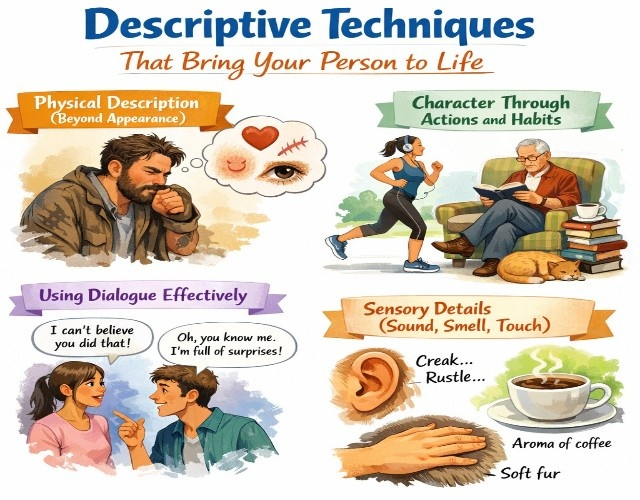
Beyond the basic structure, specific techniques make your writing more vivid and memorable. Here are four you should master:
1. Physical Description (Beyond Appearance)
Everyone knows to include height, hair color, and eye color, but those details rarely matter. What makes a person visually memorable isn't their basic features. It's the unique details and what their appearance reveals about who they are.
Instead of "He was tall with brown hair and blue eyes," focus on:
- Unique features: "A scar bisected his left eyebrow; he'd gotten it at fifteen, skateboarding down a hill someone dared him he couldn't handle. He never covered it or felt self-conscious about it; if anything, he'd run his thumb along it when he was thinking, like it helped him concentrate."
- How they carry themselves: "She walked like she was perpetually late for something important, quick, purposeful strides, shoulders back, always looking three steps ahead. Even in yoga class, trying to be zen, you could see the impatience in how she shifted her weight during long holds."
- What their appearance reveals about character: "His clothes were never quite right, shirts tucked in too tight, ties slightly crooked, one pant leg always sitting higher than the other on his shoe. But his books were immaculate. No dog-eared pages, no broken spines, no marginalia. He lavished on his books all the care he couldn't be bothered to spend on his appearance."
2. Character Through Actions and Habits
Small, repeated behaviors reveal more about someone than grand gestures. Pay attention to:
- Daily rituals: "She made her bed every single morning with hospital corners and fluffed pillows, the only thing in her chaotic apartment that was ever fully under control."
- How they interact with others: "He remembered everyone's name. Not just people he saw regularly, the barista he'd met once three months ago, the contractor who'd fixed our sink, my friend who'd stopped by for thirty seconds. He'd store names like other people stored grudges."
- Revealing habits: "When she was stressed, she'd reorganize things. Drawers, cabinets, her desk, the bookshelf, suddenly everything would be color-coded and alphabetized. We learned to read her anxiety levels by how tidy the house was."
3. Using Dialogue Effectively
Dialogue brings a person's voice onto the page. But you don't need conversations, you need the exact words that reveal who they are.
Capture their speech patterns and unique phrases:
"My grandfather never said goodbye. He'd say 'Don't do anything stupid' as you walked out the door, which was his way of saying 'I love you, be careful.'"
Use dialogue to show rather than tell character traits:
- Showing wisdom: "When I called her crying about failing my driving test for the second time, she didn't offer empty reassurance. She said, 'Okay. So you're bad at parallel parking. What are you going to do about it?' No sugar coating, no 'poor you.' Just the assumption that I'd figure it out, which somehow made me believe I would."
- Showing humor: "He'd introduce himself at parties with 'I'm Bill. I'm an accountant, which means I'm great at parties, said no one ever.' The joke was terrible, self-deprecating, and completely honest. It broke the ice every time."
4. Sensory Details (Sound, Smell, Touch)
Most students describe what people look like and forget about the other senses. But smell, sound, and touch are often what we remember most vividly.
Sound: Don't just say they have a nice voice. Describe it specifically.
"Her voice was surprisingly deep for someone so small, like warm honey over gravel. When she laughed, really laughed, it came out in these short bursts, almost like hiccups, and she'd cover her mouth like she was surprised by her own joy."
Smell: Certain people have scent associations.
"My grandmother's house smelled like Murphy Oil Soap and instant coffee, with an undertone of the lavender sachets she kept in every drawer. Even now, decades later, if I catch a whiff of Murphy's, I'm eight years old again, sitting at her kitchen table doing homework while she watches Wheel of Fortune."
Touch: Texture, temperature, the feeling of their presence.
"His handshake was firm but brief, the handshake of a man who'd been taught that a wimpy handshake revealed weak character but that holding on too long was aggressive. His hands were always warm, I noticed, even in winter, like he ran at a higher temperature than everyone else."
Descriptive Essay About a Person You Admire Examples
If you are given a task to write a paragraph about a person you admire, these examples will help you!
The Person I Admire The Most Essay (100 Words) The person I admire the most is my mother. She is a remarkable woman who has always shown unwavering love and support for our family. Her selflessness, resilience, and dedication to her role as a mother have left a lasting impression on me. She is a source of inspiration with her kind heart, strong work ethic, and the sacrifices she's made for our well-being. Her wisdom and guidance have shaped my values and principles. My mother's unconditional love and constant encouragement motivate me to be a better person every day. I am truly grateful to have her as a role model in my life. |
The Person I Admire The Most Essay (150 Words) The person I admire the most is my grandfather. His life journey and the values he embodies have left an indelible mark on me. My grandfather's wisdom, kindness, and unwavering determination have always been a source of inspiration. He lived through challenging times, yet his resilience and optimism never wavered. His stories of overcoming adversity have taught me the importance of perseverance and a positive attitude. What I admire most about my grandfather is his generosity. He's always been there to help family, friends, and even strangers in times of need. His selflessness and willingness to lend a helping hand have shown me the true meaning of compassion. My grandfather's guidance and wisdom have shaped my character and instilled in me the importance of family, hard work, and humility. I aspire to carry forward his legacy of kindness, resilience, and generosity. He is not only a role model but also a constant reminder of the values that I hold dear. My admiration for him knows no bounds, and I am grateful for the privilege of having him in my life. |
Common Mistakes in a Descriptive Essay About Someone You Admire
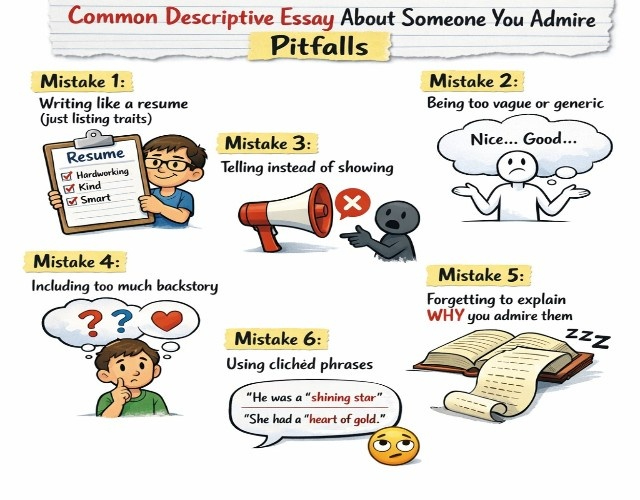
Even students who understand the techniques make predictable errors. Here's what to watch for:
Mistake 1: Writing like a resume (just listing traits)
The essay reads: "My mother is kind, hardworking, intelligent, and funny. She is also a great cook and very organized."
Why it's weak: You're just listing adjectives. There's no life in it, no proof, no personality.
| The fix: Choose 2 to 3 key qualities and give each one a full paragraph with specific examples. Quality over quantity. |
Mistake 2: Being too vague or generic
The essay reads: "My teacher changed my life and inspired me to work harder. She believed in me when no one else did."
Why it's weak: This could describe anyone. There's nothing specific to this particular teacher.
| The fix: Tell us exactly what she did or said. Quote her. Show the specific moment when something clicked for you. |
Mistake 3: Telling instead of showing
The essay reads: "He was brave and never showed fear, even in difficult situations."
Why it's weak: You're announcing the trait rather than demonstrating it.
| The fix: Describe a specific difficult situation and what he did. Let readers conclude he's brave from his actions. |
Mistake 4: Including too much backstory
The essay reads: "My grandmother was born in 1942 in a small town in Ohio. She had three siblings. She married my grandfather in 1963. They had four children. She worked as a nurse for thirty years..."
Why it's weak: This is a biography, not a descriptive essay. You're giving us a timeline, not a portrait.
| The fix: Include only the backstory that's essential to understanding who they are now. One sentence of context is usually enough. |
Mistake 5: Forgetting to explain WHY you admire them
The essay reads: Detailed descriptions of your uncle's woodworking shop, his appearance, his daily routine, but never actually says what's admirable about any of this.
Why it's weak: Description without purpose. Readers are left thinking "Okay, but so what?"
| The fix: After each descriptive section, connect it back to why this matters. "His patience with his craft taught me that anything worth doing is worth doing slowly and carefully." |
Mistake 6: Using clichéd phrases
The essay reads: "She has a heart of gold and would give you the shirt off her back. She's one in a million."
Why it's weak: These phrases are so overused that they've lost all meaning. They're lazy shortcuts.
| The fix: Show her generosity through a specific action. Let readers form their own conclusions about her character. |
Downloadable Essay Resources: Someone You Admire
Final Thought
Writing an engaging descriptive essay about someone you admire may seem challenging at first, but with the right approach, it can become an enjoyable and rewarding experience.
Remember, a strong descriptive essay doesn’t just tell, it shows. Use sensory details, precise language, and creative word choices to make your essay stand out. Take your time to plan, organize your ideas, and revise your work so that every sentence contributes to the overall impression of the person you admire.
With these tips in mind and a thoughtful approach, you’ll not only be able to craft a compelling essay but also enjoy the process of reflecting on someone who has inspired you.
Learn more about writing effective descriptive essays by visiting our in-depth descriptive essay guide.
Need Help Writing a Descriptive Essay About Someone You Admire?
Work with expert writers who bring your subject to life with vivid detail and compelling storytelling.
- Personalized essays that reflect your unique experiences and perspective
- Rich sensory details that make your writing engaging and memorable
- Clear structure with strong introduction, body, and conclusion
- 100% original, plagiarism-free content tailored to your assignment
Let professional writers help you create a descriptive essay
Order Now
-20161.jpg)



-20188.jpg)


-20358.jpg)
-20173.jpg)