



Qualities of a Strong Descriptive Essay Example
Before diving into examples, understand what to look for:
- Strong sensory details (sight, sound, smell, taste, touch)
- Show, don't tell approach
- Clear dominant impression
- Organized structure (spatial, chronological, or importance)
- Vivid, specific language instead of generic terms
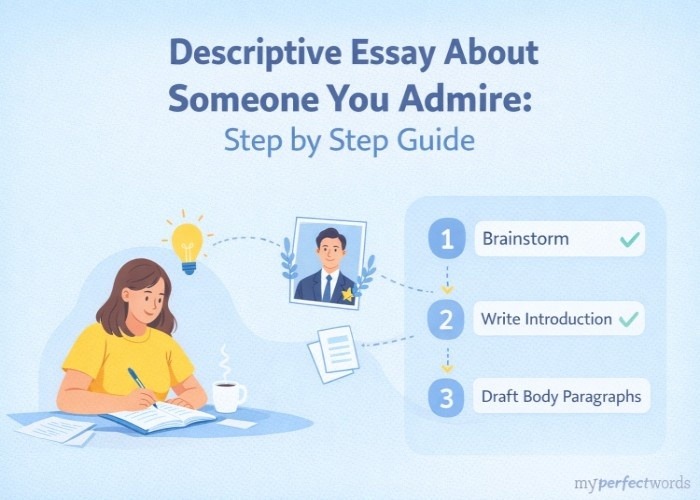
Need help writing your own? Check our complete descriptive essay guide for step by step instructions.
Descriptive Essay Example 1: Essay About a Person (Beginner Level)
Full Example Essay
My Grandfather's Hands
My grandfather's hands tell a story that words never could. They're large hands, weathered and rough, with thick calluses along the palms and deep creases that map out seventy years of hard work. When I was young, I thought his hands looked like the bark of the old trees in his backyard, brown, textured, and impossibly strong.
Those hands built our family's first house in 1975. Every morning, he'd wrap them around his coffee mug, and I'd watch the steam rise between his fingers. The mug always looked small in his grip, like a toy cup. His fingers were long and thick, the nails permanently stained from years of working with wood and engine oil. No amount of scrubbing could remove those stains, and he never tried. They were badges of honor.
I remember how gentle those same rough hands could be. When I was six and learning to tie my shoes, his massive fingers worked slowly through each loop, showing me the pattern again and again. When I fell and scraped my knee, those calloused palms pressed a Band-Aid onto my skin with surprising tenderness. At night, when he read me stories, I'd hold his hand and trace the deep lines with my small fingers, following them like roads on a map.
Now, when I visit him, his hands shake slightly when he reaches for his coffee. The skin has grown thinner, more translucent, showing the blue veins underneath. But they're still my grandfather's hands, still strong enough to pull me into a hug, still warm when they pat my shoulder, still capable of fixing anything that breaks.
Those hands built more than houses. They built a life, a family, and a legacy I'm proud to be part of.
What Makes This Example Work
This beginner-level essay succeeds because it focuses on one specific subject and explores it deeply rather than trying to describe everything about the grandfather. Notice how every paragraph adds new layers to our understanding of his hands.
The sensory details are concrete and accessible. The comparison to tree bark (visual and textual) works because it's something readers can immediately picture. The "toy cup" simile helps us understand scale. The description of tracing the lines "like roads on a map" gives us both a visual and tactile experience. The structure is chronological and spatial. We start with what the hands look like, move to what they built, then to personal memories of gentleness, and finally to the present day. This organization feels natural and easy to follow. Each paragraph has a purpose. Paragraph 1 introduces and describes. Paragraph 2 shows strength and work. Paragraph 3 shows gentleness. Paragraph 4 shows age. Paragraph 5 reflects on meaning. Why it's beginner level: The sentence structure is straightforward. The organization follows a simple pattern. The vocabulary is accessible. There's no complex symbolism or abstract meaning, just a clear, vivid description that anyone can follow and learn from. Want to write about a person? See our complete guide to descriptive essays about a person |
Descriptive Essay Example 2: Essay About a Place (Intermediate Level)
Full Example Essay
The Corner Coffee Shop at Dawn
The coffee shop doesn't officially open until six, but Maria unlocks the door at 5:30 every morning, and somehow the regulars just know. I'm one of them now.
The first thing that hits you is the smell, not just coffee, but coffee mingled with yesterday's cinnamon rolls warming in the oven and the faint vanilla of the candles Maria lights on each table. It's a smell that wraps around you like a favorite sweater, comfortable and familiar. The espresso machine hisses and gurgles in the background, a steady rhythm that sounds almost like breathing.
In the dim pre-dawn light, the shop feels smaller than it does during the lunch rush. The exposed brick walls glow amber from the Edison bulbs hanging on long cords from the ceiling. Each bulb casts a small pool of warm light onto the mismatched wooden tables below. Maria chose every table at estate sales, she told me once, because she wanted each one to have its own story. The one by the window has deep scratches that look like someone carved initials, then thought better of it and stopped.
Six round tables fill the main room, each with two or three chairs that don't match the table or each other. The chairs are a collection of rescued furniture, a velvet armchair with a faded floral pattern, wooden chairs with spindle backs, metal café chairs painted turquoise. Nothing matches, but somehow everything belongs.
The back wall is covered in a massive chalkboard where Maria writes the daily specials in her looping cursive. Below the menu, customers have added their own messages, thank you notes, doodles, a few phone numbers, and one marriage proposal. She erases it every few months, but by the end of the week, it's covered again.
By 6:15, the regulars have claimed their usual spots. The lawyer in the corner works through his case files, his americano going cold in its ceramic mug. The graduate student near the window has three textbooks open, her hands wrapped around a latte, fingerless gloves keeping her hands warm. The older couple by the door shares a scone and reads the newspaper together, one section each, occasionally reaching across to touch hands.
I sit at my table, the one with the carved initials, and watch the sky lighten through the front window. The coffee shop's reflection appears in the glass, and for a moment, the warm amber light inside competes with the cool blue dawn outside. Then the sun breaks over the buildings across the street, and another day officially begins.
But in here, time moves differently. In here, it's still 5:30 in the morning, and the world hasn't quite woken up yet.
Analysis: Techniques Used
This intermediate level essay demonstrates several advanced techniques while maintaining clarity.
Spatial organization creates a journey. We enter the coffee shop and experience it in the order you'd naturally notice things: smell first, then the dim lighting, then the tables and chairs, then the back wall, then the people. This mirrors how you'd actually experience entering a new space. Figurative language adds depth. The smell "wraps around you like a favorite sweater", This simile conveys both physical sensation and emotional comfort. The espresso machine "sounds almost like breathing", this personification makes the shop feel alive. Sensory details work together. Notice how smell (coffee, cinnamon, vanilla), sound (hissing, gurgling), sight (amber light, Edison bulbs), and touch (warm coffee cups, fingerless gloves) combine to create a complete experience. The writing shows mood through the environment. Every detail contributes to the feeling of early morning sanctuary, the dim light, the mismatched furniture, the messages on the chalkboard, the regulars in their routines. You're not told it's peaceful; you're shown evidence of peace. Why it's intermediate level: The sentence structure varies more than the beginner example. There's more sophisticated vocabulary ("looping cursive," "competes with the cool blue dawn"). The organization is spatial rather than chronological. Figurative language appears naturally throughout. The ending reflects the theme rather than just describing. Writing about a place? Check out descriptive essays about a place |
Get Your Descriptive Essay Today
Professional writers deliver quality essays in as fast as 6 hours.
Join 50,000+ students who trust MyPerfectWords.
Descriptive Essay Example 3: Essay About an Object (Advanced Level)
Full Example Essay
My Father's Pocket Watch
The pocket watch sits on my desk, suspended in the amber afternoon light that filters through my office window. It's a Waltham, circa 1920, with a hunter case that snaps closed with a satisfying click, the kind of sound that says "quality" and "permanence" in a world of disposable things.
The case itself is sterling silver, tarnished now to a soft gray that seems appropriate for its age. Someone, my great-grandfather, I assume, had his initials engraved on the front: J.T.M. The letters have worn smooth from a century of thumbs running across them, a nervous habit passed down through generations. I catch myself doing it now, tracing those same three letters, connecting to men I never met through this small ritual.
When you open the case, the watch face greets you like a old friend who's seen too much but never complains. Roman numerals mark the hours in black enamel against the white porcelain face. The hour and minute hands are blued steel, the color of deep water, moving in their eternal circular path. They stopped moving in 1987, the year my father died, frozen at 3:47, whether AM or PM, no one remembers anymore. I've never tried to wind it again.
Turn the watch over, and you'll see the real story. The back case opens to reveal the movement inside, a universe of tiny gears and wheels, each one precisely cut, fitted, and placed by hands that understood patience. Seventeen jewels sit in their brass settings, catching the light like small proud eyes. The plates are decorated with engine-turned patterns called "damaskeening," delicate swirls that serve no functional purpose except to prove that the watchmaker cared about beauty as much as accuracy.
My father carried this watch every day for forty-three years. He'd pull it from his vest pocket at exactly 7:55 every morning, check it against the kitchen clock, nod with satisfaction, and return it to his pocket. That ten-minute buffer before his 8:00 AM shift at the factory was sacred time, time to finish his coffee, kiss my mother goodbye, and step out the door prepared for whatever the day held.
The watch has a weight to it that modern watches don't carry. It's not just the three ounces of silver and brass and glass, it's the weight of continuity, of tradition, of the deliberate choice to carry time itself in your pocket. My father used to say that a man who carries a pocket watch is never late because he's always aware of time passing. He'd tap his vest pocket where the watch lived, and I'd hear that faint metallic tick-tick-tick, steady as a heartbeat.
Now it sits here, silent and still. But I keep it close. Sometimes, when I'm stressed or uncertain, I pick it up and hold its weight in my palm. I trace my great-grandfather's initials. I open the case and stare at that frozen time, 3:47, and I remember that we're all just temporary caretakers of what matters. This watch survived two world wars, the Depression, and seventy years of daily wear. It'll outlive me, too, passed on to whoever's next in line to carry its weight.
The afternoon light shifts, and the watch face catches it, gleaming briefly before returning to its quiet amber glow. Time moves on, even when watches stop. Especially when watches stop.
Advanced Techniques Breakdown
This advanced essay operates on multiple levels simultaneously: literal description, symbolic meaning, and emotional resonance.
Layered symbolism appears throughout. The stopped watch represents not just a broken mechanism but frozen time, death, memory, and the weight of inheritance. The initials worn smooth show how personal objects connect generations. The watch's weight isn't just physical, it's metaphorical. Sophisticated sentence structures create rhythm. Notice the varied sentence lengths: short sentences for impact ("They stopped moving in 1987."), longer sentences for complexity, and fragments for emphasis ("Especially when watches stop."). This variation creates a reading experience that feels crafted, not accidental. Technical vocabulary serves a purpose. Terms like "hunter case," "blued steel," "damaskeening," and "seventeen jewels" aren't showing off, they're demonstrating the precision and craftsmanship that mirrors the essay's own careful construction. The watch is precise; the writing about the watch should be too. Time operates as both subject and structure. We move through time, from the present moment, to the watch's creation in 1920, to the father's daily ritual, to his death in 1987, and back to the present. This temporal movement reinforces the theme of time's passage. The ending adds philosophical weight. The final line doesn't just conclude; it reflects on meaning. "Time moves on, even when watches stop. Especially when watches stop." This paradox invites the reader to think beyond the literal description. Why it's advanced level: Multiple layers of meaning coexist. Symbolism is woven throughout rather than stated directly. Technical knowledge is assumed and integrated naturally. The structure itself reinforces the theme. Sentences vary in length and complexity deliberately. The voice is more formal and literary while remaining accessible. |
Descriptive Essay Example 4: Essay About Food
Full Example Essay
Grandmother's Bread
Every Sunday morning, my grandmother wakes at 5 AM to make bread. Not because she has to, you can buy bread anywhere, but because, as she says, "Some things are worth doing right."
The process starts with the smell of yeast blooming in warm water, a scent that's almost alive, earthy, and faintly sweet. She adds flour slowly, measuring by feel rather than cups, her hands working the dough until it transforms from shaggy and rough to smooth and elastic. The kitchen fills with the rhythmic thump-thump-thump of kneading, a sound I've woken to every Sunday for as long as I can remember.
By 7 AM, the dough has risen, doubled in size, she tells me, though I think it looks more like magic than chemistry. She punches it down (her term, not mine), shapes it into four loaves, and slides them into the oven. Then we wait.
The smell of baking bread is impossible to describe accurately, but I'll try. It starts subtle, just a hint of warmth in the air. Then it grows, spreading through the kitchen, down the hallway, up the stairs, seeping into every room. It's yeasty and toasted, with notes of butter (she brushes the tops before baking) and a sweetness that comes from the dough itself, not from any added sugar. If comfort had a smell, this would be it.
At 8 AM, she pulls the loaves from the oven. The crusts are deep golden-brown, almost mahogany in the darker spots, and they crackle as they cool, tiny pops and snaps as the surface contracts. She makes me wait fifteen minutes ("Otherwise you'll just squish it," she warns), but those are the longest fifteen minutes of the week.
Finally, she cuts the first slice. The knife crunches through the crust and sinks into the soft interior. The bread's still steaming, releasing little wisps of vapor that carry that incredible smell directly to your face. The inside is creamy white with an irregular pattern of small air pockets, the mark of properly developed gluten, she says, though I just think it looks beautiful.
I spread butter on the still-warm slice. It melts immediately, pooling in the little holes, turning them glossy and golden. The first bite is everything: the crackle of the crust giving way to the tender interior, the rich butter coating your mouth, the subtle tang of the sourdough starter she's kept alive for twenty years. It's warm and substantial, with a chew that makes you slow down and pay attention.
My grandmother watches me eat, a small smile on her face. "Better than the store, yes?" she asks, though we both know the answer. This isn't about better or worse. This is about Sunday mornings, and tradition, and the way love sometimes looks like four loaves of fresh bread cooling on the counter.
Key Sensory Details
This essay demonstrates how food writing demands attention to all five senses, and how taste comes last because it's the culmination of everything else.
Smell dominates the description. Food writing lives or dies on smell descriptions, and this essay develops them gradually: the "earthy and faintly sweet" yeast water, the growing smell of baking bread ("subtle... then it grows"), and finally the steam rising from the first slice. Notice how the smell moves through space ("spreading through the kitchen, down the hallway, up the stairs"). Sound adds texture. The "thump-thump-thump" of kneading, the "crackle" of cooling crust, the "crunch" of the knife cutting through, these sounds tell you about the bread's texture before you even touch it. Visual details build anticipation. The dough's transformation from "shaggy and rough to smooth and elastic," the "deep golden-brown, almost mahogany" crust, the "creamy white" interior with "irregular air pockets," the butter turning them "glossy and golden", each visual cue increases your desire to taste it. Touch and texture create experience. The "elastic" dough, the crust that "crunches" under the knife, the butter that "melts immediately," the bread's "chew", these tactile descriptions let readers experience the bread through their own sense memory. Taste comes last, and deserves it. After all that build-up, the actual taste description can be relatively brief: "the crackle of the crust giving way to the tender interior, the rich butter coating your mouth, the subtle tang of the sourdough." The taste pays off all the anticipation. Love food descriptions? Read descriptive essays about food. |
Descriptive Essay Example 5: Essay About Nature
Full Example Essay
October in the Woods
The forest in October is a completely different place than the forest in July. It's quieter, for one thing. The birds have mostly left, the insects are dying or dormant, and your footsteps on the trail suddenly seem loud in the absence of summer's constant buzz and chirp.
I'm walking on a narrow path that winds through mixed hardwoods, oak, maple, beech, and birch. A month ago, this canopy was solid green. Now it's fire. The maples burn red and orange, the oaks hold onto their deep burgundy, and the birches have turned the color of butter, their white bark gleaming against the darker colors around them. Leaves fall constantly, a gentle rain of color that rustles and whispers as it comes down.
The air smells different in autumn. There's the sweet rot of fallen leaves starting to decompose, a smell that's earthy and rich, like good soil. There's the sharper scent of pine sap. And underneath it all, there's a clean, cold edge, the smell of weather changing, of winter waiting just beyond these bright October days.
I stop walking and just stand for a minute. A single red leaf spirals down in front of me, caught by a light breeze, turning as it falls. It lands on the path with dozens of others, and the path itself has become a mosaic of yellows and reds and oranges, still bright but already curling at the edges.
The light in October is different, too. It's lower now, slanting through the trees at angles that don't exist in summer. Where the sun breaks through the canopy, it illuminates the falling leaves from behind, turning them translucent, glowing like stained glass. The shadows are longer, deeper, pooling in the hollows and behind the larger trees.
I hear a branch crack somewhere to my right, probably a deer, moving carefully through the understory. The sound carries farther than it would have in summer when the leaves were thick and full of moisture, absorbing sound. Now everything is drier, crisper, louder. My jacket rustles. A squirrel scolds from overhead. Even my breathing seems amplified.
The temperature's dropping as the sun gets lower. I can feel it on my face, that October chill that starts polite and gets serious after dark. My hands are cold in my pockets, but I don't mind. This is the best time to be in the woods, between the heat of summer and the deep freeze of winter, when everything is changing and you can see the change happen in real time.
I turn back toward the trailhead, my boots crunching through the leaf cover. Tomorrow, there will be more leaves on the ground. Next week, the maples will be bare. By Thanksgiving, the forest will look entirely different, gray and brown and waiting. But right now, in this exact moment, it's October, and the woods are on fire with color, and I'm here to see it.
Nature Specific Techniques
Nature writing presents unique challenges. How do you describe something so familiar that readers might think they already know what you're going to say?
Contrast creates interest. This essay constantly compares October to other seasons: "quieter" than July, "different" air smell, "lower" light, "between the heat of summer and the deep freeze of winter." These comparisons help readers see October specifically, not just "autumn in general." Seasonal specificity matters. The essay doesn't just say "fall", it says October. It doesn't just say "leaves are changing", it details which trees turn which colors and in what order. Specificity makes nature writing credible. Movement through time adds dimension. The essay acknowledges what was ("A month ago"), what is ("right now"), and what will be ("Tomorrow... Next week... By Thanksgiving"). This temporal awareness mirrors how we actually experience nature, as constantly changing. Weather integrates with description. Temperature, light quality, and sound carry differently in dry air; these aren't separate observations but interconnected details that create the complete October experience. The narrator is present and active. "I'm walking... I stop... I hear... I can feel it... I turn back..." This isn't just observation from outside; it's immersion. The reader walks with you. Explore more nature writing in descriptive essays about nature |
Short Descriptive Essay Example
Topic: The School Library After Hours
Length: 364 words
Grade Level: 9 to 10
Type: Place Description
The School Library After Hours
Most students never see the library like this, empty, quiet, and somehow alive in a way the crowded daytime version never is.
The silence hits first. Not the forced quiet of a study hall, but genuine stillness that makes every small sound amplified. The ancient heating system ticks and groans in the walls. Outside, wind rattles the tall windows, and bare tree branches scratch against the glass like fingers seeking entry. My footsteps on the worn carpet whisper secrets to the empty aisles.
Late afternoon light slants through the western windows, cutting the room into bands of gold and shadow. Dust particles float lazily through these beams, thousands of tiny galaxies drifting in slow motion. The light catches the edges of book spines, making them glow, crimson, emerald, sapphire. Shadows pool in the corners and between the stacks, dark and velvet-thick.
The smell is intoxicating. Old paper and leather bindings mix with lemon furniture polish and the faint mustiness of books that haven't been opened in decades. I breathe it in deeply, this perfume of knowledge and time. The books themselves seem to exhale stories, adventure, mystery, romance, waiting to be discovered.
I run my fingers along a shelf as I walk, feeling the varied textures. Smooth dust jackets give way to cloth bound covers, then leather, then paperback spines soft and bent from countless readings. Some books stick out slightly, creating a landscape of peaks and valleys. The wood shelf is cool and solid beneath my palm.
At the far end, near the biography section, sits my favorite chair, a green wingback with a reading lamp beside it. The leather is cracked and soft from years of students curling into its embrace. I sink into it, and it exhales a sigh that smells of old coffee and pencil shavings. The lamp casts a warm circle of light in the gathering dusk.
This is my secret place, my sanctuary between the final bell and the janitor's evening rounds. Here, surrounded by a million silent voices, I've never felt less alone.
What Makes This Short Example Effective
|
Descriptive Essay Examples by Grade Level
Middle School Descriptive Essay Examples (Grades 6 to 8)
Characteristics:
|
High School Descriptive Essay Examples (Grades 9 to 12)
Characteristics:
|
College & University Descriptive Essay Examples
Characteristics:
|
Before and After: Improving a Descriptive Essay
Let's take a weak descriptive essay and improve it. You'll see exactly what changes and why.
Before Version (Weak Example)
The Beach
The beach is a nice place to visit. The sand is soft and warm. The ocean is blue and makes waves. There are seagulls flying around making noise. The sun is bright and hot. People are swimming and playing in the water. There are umbrellas set up for shade. The beach smells like salt water. It's a relaxing place where you can have fun.
After Version (Improved)
The Beach at Noon
I drop my bag at the edge of the tide line, where wet sand meets dry, and the temperature under my feet jumps from cool to burning in a single step. The sand up here is white-hot, fine as powder, and it gets between my toes immediately.
The ocean stretches out in layers of color, pale turquoise where it's shallow, deepening to navy further out where the continental shelf drops away. Waves roll in with a rhythm you can feel in your chest, building, curling, and crashing in a line of white foam that races up the beach before pulling back with a hiss. Again. And again. And again.
Overhead, gulls wheel and cry, their calls sharp and insistent. They're watching the family to my left, waiting for dropped chips, leftover sandwich crusts, any opportunity. One brave gull lands three feet away, cocks its head, and eyes my lunch bag.
The sun at noon is unforgiving. My shoulders are already starting to feel tight, that first hint of sunburn. I pop open the beach umbrella, and the instant shade is ten degrees cooler. The fabric snaps in the wind that comes constantly off the water, carrying the smell of salt and seaweed and sunscreen.
I can hear everything: kids shrieking as waves hit them, someone's bluetooth speaker playing music I don't recognize, the rustle of someone shaking sand from a towel. But underneath all of it, constant and rhythmic, the ocean keeps its percussion, crash, hiss, pause, repeat.
What Changed and Why
Vague became specific. "The sand is soft and warm" became "white-hot, fine as powder, and it gets between my toes immediately." One tells you facts; the other creates an experience. Generic observations became sensory details. "The ocean is blue" expanded into "pale turquoise where it's shallow, deepening to navy further out where the continental shelf drops away." This shows observation, not just casual glancing. Telling became showing. Instead of "It's a relaxing place," the improved version shows details that let readers decide if it seems relaxing: the rhythm of waves, the constant wind, and the shade of the umbrella. One general scene became a specific moment. "The Beach" could be any beach, any time. "The Beach at Noon" is a particular experience with particular conditions: the sun at its hottest, the family with chips, the brave gull, the already-tight shoulders. Passive observation became active experience. The weak version watches from outside: "There are seagulls." The improved version participates: "One brave gull lands three feet away, cocks its head, and eyes my lunch bag." The narrator is in the scene, not reporting on it. Sound layered throughout. Instead of "seagulls flying around making noise," we get specific sounds: "gulls wheel and cry, their calls sharp and insistent" plus kids shrieking, music playing, towels shaking, and underneath it all, the ocean's rhythm. These aren't minor tweaks; this is a fundamental transformation. The previous version could describe any beach anywhere. The latter version could only describe this particular beach at this particular moment, which is exactly what descriptive writing should do. |
Common Mistakes in Descriptive Essay Examples
Here are the mistakes I see most often, with examples of each and how to fix them.
1. Using Too Many Adjectives
Wrong: "The beautiful, magnificent, gorgeous, stunning, incredible sunset painted the sky with amazing, wonderful colors."
Why it fails: When you use five adjectives where one would work, none of them land with impact. Readers skim over adjective pileups without really processing them.
Right: "The sunset turned the sky orange, then pink, then deep purple, each color lasting just minutes before fading to the next."
| The fix: Choose one strong, specific detail over multiple generic compliments. Show the colors changing instead of telling us it was "beautiful." |
2. Vague Language
Wrong: "The old house was scary and gave me a weird feeling."
Why it fails: "Scary" and "weird" don't create images. They're conclusions, not descriptions. Ten readers will imagine ten different things.
Right: "The house's front porch sagged in the middle, and every window on the second floor was dark except one, where a yellowed curtain moved slightly, though there was no breeze."
| The fix: Describe what you see, hear, smell, touch, or taste. Let readers reach their own conclusions about "scary" based on the evidence you provide. |
3. Telling Instead of Showing
Wrong: "My grandmother was a kind person who loved to cook."
Why it fails: This is a character summary, not a description. It tells us facts but doesn't let us experience her kindness or her love of cooking.
Right: "My grandmother kept a jar of cookies on the counter that never emptied. Whenever we visited, she'd refill it before we arrived, and she'd watch with a small smile as we reached for seconds, then thirds, never saying a word about spoiling our dinner."
| The fix: Give us a scene that demonstrates the quality you're describing. Let readers see her kindness in action rather than taking your word for it. |
4. Lack of Organization
Wrong: "The park has trees. There's also a pond. I heard birds. The grass was green. A dog ran past. There were benches. The sky was blue."
Why it fails: Random observations don't create a coherent picture. Readers can't construct a mental image when details arrive in chaotic order.
Right: "I enter the park through the main gate, where two oak trees frame the path. The path curves left around a small pond, ducks paddling near the far edge, before opening into a wide lawn dotted with benches. Overhead, sparrows chatter in the trees, and somewhere in the distance, a dog barks."
| The fix: Organize spatially (follow a path through the space) or by importance (start with the most striking feature). Give readers a way to follow your description logically. |
5. No Dominant Impression
Wrong: An essay that describes a carnival as both "joyful and exciting" and "sad and depressing" without reconciling these contradictions or explaining why both exist.
Why it fails: Descriptive essays need a unifying idea, a dominant impression that ties details together. Random observations, even vivid ones, don't add up to anything meaningful.
Right: Choose one dominant impression and make every detail support it. If the carnival is "joyful," every description should contribute to that feeling. If it's "melancholy beneath the surface," show us both the bright lights and the tired workers, the children's laughter and the peeling paint, details that work together to create that complex but unified impression.
| The fix: Decide what feeling or idea you want to convey, then ruthlessly cut any details that don't serve that purpose. Every observation should earn its place by contributing to the whole. |
Getting the Most from These Examples
The examples above aren't just for reading, they're study tools. Pick one that matches your assignment level. Notice how it organizes information, how it uses sensory details, and how each paragraph builds on the previous one. Then try describing your own subject using similar techniques.
Ready to Write Your Descriptive Essay?
You've seen what works in successful descriptive essays. Now it's time to create your own. For complete guidance on the writing process, from brainstorming sensory details to final edits, check out our descriptive essay guide.
If you need professional help with your descriptive essay, whether it's writing from scratch, improving a draft, or just getting unstuck, our expert writers are here to help.
Learn From Expert Descriptive Essay Examples
Use proven examples to improve your writing and create vivid, engaging essays
- Study high quality descriptive essay samples written by professionals
- Understand how to use sensory details and strong imagery effectively
- Learn proper structure, tone, and organization
- Apply proven techniques to improve your own essays
Our essay writing service provides expert examples and support to help you write descriptive essays with confidence.
Order Now
-20161.jpg)




-20188.jpg)




-20358.jpg)
-20173.jpg)