MyPerfectWords - Essay Writing Service
  • Writers
  • Services

      Essays

    • College Essay
    • Argumentative Essay
    • Expository Essay
    • Narrative Essay
    • Descriptive Essay
    • Scholarship Essay
    • Admission Essay
    • Reflective Essay
    • Nursing Essay
    • Law Essay
    • Economics Essay
    • … and more!

      Assignments

    • Term Papers
    • Reports
    • Coursework
    • Speeches
    • Research Papers
    • Case Studies
    • Dissertation
    • Presentation
    • Write My Assignment

      Other

    • Editing Help
    • Buy Essays
    • Cheap Essay Writing
  • About Us
  • Pricing
  • Samples
  • Blog
Place an Order
  • Login
  • Signup
MyPerfectWords - Essay Writing Service
MPW Logo
  • Writers IconWriters
  • Services IconServices

      Essays

    • College Essay
    • Argumentative Essay
    • Expository Essay
    • Narrative Essay
    • Descriptive Essay
    • Scholarship Essay
    • Admission Essay
    • Reflective Essay
    • Nursing Essay
    • Law Essay
    • Economics Essay
    • … and more!

      Assignments

    • Term Papers
    • Reports
    • Coursework
    • Speeches
    • Research Papers
    • Case Studies
    • Dissertation
    • Presentation
    • Write My Assignment
    • Other

    • Editing Help
    • Buy Essays
    • Cheap Essay Writing
  • About Us IconAbout Us
  • Pricing IconPricing
  • Blog IconBlog
  • Account IconAccount
    • Login
    • Sign Up
Place an Order
Email Iconinfo@myperfectwords.comPhone Icon(+1) 888 687 4420

Home

>

Blog

>

Descriptive Essay

>

Descriptive Essay About Nature

Descriptive Essay About Nature - Complete Guide

CS

Written ByCaleb S.

Reviewed By David L.

14 min read

Published: Dec 10, 2025

Last Updated: Dec 11, 2025

Descriptive Essay About Nature

Writing descriptive essays about nature requires observing natural environments through all five senses and translating those observations into vivid prose. Choose specific natural subjects—a forest at dawn, a mountain stream, a desert landscape—rather than generic "nature" descriptions.

Use precise sensory details like "pine needles carpeting the forest floor" instead of "trees everywhere." Organize spatially (near to far, ground to sky) or temporally (sunrise to sunset). The goal isn't poetic abstraction but concrete observation that lets readers experience the natural setting as if they were present.

Nature descriptions work best when you focus on specific locations at particular times rather than attempting comprehensive nature overviews. A two-hour observation period at one location yields richer details than surface descriptions of multiple places. It also helps while writing a descriptive essay about a place. 

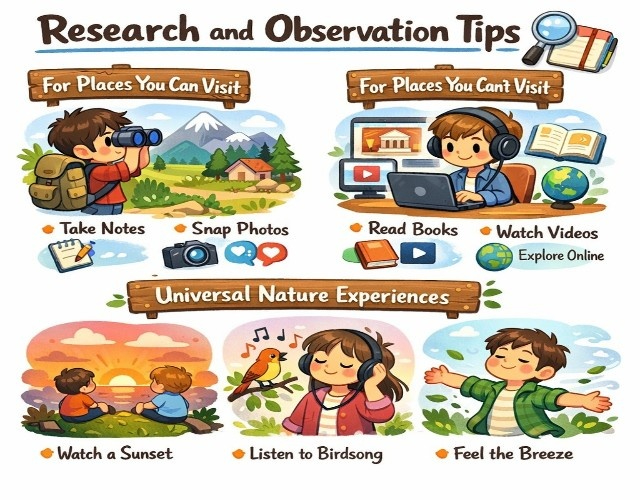
Take notes during actual outdoor experiences rather than relying on memory or imagination. Weather conditions, seasonal changes, time of day, and wildlife activity all create distinctive atmospheres worth capturing. Your dominant impression—whether peaceful, threatening, vibrant, or desolate—should guide which sensory details you emphasize throughout the essay.

CAN'T ENGAGE ALL FIVE SENSES?

Get Essays Rich With Sensory Language and Imagery

Order My Descriptive Essay Now

Master writers create immersive experiences through detailed descriptions.

Why Nature Makes Powerful Descriptive Subjects

Nature writing connects readers to environments they've experienced or dream of exploring. Unlike indoor scenes, where human design dictates most elements, natural settings present infinite sensory variety. The same mountain meadow transforms completely between dawn and dusk, winter and summer, calm weather and storms.

Natural subjects engage all five senses simultaneously. Wind creates sound and touch sensations. Plants offer visual beauty and distinctive scents. Water provides sound, visual movement, and temperature sensations. This sensory richness makes nature ideal for practicing descriptive writing techniques.

Nature descriptions teach observation skills that transfer to other descriptive subjects. Learning to distinguish between oak and maple leaves, identify bird calls, or describe cloud formations sharpens your ability to notice and articulate subtle differences anywhere. These observation skills make all your future descriptive essays more vivid and precise.

Check out this video about descriptive essays:


Continue reading to find some helpful tips and tricks for writing a descriptive nature essay, but if you are having a deadline issue, then take help from a descriptive essay writing service. 

Selecting Your Natural Subject

Specific Locations Over Generic Nature

Don't write about "nature" or "the forest" generally. Choose "the oak grove behind Miller's Farm, where morning fog lingers until noon" or "the tidal pools at Baker Beach during low tide." Specificity enables authentic observation and distinctive details.

General nature descriptions produce generic essays because forests, beaches, and mountains share many similar characteristics. Specific locations have unique features—unusual rock formations, distinctive plant species, characteristic sounds—that make your description memorable. These unique details separate strong nature descriptions from weak ones.

Choose Observable Times and Conditions

Write about nature you've actually experienced rather than imagined or researched. If you haven't witnessed a forest at dawn, don't write about it based on assumptions. Choose subjects accessible for extended observation periods—two hours minimum provides enough time for thorough sensory note-taking.

Consider seasonal variations when selecting subjects. Spring meadows explode with wildflowers and insect activity. Winter forests reveal structural elements hidden by summer foliage. Fall landscapes showcase color transformations. Each season presents different descriptive opportunities for the same location.

Weather conditions dramatically affect natural settings. Rain transforms forest atmospheres. Wind activates sounds across landscapes. Fog creates mysterious visual effects. Clear skies enable distant visibility. Choose specific weather conditions rather than assuming "nice weather" for your description.

Expert Tip

You may also check out other descriptive essay topics if you are still deciding what to write about.

Essential Nature Description Techniques

The Five Senses Framework for Nature

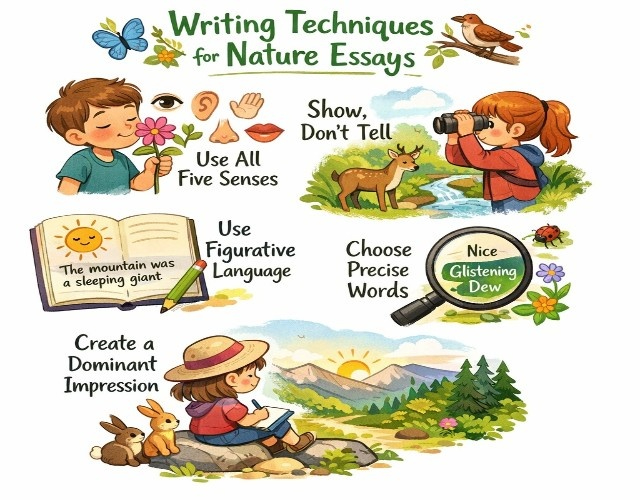
  1. Sight dominates most nature descriptions, but shouldn't monopolize your essay. Describe colors precisely—not "green trees" but "emerald moss coating gray bark" or "chartreuse lichen spreading across sandstone."
    Note light quality: harsh midday sun versus soft dawn light creates completely different visual atmospheres.
  2. Sound defines natural atmospheres powerfully. Forests have characteristic soundscapes—wind through pine needles sounds different from wind through aspen leaves. Water sounds vary by volume and surface: babbling brooks, crashing waves, gentle rain, thundering waterfalls. Bird calls, insect hums, and animal movements all contribute to acoustic environments.
  3. Smell connects strongly to memory and emotion. Forests smell like damp earth, pine resin, or decaying leaves, depending on conditions. Oceans smell of salt and seaweed. Deserts smell of hot sand and sage. Rain approaching changes the air scents noticeably. Don't neglect olfactory details—they make nature descriptions feel authentic.
  4. Touch describes temperature, humidity, and texture. Sun warmth on skin, cool shade beneath trees, humidity hanging heavy in summer air, or crisp autumn breezes all create tactile sensations. Bark texture, grass softness, rock smoothness, or water temperature add physical dimension to descriptions.
  5. Taste applies less frequently to nature descriptions, but shouldn't be ignored when relevant. Salt spray from ocean waves, dust on hot desert winds, or fresh spring water from mountain streams provide taste experiences. Don't force taste descriptions where they don't naturally occur, but include them when authentic to your experience.

Spatial Organization for Landscapes

Nature descriptions work well with spatial organization patterns that guide readers systematically through environments. Start with overview impressions—what strikes you first approaching this location—then move methodically through space.

1. Ground-to-sky organization works effectively for forests, meadows, and most terrestrial environments. Begin with ground cover, proceed to mid-level vegetation or features, and finish with canopy or sky elements. This pattern mirrors how humans naturally observe new environments.

2. Near-to-far organization suits open landscapes where distance creates layers—beaches, prairies, mountain valleys. Describe foreground details first, move to middle distance features, and conclude with distant elements. This creates depth perception in prose.

3. Circumferential organization—describing what you see turning slowly in a circle—works for locations where you're positioned centrally. This pattern suits mountain summits, forest clearings, or lakeshores where you describe surrounding features systematically.

Choose spatial organization patterns that match your natural subject rather than forcing one pattern everywhere. The landscape itself suggests how to guide readers through space most effectively.

The descriptive essay outline should include your main points. This will help you keep your thoughts organized, and it'll also make the writing process much smoother.

CAN'T ENGAGE ALL FIVE SENSES?

Get Essays Rich With Sensory Language and Imagery

Order My Descriptive Essay Now

Master writers create immersive experiences through detailed descriptions.

Describing Different Natural Environments

1. Forest and Woodland Descriptions

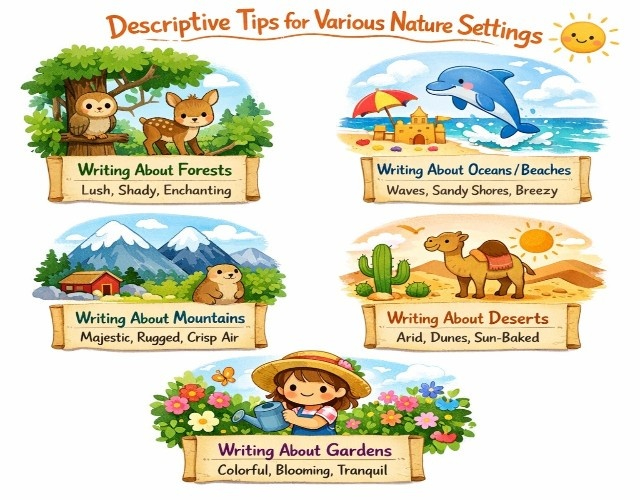
Forests present layered environments requiring vertical awareness. Ground layer includes soil, rocks, fallen logs, fungi, and low vegetation. Understory layer features saplings, shrubs, and shade-tolerant plants. Canopy layer creates overhead architecture with mature tree crowns and upper foliage.

Light behaves distinctively in forests—dappled, filtered, or completely blocked depending on canopy density. Describe how sunlight reaches the forest floor: "Shafts of morning light pierce the canopy, illuminating dust motes suspended in air thick with pine scent."

Forest sounds create acoustic environments unlike open spaces. Wind moves through different tree types distinctively. Bird calls echo differently in dense woods versus open groves. Creaking branches, rustling undergrowth, and distant woodpecker drumming all contribute to forest soundscapes.

2. Water Features: Rivers, Lakes, Oceans

Water descriptions require attention to movement, light reflection, and sound characteristics. Still water mirrors the surroundings and sky, creating reflective surfaces that change with the viewer's position. Moving water creates sound and visual patterns—wavelets, currents, ripples, or surging surf.

Rivers and streams vary dramatically. Mountain streams tumble over rocks, creating white water and constant rushing sounds. Lowland rivers move sluggishly, meandering through flat terrain with gentle currents. Describe specific water behavior rather than generic "flowing water."

Ocean descriptions need awareness of tidal rhythms, wave patterns, and the horizon's vastness. Surf sounds differ by beach composition—waves crashing on rocky shores versus washing across sandy beaches. Salt spray, seabird cries, and ocean scent all characterize coastal environments distinctively.

Lakes present calmer water features than oceans, but still vary by conditions. Morning mist rising from cool lake surfaces, afternoon boat wakes spreading ripples, or evening glass-smooth water reflecting sunset colors—each time creates different descriptive opportunities.

3. Mountain and Hill Landscapes

Elevation creates unique descriptive challenges and opportunities. Higher elevations feature thinner air, stronger winds, colder temperatures, and distinctive plant life. Treelines mark elevation zones where forests can no longer survive—describe these transition zones carefully.

Mountain vistas enable long-distance descriptions rare in other environments. Describe layered ridges fading to blue-gray distances, valleys far below, or weather patterns moving across ranges. These distant views require different descriptive language than close observation.

Rock formations dominate mountain landscapes. Describe specific rock types, weathering patterns, lichen coverage, and geological features. Cliffs, boulders, talus slopes, and exposed bedrock all create characteristic mountain scenery requiring precise geological vocabulary.

Mountain weather changes rapidly. Clouds forming below you, sudden temperature drops, or afternoon thunderstorms building over peaks all create dramatic atmospheric conditions worth detailed description.

4. Meadows and Grasslands

Open landscapes present different challenges than enclosed environments. Meadows reveal themselves all at once rather than gradually through exploration. Describe these spaces by identifying distinctive features—wildflower patches, scattered trees, rock outcrops, or water features—that create landmarks in otherwise uniform openness.

Grassland descriptions need awareness of plant height, density, and species diversity. Prairie grasses sway differently from cultivated pastures. Alpine meadows feature low vegetation adapted to harsh conditions. Describe specific plants rather than "grass everywhere."

Wind visibility defines grassland descriptions. Wind moving across open spaces creates visible patterns—waves flowing through tall grass, ripples spreading across wheat fields. These movements add dynamism to otherwise static landscapes.

Light behaves differently in open spaces. Without shade, harsh midday sun flattens colors and creates glare. Dawn and dusk light transform meadows dramatically as low-angle sunlight enriches colors and creates long shadows.

5. Desert Environments

Desert descriptions challenge writers to find richness in apparent emptiness. Deserts aren't actually empty—they contain distinctive plants, animals, and geological features requiring close observation to discover.

Temperature extremes define desert experiences. Scorching daytime heat radiating from sand and rock, versus surprisingly cold night temperatures, create dramatic contrasts. Describe how temperature affects your experience physically—sun beating on exposed skin, shade providing dramatic relief, or cool morning air before heat arrives.

Desert light creates distinctive visual effects. Clear air enables sharp distant visibility. Mirages shimmer on hot horizons. Dust suspended in the air creates spectacular sunrises and sunsets. Rock formations reveal intricate colors and textures in desert clarity.

Desert sounds differ from humid environments. Silence predominates, making any sound—wind, bird call, rattlesnake rattle—notable. Your footsteps on sand or gravel become audible in desert quiet. This soundscape contrast requires different descriptive approaches than noisy environments.

Time and Seasonal Variations

1. Dawn Descriptions

Dawn transforms any natural setting dramatically. Describe transitions from pre-dawn darkness through first light to full sunrise. Colors progress from deep blues and grays through pastels to full daylight hues.

Morning sounds differ from other times. Birds create dawn choruses absent later. Nocturnal animals quiet as diurnal creatures awaken. Temperature rises perceptibly as the sun clears the horizon. Morning dew or frost appears on surfaces before evaporating.

Light quality at dawn remains softer than midday harshness. Low-angle sunlight creates long shadows and illuminates subjects from the sides rather than overhead. This lighting reveals textures and depth invisible at noon.

2. Midday Natural Settings

Midday presents descriptive challenges. Harsh overhead light flattens visual depth. Colors appear washed out compared to dawn or dusk. Heat at midday creates different atmospheres than cooler morning or evening conditions.

Despite challenges, midday descriptions offer opportunities. Full illumination reveals details invisible in dim light. Activity levels change—many animals rest during midday heat, while others remain active. Human experiences of heat, glare, and exposure become more pronounced.

Describe midday as honestly as dawn or dusk rather than avoiding it because conditions seem less "poetic." Authentic midday descriptions require different techniques but remain worthwhile subjects.

3. Sunset and Dusk

Sunset descriptions risk cliché through overuse. Create distinctive sunset descriptions by focusing on specific elements rather than generic, beautiful colors. How does sunset light affect particular landscape features? What sounds emerge as day transitions to night?

Dusk extends beyond sunset—describe the gradual darkening after the sun disappears. Evening sounds replace day sounds. Temperature drops. Star visibility increases. This transition period offers rich description opportunities often neglected in favor of sunset moments themselves.

Animals become active during dusk—birds settling to roost, bats emerging, and nocturnal animals beginning activity. These behavioral changes add movement and life to dusk descriptions beyond purely visual sunset elements.

4. Night Natural Environments

Night descriptions require different sensory emphasis. Vision limitations force attention to sounds, smells, and other non-visual sensations. Darkness itself becomes a descriptive element—its completeness in wilderness locations versus light pollution in developed areas.

Starlight, moonlight, or complete darkness create vastly different night experiences. Full moon illuminates landscapes dramatically compared to the new moon darkness. Describe how available light affects perception and movement through night environments.

Night sounds dominate when visual elements diminish. Insect choruses, nocturnal bird calls, animal movements, wind, and water sounds become primary environmental features. Night temperatures, humidity, and air currents also gain prominence when visual distractions disappear.

UNSURE WHAT TO DESCRIBE?

Get Help Choosing and Developing Your Perfect Topic

Order Essay With Confidence

Expert guidance from topic selection to final draft.

5. Seasonal Transformations

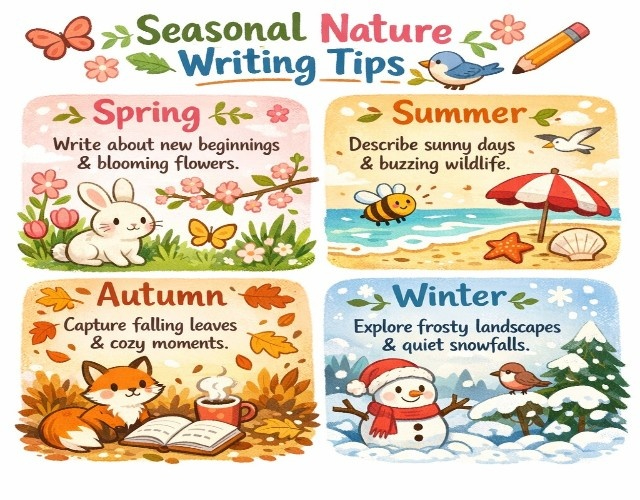
The same location transforms completely across seasons. Spring brings new growth, increased animal activity, rain, and moderate temperatures. Summer features peak vegetation, hot weather, and intense activity. Autumn showcases color changes, harvest periods, and preparation for winter. Winter reveals structures hidden by foliage, creates snow or ice features, and reduces activity levels.

Seasonal descriptions require awareness of specific changes rather than generic "spring is renewal" abstractions. Which plants bloom when? Which animals migrate? How do weather patterns shift? Specific seasonal details create authentic nature descriptions rather than poetic generalities. For a better understanding, you can browse our descriptive essay about autumn. 

Descriptive Essays About Nature Examples

Now that you know the tips and tricks for writing a descriptive nature essay, let's look at some examples. These samples will give you an idea of what your own essay can look like.

Descriptive Writing About Nature

Descriptive Essay About Mother Nature

Descriptive Essay About Beauty of Nature

Short Descriptive Essay About Nature - PDF Example

Beauty of Nature Essay Example 300 Words

Descriptive Essay About A Beautiful Location in Nature

Expert Tip

Read more descriptive essay examples on various other topics to broaden your horizon.

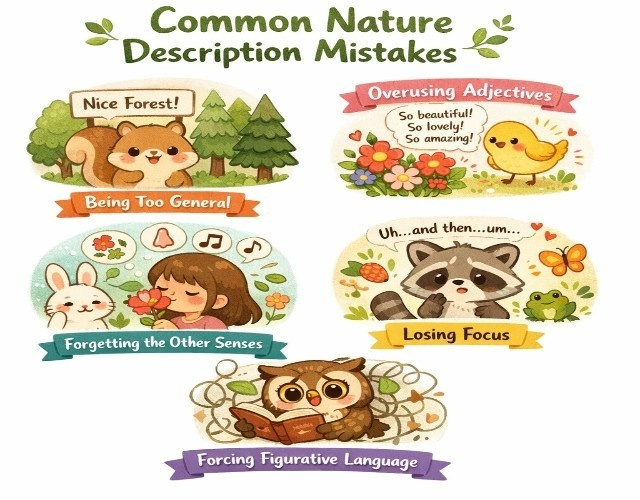
Common Nature Description Mistakes

1. Generic Language and Clichés

Nature writing attracts clichés like "babbling brook," "majestic mountains," or "peaceful forest." These phrases communicate nothing distinctive because they're so overused that readers skip past them automatically.

Replace clichés with precise observation. Instead of "beautiful sunset," describe actual colors, light patterns, and atmospheric conditions. Rather than "singing birds," identify species and describe actual calls. Generic praise ("amazing," "incredible") tells readers your opinion rather than showing them what you experienced.

2. Anthropomorphism and Pathetic Fallacy

Nature doesn't have human emotions. Trees don't "weep," skies don't "smile," and storms don't "rage." These anthropomorphic descriptions distance readers from authentic natural experiences by filtering observations through human emotional projections.

Describe what you actually observe—tree branches drooping under ice weight, clear blue sky stretching horizon to horizon, wind driving rain horizontally. These concrete descriptions communicate more effectively than emotional projections onto non-sentient nature.

3. Overwriting and Purple Prose

Nature's beauty doesn't require elaborate language to communicate effectively. Overwritten nature descriptions with excessive adjectives, metaphors, and flowery language often obscure rather than reveal subjects. "The verdant, emerald, lush, vibrant, flourishing forest" says less than "Sunlight couldn't penetrate the dense canopy."

Simple, precise language serves nature descriptions better than elaborate vocabulary displays. Choose specific verbs, concrete nouns, and precise adjectives rather than piling on descriptive phrases, hoping something resonates.

4. Ignoring Unpleasant Elements

Nature includes mosquitoes, mud, heat, cold, thorns, and discomfort. Sanitized nature descriptions that omit unpleasant realities feel fake. Include realistic details—sweat, sunburn, blisters, bug bites—that authenticate your experience.

Unpleasant elements don't dominate descriptions, but shouldn't be ignored either. Acknowledging challenges makes pleasant elements feel earned rather than idealized. Authentic nature writing includes both beauty and difficulty.

5. Lack of Specific Knowledge

Generic nature descriptions reveal a lack of actual knowledge. "Trees" could mean hundreds of species with completely different appearances. "Birds singing" could describe anything from chickadees to crows. Specific knowledge creates authentic descriptions.

Learn to identify common plants, trees, birds, and geological features in environments you're describing. This knowledge enables precise language—"red-tailed hawk circling thermal updrafts" communicates more than "bird flying overhead." Field guides and naturalist knowledge improve nature writing dramatically.

Integrating Environmental Context

Weather and Atmospheric Conditions

Weather creates atmosphere—literally and figuratively—in nature descriptions. Approaching storms change light, sounds, air pressure, and animal behavior. Fog transforms familiar landscapes into mysterious settings. Snow muffles sounds and simplifies visual complexity.

Describe weather's effects rather than just weather itself. How does wind affect your subject? What happens to sounds during rain? How does fog limit visibility and create isolation feelings? Weather impacts everything in natural environments—integrate these effects throughout descriptions rather than isolating them in weather sections.

Human Presence and Impacts

Even wilderness locations show human impacts—trails, fire rings, distant sounds of civilization. Include these elements honestly rather than pretending pure wilderness exists everywhere. Describing human impacts adds realism and can create meaningful contrasts.

Sometimes human absence becomes notable—describing locations where human influence is minimal creates a different atmosphere than populated natural areas. Remote wilderness descriptions emphasize isolation and wildness through the absence of human elements.

Wildlife Integration

Animals animate nature descriptions, but shouldn't dominate unless they're your primary subject. Integrate wildlife naturally—birds moving through trees, squirrels gathering food, insects pollinating flowers. These details show ecosystem activity rather than static landscapes.

Describe animal behaviors specifically rather than just their presence. "Blue jay scolding from oak branch" communicates more than "bird in tree." Animal sounds, movements, and interactions with the environment all enrich nature descriptions authentically.

If you are still confused and looking for a descriptive essay writing service then take help from a professional writer. 

Creating Your Nature Description

Start with extended observation periods in specific natural locations. Take detailed notes across all five senses rather than relying on memory or photography. Identify distinctive features that make this location unique rather than representative of nature generally.

Choose organizational patterns matching your landscape—spatial, temporal, or categorical. Create a descriptive essay outline before drafting, ensuring logical flow through your natural subject. Your introduction should establish location, time, conditions, and dominant impression immediately.

Draft using concrete sensory details rather than abstract praise. Revise by removing clichés, generic language, and anthropomorphism. Verify scientific accuracy of species identification, geological references, and weather descriptions.

Strong nature descriptions balance scientific precision with vivid sensory language that makes readers feel present in environments they're reading about. For additional guidance on descriptive writing techniques applicable beyond nature subjects, explore our comprehensive descriptive essay guide. 

Struggling to Create Vivid, Engaging Descriptions?

Our expert writers craft descriptive essays rich with sensory details, vivid imagery, and compelling language that captivates readers.

  • Tell us about your subject and descriptive requirements
  • Get matched with a creative writing expert
  • Receive drafts with rich sensory language
  • Get your final essay with powerful descriptive techniques

Every essay is crafted with careful word choice, figurative language, and immersive descriptions that engage all five senses.

Hire an Expert Writer

Frequently Asked Questions

What makes a good nature descriptive essay topic?

Good nature topics are specific locations you've personally experienced at particular times, like the redwood grove at Muir Woods during morning fog, rather than generic forests. Choose places you can observe for 2+ hours, taking detailed notes across all five senses. The best topics engage multiple senses naturally—waterfalls provide sound, sight, touch, and smell descriptions simultaneously. Avoid subjects requiring pure imagination or research without personal observation.

How do I organize a descriptive essay about a landscape?

Use spatial organization patterns matching your landscape type. For forests, organize ground-to-canopy vertically. For open landscapes, organize near-to-far horizontally. For mountain views, describe foreground to distant ridges. Start with dominant impressions—what strikes you first approaching the location—then systematically guide readers through space. Transition phrases like (above the treeline) or (in the distance) help readers follow your spatial movement through the environment.

Should nature essays include scientific information?

Include scientific knowledge that enhances authentic description—tree species, rock types, weather phenomena—but avoid turning descriptive essays into nature reports. Scientific accuracy improves credibility when you identify red-tailed hawks specifically rather than birds, or distinguish granite from sandstone. However, the goal remains vivid sensory description, not educational content. Balance specific knowledge with descriptive language that makes readers feel present in the environment.

How can I avoid clichés in nature writing?

Replace overused phrases with precise observations. Instead of (babbling brook,) describe actual water sounds— water tumbling over rounded stones, creating percussive rhythms.

Rather than majestic mountains, describe specific features—weathered granite peaks thrusting skyward, snow clinging to north faces. 

Avoid emotional projections like (angry storm) or (peaceful forest)—describe observable conditions that create those impressions. Fresh observation always beats familiar phrases.

What time of day works best for nature descriptions?

Dawn and dusk offer dramatic light, temperature changes, and wildlife activity transitions, making them popular descriptive times. However, midday, afternoon, and night each provide distinctive descriptive opportunities. Choose times you've actually experienced rather than imagining ideal conditions. Extended observation periods matter more than specific times—spending three hours at one location at any time yields better material than brief visits to multiple places or times.

How do I describe nature without being too poetic or abstract?

Ground descriptions in concrete sensory details rather than abstract impressions. Instead of the forest breathed with life, describe observable phenomena—branches swayed in the wind while birds darted between trunks and insects hummed through undergrowth. Avoid metaphors that prioritize cleverness over clarity. Use figurative language sparingly and only when it genuinely clarifies rather than obscures. Straightforward, precise observation communicates nature's beauty without elaborate language.

Can I write about nature I've only seen in photos or videos?

Authentic nature descriptions require personal sensory experience across sight, sound, smell, touch, and sometimes taste. Photos and videos provide only visual information, missing four-fifths of sensory experience. You can't describe wind, temperature, scents, or sounds from images. Choose nature you've personally experienced even if less exotic than photographed locations. Your local park at dawn provides richer material than Yosemite photographs because you experienced it fully.

How detailed should nature descriptions be?

Include enough detail for readers to visualize and experience the setting clearly without overwhelming them with exhaustive catalogs. Select most distinctive, representative details rather than describing everything present. If describing a forest, choose characteristic elements—dominant tree species, ground cover, notable sounds—rather than mentioning every plant. Two or three well-chosen, precise details communicate more effectively than lengthy lists of generic observations.

What's the difference between nature and place descriptions?

Nature descriptions focus on natural environments, emphasizing ecological elements, weather, wildlife, and geological features. Place description in a descriptive essay about a place can include natural settings but often emphasizes human-built elements, cultural significance, or personal connections to locations. A beach can be described as nature (focusing on waves, sand, wildlife) or as a place (focusing on beach culture, nearby buildings, personal memories). The distinction lies in emphasis rather than absolute categories.

How do I make seasonal nature descriptions feel fresh?

Avoid generic seasonal clichés (spring renewal, fall colors) by focusing on specific, observable changes rather than abstract meanings. Describe exactly which wildflowers bloom in your location during spring, how leaves change color on specific tree species, or how snow transforms particular landscape features. Include less commonly mentioned seasonal elements—spring mud, fall fungi, summer dust, winter icicles—that create authentic rather than idealized seasonal portraits.

Caleb S.

Caleb S.Verified

Caleb S. has been providing writing services for over five years and has a Masters degree from Oxford University. He is an expert in his craft and takes great pride in helping students achieve their academic goals. Caleb is a dedicated professional who always puts his clients first.

Specializes in:

MarketingTerm PaperFinance EssayMedical school essayPersuasive EssayNursing EssayLawReflective EssayAnnotated Bibliography EssayEducationLiteratureArtsScience EssayLinguisticsGraduate School EssayUndergraduate EssayNarrative EssayExpository Essay
Read All Articles by Caleb S.

Keep Reading

23 min read

How to Write a Descriptive Essay: Complete Guide With Examples (2025)

descriptive essay
Essay Writing20 min read

Descriptive Essay Examples - Learn from Real Samples (2025)

descriptive essay examples
Essay Writing14 min read

250+ Descriptive Essay Topics for Students (2025)

descriptive essay topics
Essay Writing12 min read

Descriptive Essay Outline - Complete Guide with Templates

descriptive essay outline
Essay Writing26 min read

How to Write a Descriptive Essay About a Person (2025 Guide)

Descriptive Essay About a Person
Essay Writing10 min read

Descriptive Essay About Myself - Complete Writing Guide 2025

descriptive essay about myself
Essay Writing11 min read

Descriptive Essay About a Place - Complete Guide with Examples

Descriptive Essay About A Place
How to Write6 min read

How to Craft the Perfect Descriptive Essay About A Person You Admire

Descriptive Essay About A Person You Admire
8 min read

Descriptive Essay About My Mother - A Guide to Writing

descriptive essay about my mother
Essay Writing12 min read

Descriptive Essay About Food - Complete Guide

descriptive essay about food
14 min read

Descriptive Essay About Autumn - Complete Guide

Descriptive Essay about Autumn

Was This Blog Helpful?

On this Page

    MPW Logo White
    • Phone Icon(+1) 888 687 4420
    • Email Iconinfo@myperfectwords.com
    facebook Iconinstagram Icontwitter Iconpinterest Iconyoutube Icontiktok Iconlinkedin Icongoogle Icon

    Company

    • About
    • Samples
    • FAQs
    • Reviews
    • Pricing
    • Referral Program
    • Jobs
    • Contact Us

    Legal & Policies

    • Terms
    • Privacy Policy
    • Cookies Policy
    • Refund Policy
    • Academic Integrity

    Resources

    • Blog
    • EssayBot
    • AI Detector & Humanizer
    • All Services

    We Accept

    MasterCardVisaExpressDiscover

    Created and promoted by Skyscrapers LLC © 2025 - All rights reserved

    Disclaimer: The materials provided by our experts are meant solely for research and educational purposes, and should not be submitted as completed assignments. MyPerfectWords.com firmly opposes and does not support any form of plagiarism.

    dmca Imagesitelock Imagepci Imagesecure Image