


Descriptive Essay Topics for Different Categories
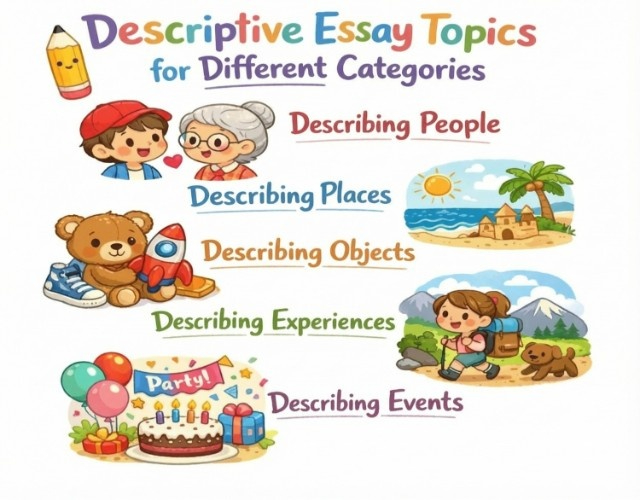
Describing People (50 Topics)
People make excellent descriptive essay subjects because they're naturally complex. When you describe a person, you're not just capturing physical appearance; you're revealing personality through gestures, speech patterns, habits, and presence. These topics work well because they invite both concrete sensory details and emotional interpretation.
Family & Relationships Descriptive Topics:
- Your grandmother's hands and what they reveal about her life's work
- The way your best friend laughs, the sound, the timing, what triggers it
- Your parent getting ready for work in the morning (routine, sounds, transformation)
- A sibling's bedroom and what it says about who they're becoming
- The family member everyone turns to during a crisis, their demeanor, and presence.
Characters & Personality Descriptive Topics:
- The most confident person you know, how they move through the world
- Someone who makes every room brighter when they enter it
- A person whose silence speaks louder than most people's words
- The friend who's always perfectly organized versus your chaotic tendencies
- Someone whose style perfectly matches their personality
- A person who laughs at the wrong moments (but it somehow works)
- The quietest person in class and the energy they bring despite their silence
- Someone who can't sit still, their constant motion and fidgeting
- A person whose face shows every emotion they're feeling
- The friend who remembers every detail about everyone
Occupations & Roles Descriptive Topics:
- Your favorite teacher's classroom presence (voice, movements, teaching style)
- A barista who knows your order by heart, their routine, and workspace
- The school janitor nobody notices, but everyone depends on
- A coach during practice versus during competition (voice, intensity, focus)
- The librarian at your local library and their relationship with the space
- A street performer you've watched multiple times (technique, audience interaction)
- The nurse or doctor who made you feel safe during a scary medical moment
- A bus driver's routine and how they interact with regular passengers
- The security guard who greets everyone by name
- A server at your favorite restaurant and their system for remembering orders
Impact & Influence Descriptive Topics:
- The person who changed your perspective on something important
- Someone who intimidated you until you really got to know them
- A mentor whose advice you still hear in your head
- The person who believed in you when you didn't believe in yourself
- Someone whose disappointment affected you more than any punishment could
- A stranger who helped you when you needed it most
- The person you aspire to be like (specific qualities and behaviors)
- Someone who apologized sincerely and changed your understanding of apology
- A person who stayed calm when everyone else panicked
- The friend who tells you the truth even when it's uncomfortable
Historical Figures Descriptive Topics:
- A historical figure based on portraits and written descriptions (facial features, posture, presence)
- An artist, writer, or musician based on their work and historical accounts
- A revolutionary leader's appearance at a pivotal moment
- An inventor in their workshop or laboratory (imagined from historical records)
- A monarch or ruler during a public appearance (regalia, bearing, atmosphere)
- A scientist at the moment of breakthrough (expression, surroundings, emotion)
- An explorer at the edge of the known world (appearance, gear, determination)
- A civil rights leader during a famous speech (posture, voice, crowd energy)
- An athlete at the peak of their career (physical condition, focus, movement)
- A philosopher or thinker in their study (surroundings, appearance, thoughts visible on their face)
For more guidance on describing people effectively, see our article on descriptive essays about people.
Describing Places (60 Topics)
Places anchor our memories and emotions in physical space. Describing locations isn't just about listing physical details; it's about capturing the feeling of being there, the atmosphere, the way light moves through windows or sounds echo off walls. These place based topics work well because they naturally invite rich sensory description and often carry emotional weight.
Childhood & Memory Descriptive Essay Topics:
- Your childhood bedroom exactly as you remember it (smells, sounds, the view from your bed)
- The backyard where you played, specific corners and hiding spots
- Your elementary school cafeteria during lunch (sounds, smells, social geography)
- A grandparent's house from a child's perspective (what seemed huge, special details)
- The route you walked to school (landmarks, seasonal changes, daily observations)
- A playground you frequented, the equipment, the other kids, the unwritten rules
- The backseat of your family car during long road trips
- Your childhood hiding spot when you needed to be alone
- A friend's house where you spent countless hours (their family's routines, the differences from your home)
- The place you felt safest as a child
Natural Environments Descriptive Essay Topics:
- A forest trail at dawn (light through trees, morning sounds, dew on everything)
- The beach during off season when it's nearly empty
- A mountain overlook at the exact moment the view opens up
- A river or stream where you spent summer afternoons
- Your backyard during a specific season (spring bloom, summer heat, fall decay, winter silence)
- A park at sunset when dog walkers and joggers share the space
- The desert at night (temperature drop, stars, sounds you don't expect)
- A lake's edge early morning when mist rises off the water
- A meadow in summer (tall grass, wildflowers, insect activity, heat)
- The woods after rain (smells, sounds of dripping, how light changes)
Urban Spaces Descriptive Essay Topics:
- Your neighborhood's main street on Saturday morning
- A subway or metro station during rush hour (movement, sounds, unspoken rules)
- The downtown area of your city at 3 AM versus 3 PM
- An alley you pass through regularly (lighting, smells, what makes it feel safe or unsafe)
- A rooftop or high vantage point overlooking the city
- Your city's oldest neighborhood (architecture, atmosphere, who lives there now)
- A parking garage late at night (echoes, lighting, emptiness)
- The intersection where everything in your neighborhood converges
- A bridge you cross regularly (view from it, sounds underneath, who else uses it)
- The abandoned building everyone knows about but nobody enters
Special Locations Descriptive Essay Topics:
- A place you discovered by accident that became important to you
- The library where you studied for finals (specific desk or corner, lighting, other regulars)
- A coffee shop that became your second home (smells, sounds, your usual spot)
- The hospital room where something significant happened
- A friend's dorm room or college apartment (their organizational system, the contained life)
- A concert venue or stadium during a memorable event
- The waiting room where you got life changing news
- A place you return to when you need to think
- The parking lot where you learned to drive
- A place that looks completely different at night than during the day
Commercial & PublicDescriptive Essay Topics:
- A bookstore's specific section where you browse for hours
- The grocery store at closing time (lighting, emptiness, cleaning sounds)
- A gym or fitness center during peak hours (sounds, smells, movement patterns)
- Your favorite restaurant's kitchen during dinner rush (sounds, heat, coordination)
- A movie theater right before the previews start (anticipation, sounds, light dimming)
- The mall during holiday shopping season (decorations, crowds, stressed energy)
- A laundromat late at night (machine sounds, fluorescent lighting, other night owls)
- A hardware store's organized chaos (smells, labyrinth of aisles, helpful employees)
- A farmers market at peak morning hours (colors, smells, vendor calls, samples)
- An airport terminal during a layover (transient energy, announcements, varied languages)
Travel Destinations Descriptive Essay Topics:
- A foreign city's street market (unfamiliar sights, sounds, smells, interactions)
- A famous landmark at dawn before the tourists arrive
- A small town main street that time forgot
- A hostel common room late at night (international mix, shared stories, cheap wine)
- A train station in a country where you don't speak the language
- A beach resort versus the local beach three miles away
- A historical site where you felt connected to the past
- A festival or celebration in an unfamiliar culture
- A mountain village at altitude (air quality, sounds, pace of life)
- The view from a long bus or train ride through a changing landscape
Perfect Your Place Descriptions: Learn spatial organization, atmospheric detail, and how to make locations come alive in our guide to describing places.
Describing Objects (40 Topics)
Objects carry stories, memories, and meaning beyond their physical properties. When you describe an object well, you're revealing your relationship with it, its history, and why it matters. These topics work because they force you to observe closely and find significance in the mundane or ordinary.
Personal Possessions Descriptive Essay Topics:
- Your phone, not just what it looks like, but the scratches, case, how it feels in your hand, what it contains
- A piece of jewelry you wear constantly (weight, temperature, how you fidget with it)
- Your most comfortable pair of shoes (wear patterns, how they've molded to your feet, where they've been)
- A book you've read multiple times (condition, marginalia, smell, where you keep it)
- Your favorite hoodie or jacket (fabric, pockets, stains that tell stories, how it fits)
- A bag or backpack you carry everywhere (organization system, weight distribution, hidden pockets)
- The wallet or purse you've had for years (contents, wear patterns, what you can't bring yourself to throw away)
- Your first car or bike (dents, quirks, smells, sounds it makes)
- A musical instrument you play (wood grain, keys or strings, how it sounds when you versus others play it)
- Your bedroom's lighting setup (lamps, natural light, how you adjust it for different moods)
Heirlooms & Antiques Descriptive Essay Topics:
- A piece of furniture passed down through generations (scratches, repairs, style that dates it)
- Your grandmother's recipe box (cards, stains, handwriting, smells that linger)
- An old photograph that captures someone you never met
- Vintage clothing from another era (fabric, construction, what it reveals about past fashion)
- A watch that stopped working but you keep anyway
- Letters or postcards from decades ago (paper quality, handwriting, stamps, what they reveal)
- A tool your grandfather used in his work (wear, weight, craftsmanship)
- China or dishware used only for special occasions (pattern, delicacy, the ritual of using it)
- An old toy from your parent's childhood that survived to reach you
- A piece of technology that's now obsolete (physical design, what it says about the era)
Everyday Objects Descriptive Topics:
- Your coffee mug (shape, weight, handle comfort, stains, why you chose it)
- The couch in your living room (indentations, textures, the spot everyone fights over)
- Your alarm clock and how you feel about it (sound, placement, your relationship with waking up)
- A kitchen appliance you use daily (sounds it makes, quirks, your routine with it)
- Your workspace or desk setup (organization, chaos, what it says about how you work)
- A plant you're trying to keep alive (appearance, your care routine, its responses)
- The mirror you look in most often (lighting, what you check, time of day)
- Your bedding (textures, temperature, how it looks made versus unmade, comfort level)
- A door in your home (how it opens, sounds it makes, what's on either side, your relationship with privacy)
- The refrigerator's contents and organization (what's always there, what it reveals about eating habits)
Symbolic Items Description Topics:
- An object that reminds you of someone no longer in your life
- Something broken that you keep for sentimental reasons
- A gift that meant more than the giver knew
- An object you bought to commemorate a specific moment
- Something ordinary that became significant through circumstance
- An item you rescued or saved (condition when found, restoration, what it means now)
- A collection you've built over the years (what ties it together, your favorites, how you display it)
- An object that makes you feel safe or comforted
- Something you created yourself (flaws, what the process taught you, evolution over time)
- An item that represents a goal or aspiration (why you keep it visible, what it reminds you of)
Describing Experiences (50 Topics)
Experiences are harder to describe than static subjects because they involve time, change, and multiple sensory inputs at once. But that's what makes them powerful: you're capturing a moment or period in motion, letting readers feel what you felt. These experience based topics work well because they combine sensory detail with emotional resonance.
Firsts & Milestones Description Topics:
- Your first day at a new school (arriving, finding your way, first impressions, lunch alone or with strangers)
- Learning to drive, the exact moment something clicked and you understood it
- Your first time living alone (the silence, freedom, responsibility, strange sounds at night)
- The first time you cooked a meal successfully after many failures
- Moving into a dorm or first apartment (unpacking, making it yours, that first night)
- Your first flight, from takeoff to landing, every sensation
- The first time you voted or participated in civic life
- Your first day at a job (training, meeting people, imposter syndrome, lunch break)
- The first time you felt truly independent
- Your first concert or live music experience (crowd, sound, energy, being part of something larger)
Achievements & Triumphs Descriptive Essay Topics:
- Crossing a finish line (literal or metaphorical), the exhaustion and exhilaration
- The moment you got acceptance news (where you were, who you told first, physical reaction)
- Performing or presenting when everything went right (flow state, confidence, audience response)
- Completing a project you'd worked on for months (final steps, exhaustion, satisfaction)
- The moment you realized you'd mastered a difficult skill
- Receiving recognition or an award (announcement, walk to stage, holding the trophy or certificate)
- Defending your thesis, idea, or creative work successfully
- The first time someone paid you for your creative work
- Finishing a race or physical challenge you'd trained for
- The day you proved wrong someone who doubted you
Challenges & Struggles Descriptive Essay Topics:
- A panic attack or anxiety episode (physical sensations, what triggered it, coming down from it)
- Being lost in an unfamiliar place (realization, attempts to find your way, eventual resolution)
- All nighter studying for an exam (progression through the night, coffee, sunrise, exhaustion)
- A medical procedure or hospital stay (waiting, sounds, smells, loss of control, recovery)
- The hardest conversation you've ever had (setting, building up to it, aftermath)
- Failing at something you'd worked hard for (moment of realization, physical reaction, who you told)
- Moving away from home (packing, saying goodbye, the journey, arriving somewhere new)
- Your worst day at work or school (how it escalated, breaking point, going home)
- Being rejected or broken up with (where, what was said, the walk or drive home)
- Dealing with grief (specific moments, not the whole process)
Sensory Experiences Descriptive Essay Topics:
- A meal that surprised you (appearance, smell, first bite, flavors unfolding, textures)
- Swimming in the ocean versus a pool versus a lake (temperature, sounds, what's beneath you, salt or chlorine)
- A thunderstorm from inside versus caught outside in it
- Your first snow (or experiencing snow after years without it)
- Extreme heat, a day you'll never forget how hot it was (air quality, sweat, seeking relief)
- The smell of a place that transports you instantly to a memory
- Physical pain that taught you something (injury, recovery, what you learned about your body)
- A massage or spa treatment (tension, release, specific techniques, aftermath)
- Extreme cold, how your body responds and adjusts (or doesn't)
- The sensory overload of a new city (sounds, smells, crowds, getting your bearings)
Routine & Daily Descriptive Essay Topics:
- Your morning routine when everything goes right versus when everything goes wrong
- The commute you make every day (seasonal variations, fellow commuters, podcasts or music)
- A typical Friday night (routine, anticipation, transition from work to weekend mode)
- Grocery shopping with intention versus just browsing
- Your workout routine (specific exercises, how your body feels, the mental game)
- Doing laundry (sorting, sounds of machines, folding, the satisfaction of completion)
- Your wind down routine before bed (steps, how you prepare for sleep, what helps versus what doesn't)
- Cooking your signature dish (steps, smells at each stage, taste testing, serving)
- A typical Sunday morning (pace, sounds, what makes it different from weekdays)
- The ritual of making coffee or tea (method, equipment, the first sip, where you drink it)
Need Help Organizing Experiences in a Descriptive Essay: Use proven frameworks and templates to structure time-based descriptions effectively, explore see our descriptive essay outline guide.
Get Your Descriptive Essay Today
Professional writers deliver quality essays in as fast as 6 hours.
Join 50,000+ students who trust MyPerfectWords.
Describing Events (30 Topics)
Events combine multiple elements, people, places, atmosphere, and progression through time, making them complex but rewarding descriptive subjects. These event based topics work because they're contained experiences with clear beginnings, middles, and ends, a natural narrative arc built in.
Descriptive Essay Topics on Celebrations:
- A birthday party where everything went perfectly right or hilariously wrong
- Your high school or college graduation ceremony (waiting, the walk, reactions afterward)
- A wedding you attended (ceremony, reception, specific moments that stuck with you)
- New Year's Eve at midnight (countdown, energy shift, first moments of the new year)
- A surprise party, from the perspective of the surprised or the supriser
- Thanksgiving dinner at your family's table (preparation, the meal itself, cleanup, who fell asleep)
- A baby shower or gender reveal (anticipation, decorations, games, emotional moments)
- An anniversary celebration that honored something meaningful
- A retirement party (speeches, gifts, the honoree's reaction, what wasn't said)
- Halloween night trick or treating or at a party (costumes, candy, atmosphere, the specific year that stands out)
Cultural & Religious Descriptive Essay Topics:
- A religious ceremony you participated in or witnessed (rituals, symbolism, community atmosphere)
- A cultural festival in your community (music, food, traditional clothing, intergenerational mixing)
- A Quinceañera, Bar/Bat Mitzvah, or similar coming of age ceremony
- Diwali, Eid, Lunar New Year, or other cultural celebration (specific rituals, family traditions, meaning)
- A pilgrimage or spiritual journey (anticipation, the place itself, fellow travelers, transformation)
Community Events Descriptive Essay Topics:
- A farmers market in full swing (vendor interactions, samples, crowd energy, wfarmers'hat you bought)
- A local parade (floats, marching bands, crowd on sidewalks, weather, small town feeling)
- A town hall or community meeting (tensions, voices, democratic process in action)
- A neighborhood block party (setup, food sharing, kids running around, sunset timing)
- A protest or demonstration you witnessed or participated in (signs, chants, energy, police presence)
Sports & Competition Descriptive Essay Topics:
- The most intense game you played or watched (specific plays, score progression, atmosphere shifts)
- A championship match (stakes, crowd, key moments, outcome)
- A youth sports game from the sidelines (parent energy, kids' focus, what matters versus what doesn't)
- The last game of the season (nostalgia, knowing it's ending, senior night energy)
- A competition or tournament (preparation, nerves, performance, results, camaraderie)
Natural Events Descriptive Essay Topics:
- A solar eclipse (preparation, anticipation, the moment of totality, aftermath)
- A severe storm (sky changes, wind picking up, the storm itself, and cleanup)
- The first snowfall of the season (anticipation, first flakes, accumulation, morning after)
- A meteor shower viewing (finding a dark sky, waiting, seeing one, then many, cold and awe)
- Sunrise or sunset at a specific memorable location (color progression, temperature changes, light quality, who you were with)
Descriptive Topics by Academic Level
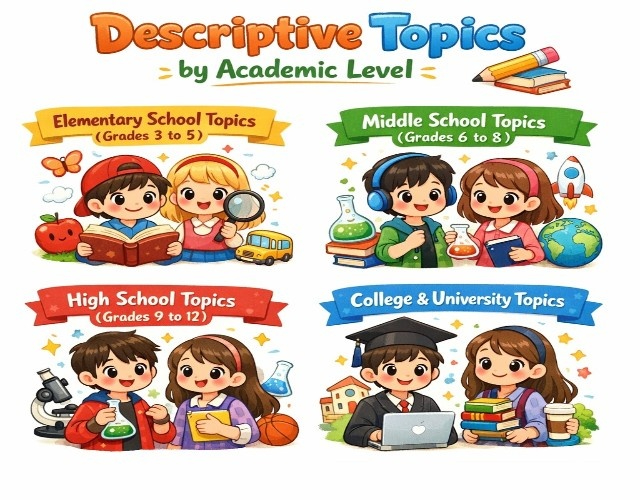
Elementary School Descriptive Essay Topics (Grades 3 to 5)
Elementary students write best about concrete, immediate experiences, things they can see, touch, and feel right now. These topics focus on observation and personal emotion rather than complex analysis. At this level, descriptive writing builds vocabulary and teaches students to notice details they usually pass over.
- My bedroom and my favorite spot in it
- My pet's daily routine and personality
- What I see on the walk to school
- My favorite food (appearance, smell, taste, texture)
- The playground at recess, equipment, and games
- My best friend's face when they laugh
- The school cafeteria during lunch
- My family's car (inside and outside)
- A stuffed animal or toy I've had since I was little
- What my backyard looks like in my favorite season
- The park where I play after school
- My favorite place to read or do homework
- What Saturday morning feels like at my house
- A holiday meal at my family's table
- The classroom on the first day of school
- What I can see from my bedroom window
- My favorite spot in the library
- The swimming pool on a summer day
- A rainy day spent inside
- My neighborhood from my front steps
Middle School Descriptive Essay Topics (Grades 6 to 8)
Middle schoolers can handle more emotional complexity and abstract thinking, but they still write best about personal experience. These topics introduce social dynamics, internal feelings, and the beginning of self reflection, while staying grounded in sensory detail.
- The moment I realized my friend was upset (facial expressions, body language, what tipped me off)
- My locker area and the social map around it
- The walk home from school when I'm thinking about something important
- A family tradition that's more meaningful than it seems
- The place I go when I need to be alone
- My phone's lock screen and why I chose that image
- What nervousness feels like before a performance or presentation
- The smell of my house versus my friend's house (what makes each unique)
- A teacher whose classroom feels different from all the others
- The bus ride to school (sounds, regular passengers, scenery, social dynamics)
- My spot at the lunch table and why it matters
- A hobby that's become part of my identity
- The moment I figured out something I'd been working on
- What it feels like to wait for important news
- My favorite local hangout spot (coffee shop, park, mall area)
- A moment when I felt proud of myself
- The sounds of my house at different times of day
- A memory from childhood that feels different now
- What confidence looks like on someone I admire
- The atmosphere before a big game or school event
High School Descriptive Essay Topics (Grades 9 to 12)
High school students can handle sophisticated topics that require layered thinking and emotional nuance. These topics push toward reflection, social awareness, and the beginning of an adult perspective while maintaining specific, concrete detail.
- The parking lot after school (social geography, routines, independence)
- A place in my town that's changed dramatically over the years
- The feeling of driving alone for the first time
- My workspace when I'm deep in a project (organized chaos, tools, focus state)
- A conversation that changed my perspective on something important
- The atmosphere in the library during finals week
- A person whose confidence I initially mistook for arrogance
- The job interview or college interview waiting room
- What senioritis actually feels like (physical and emotional)
- A local business that's a community institution
- The moment I realized an assumption I'd always held was wrong
- My favorite teacher's classroom as a physical space (not just their teaching)
- The coffee shop where students from my school work on homework
- A protest or civic event I attended or witnessed
- The different faces people wear in different social contexts
- A place that means something different to me now than it did as a child
- The walk across the stage at graduation (anticipation, moment, relief)
- My college essay draft, the physical or digital document and my relationship with it
- A summer job and the workplace's specific atmosphere
- The balance between who I am at home versus at school
College & University Descriptive Essay Topics
College students can explore abstract concepts grounded in concrete detail, complex social dynamics, and intellectual discovery. These topics assume independence, broader life experience, and the ability to analyze while describing.
- The library during finals week (different floors, types of students, desperation levels)
- My first apartment or dorm room (what I chose to bring, compromises, making it mine)
- The walk home from a party at 2 AM (sounds, other people, thoughts)
- A professor's office during office hours (books, personality revealed through space, conversations)
- The campus quad on the first warm day of spring (transition, energy, everyone outside)
- The moment I found my major or realized my career path
- An internship's workplace (professional environment, hierarchy, learning curves)
- The study abroad arrival, first 24 hours in a new country
- A lab or research space during long experiment hours
- The coffee shop that's become my second office (regulars, my usual order, unspoken rules)
- My thesis or capstone project workspace (organization, stress, stakes)
- The gym at my university (types of students, routines, unspoken social patterns)
- A lecture hall in a class that changed how I think
- The local bar or venue that students from my school frequent
- The anxiety and relief of submitting a major application
- Moving out of the dorms or an apartment (packing, nostalgia, transitions)
- An academic conference or professional event (imposter syndrome, networking, what I learned)
- The student union at different times of day (morning commuters, midday socializers, late night studiers)
- A protest or political organizing meeting on campus
- The job search process (applications, interviews, waiting, the offer, or rejection)
Descriptive Essay Topics by Current Trends (2025 to 2026)
These topics reflect current social, technological, and cultural moments. They'll be particularly relevant for students writing in 2025 and 2026, but might feel dated in future years. That's fine, descriptive essays capture specific moments in time.
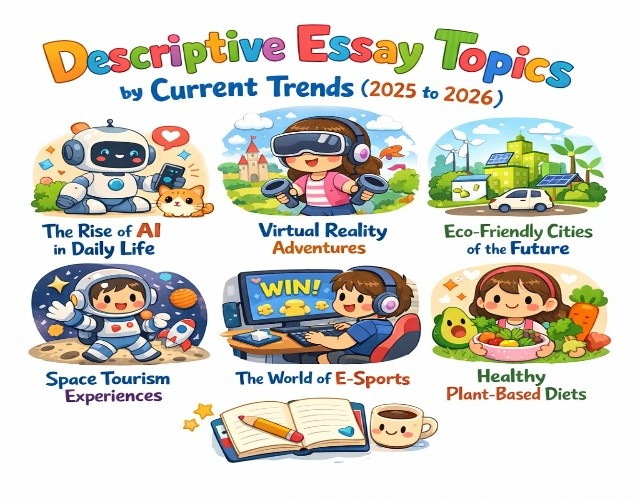
Technology & Modern Life Descriptive Essay Topics:
- The dopamine hit of a notification (physical sensation, compulsion, what it interrupts)
- Digital detox, the first day without your phone (what you notice: phantom vibrations, withdrawal)
- A Zoom or video call that actually mattered (setup, awkwardness, technical difficulties, connection despite distance)
- Your phone's screen time report and what it reveals about your habits
- An AI generated image or text that unsettled you (uncanny valley, implications, your reaction)
- The experience of going viral (or watching someone you know go viral)
- A dating app interaction that felt surprisingly human
- The atmosphere of a co-working space (digital nomads, freelancers, the illusion of productivity)
- Smart home technology fails (what you asked for versus what happened)
- The Reddit or Discord community that became meaningful to you
Environmental & Social Descriptive Essay Topics:
- The climate anxiety moment, a specific event that made it real to you
- A protest for climate action (energy, signs, age diversity, what people were willing to risk)
- The experience of extreme weather that broke records
- A beach or natural area visibly affected by climate change
- The farmer's market as political statement (local food, community, rejecting corporate agriculture)
- A zero waste attempt (challenges, judgment from others, what you learned)
- The gentrification of a neighborhood you've watched change
- A conversation about social justice that got uncomfortable but necessary
- Seeing homelessness increase in your area (specific encampments, people, community response)
- A community garden or urban farming project
Health & Wellness Descriptive Essay Topics:
- A therapy session that broke something open
- The gym at 5 AM versus 5 PM (different people, different energy, your mental state)
- A meditation or mindfulness practice (what your mind does, resistance, moments of actual stillness)
- The COVID-19 vaccination moment (relief, arm soreness, feeling like maybe things would improve)
- Telehealth appointments (talking to a doctor through a screen, the weird intimacy of it)
- A mental health crisis and the systems that did or didn't help
- The wellness industry's promises versus reality (what you bought into, what actually helped)
- Sobriety at a party or social event (your perspective, what you notice that others miss)
- The fitness trend you tried (CrossFit, Peloton, yoga, running clubs, specific experience)
- Stress symptoms your body manifests (jaw clenching, stomach issues, insomnia, physical manifestations)
Post Pandemic Life Descriptive Essay Topics:
- The first concert or crowded event after two years of isolation
- Hybrid work, switching between home office and actual office (transitions, which you prefer, why)
- The mask debate in real time (specific confrontation or observation)
- Reconnecting with friends after pandemic isolation (awkwardness, what changed, what didn't)
- The college experience you got versus the one you expected pre-pandemic
- Essential workers during lockdown (what you noticed, who kept things running, new appreciation)
- The supply chain shortage moment (empty shelves, panic buying, what you couldn't get)
- Learning something new during lockdown (sourdough, languages, hobbies born of boredom)
- The decision to go back to in-person versus stay remote (factors, anxiety, trade offs)
- The pandemic's long term effects on your social skills or mental health
Quick Descriptive Essay Topic Selection Guide
Before browsing the topics below, understand what makes a strong choice:
Three Essential Criteria
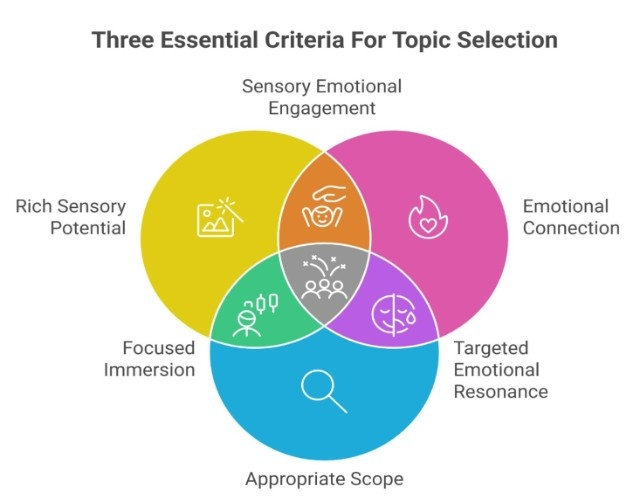
- Rich Sensory Potential: Can you engage at least 3 of the 5 senses? If you can only describe what something looks like, pick a different topic.
- Emotional Connection: Do you genuinely care about this subject? Forced enthusiasm shows in your writing.
- Appropriate Scope: Match topic breadth to your word count requirement.
Test Your Topic (30 Second Check)
- Can you list 10 to 15 specific sensory details right now?
- If you're struggling to get past 5 to 6, choose a narrower focus or a different topic.
Word Count Guidelines
- 500 to 800 words: Narrow slice (not "my grandmother," but "my grandmother's kitchen on Thanksgiving morning")
- 1,000 to 1,500 words: Complete but bounded subject (a full person, specific event, entire meaningful experience)
- 2,000+ words: Complex subject with layers (a place over time, person in multiple contexts, experience with before/during/after structure)
Final Thoughts
Choosing the right descriptive essay topic is half the battle. The other half is executing it with vivid sensory details, authentic emotion, and careful organization.
Remember these principles:
- Narrow beats broad: Specific details create stronger essays than general overviews
- Emotion matters: Write about what genuinely connects with you
- Senses create immersion: Engage at least three of the five senses
- Originality distinguishes: Find the unique angle that makes your topic yours
Whether you're describing a person who changed your life, a place that feels like home, or an experience you'll never forget, you now have 250+ options to inspire your writing.
Pick your topic, gather your sensory details, and start writing. Your reader is waiting to see, hear, smell, taste, and touch the world you're about to create.
For more guidance on executing your chosen topic effectively, check out our comprehensive descriptive essay writing guide.
Find the Perfect Descriptive Essay Topic Today Get expert help choosing and writing engaging descriptive essays that stand out Our essay writing service helps you turn great topics into vivid, high-scoring essays.

-20161.jpg)


-20188.jpg)



-20358.jpg)
-20173.jpg)