


-20755.png)
The Quickest Way to Tell Them Apart
The fastest way to figure out which document you're looking at (or which one you need to write) is timing.
A research proposal comes before the research. A research paper comes after. It really is that simple as a starting point.
Tense is another dead giveaway. Proposals are written in the future tense: "I will examine," "this study will explore," "the methodology will involve." Papers are written in the past tense: "This study examined," "participants were asked," "the results showed."
Think of it as a research journey with two distinct stages. You submit the proposal to get permission and direction, you do the actual research, and then you write the paper to report on what you found. They're connected, but they're not the same document.
| If you're still figuring out your plan, you're writing a proposal. If you've completed the work, you're writing a paper. |
Here's what each one is for at its core:
- Proposal: your plan and your case for permission to conduct the research
- Paper: your results and your contribution to the field
Research Proposal vs Research Paper: Full Comparison Table
Here's how they stack up across every dimension that matters.
Dimension | Research Proposal | Research Paper |
Purpose | Persuade and plan | Report and contribute |
When it's written | Before the research | After the research |
Tense | Future ("I will examine...") | Past ("This study examined...") |
Audience | Supervisor, committee, funder | Academic community, journal reviewers |
Length | 2-10 pages typically | 10-50+ pages |
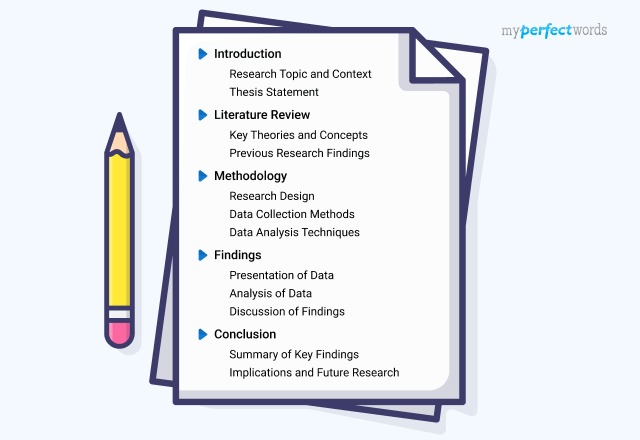
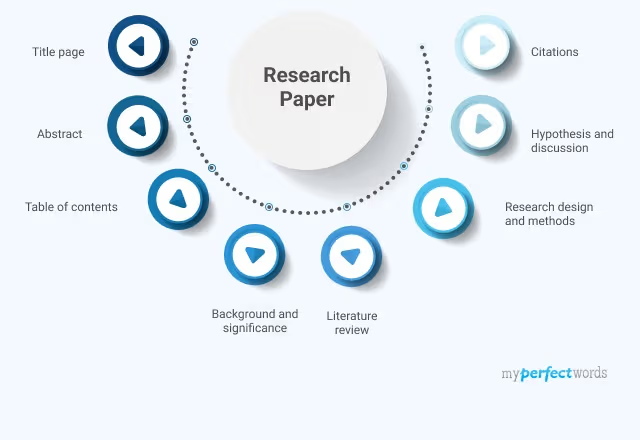
Core sections | Intro, literature review, methodology, objectives, significance | Abstract, intro, literature review, methods, results, discussion, conclusion |
Research questions | Poses them | Answers them |
Data | None yet; outlines collection plan | Collected, analysed, interpreted |
The reason students get confused is that both documents share some structural overlap. They both have introductions and both include a literature review. But those shared sections serve completely different functions in each document.
In a proposal, the literature review is long and detailed because it's doing the heavy lifting of justifying the research. In a paper, it's shorter. It's there to give context, not to make a case.
What Goes Into Each One?
Here's what you need to include in each of them:
Research Proposal: What You Need to Include
A research proposal is entirely forward-looking. Every section is building the argument that your proposed research is worth doing.
- Introduction: What you're researching and why it matters. This is where you hook the reader and frame the problem.
- Literature review: What's already been studied, what the gaps are, and why your proposed research fills one of them. This section is usually longer and more detailed in a proposal than in a final paper. It's doing persuasive work.
- Research questions / objectives: The specific questions you'll investigate or the outcomes you're aiming to achieve.
- Methodology: How you'll collect and analyse data. You don't have results yet, so you're explaining your plan: surveys, interviews, experiments, archival analysis, and so on.
- Significance: What your research will contribute to the field if it succeeds.
- Timeline (sometimes required): A projected schedule for each stage of the work.
| Everything is written in the future tense throughout. You're making a case for research that hasn't happened yet. For a full breakdown of the required sections and how to format them, see our research proposal format guide. |
Research Paper: What You Need to Include
A research paper reports on work that's complete. The structure reflects that.
- Abstract: A 150-300 word summary of the entire paper: purpose, methods, results, and conclusions.
- Introduction: Background context and your research question. Similar to the proposal's intro, but now you're framing completed work rather than planned work.
- Literature review: Shorter than in a proposal. It positions your work within the existing field, but it doesn't need to justify why the research should happen. That's already been done.
- Methodology: What you actually did. Not what you planned. What happened. Written in past tense.
- Results: What you found. Data, patterns, outcomes, reported objectively.
- Discussion: What the findings mean. This is where you interpret the results, connect them back to your research questions, and address any limitations.
- Conclusion: Key takeaways, implications, and suggestions for future research.
| The overlap in structure is real. Both have an intro and a lit review. But the purpose of each section shifts significantly between the two documents. |
Purpose and Audience: Why That Changes Everything
One of the biggest differences between a proposal and a paper isn't structural. It's who you're writing for and what you need them to do.
When you write a research proposal, your reader hasn't agreed to let you do the research yet. You need to convince them it's worth pursuing. That means the tone is persuasive. You're making an argument. Common audiences include your professor, your thesis committee, or a grant-funding body.
When you write a research paper, your reader already knows the research happened. You're no longer asking for permission. You're delivering on it. The tone shifts to objective and analytical. You're reporting what happened and what it means. Common audiences include journal reviewers, peers in your field, and professors evaluating your work.
This is why the same topic looks so different across the two documents. It's not just the sections. It's the entire rhetorical purpose.
| "The proposal says 'here's what I'm going to do.' The paper says 'here's what I did and what it means.'" |
A proposal asks for permission. A paper delivers the result.
Need a Research Proposal That Gets Approved?
Our writers handle proposals at every academic level, from undergrad to PhD.
Get your proposal done right the first time.
A Real Example: One Research Project, Two Documents
Let's say you're a psychology student studying the effect of social media use on exam performance. Here's what each document looks like for the same project.
The research proposal might open like this:
| "This study will examine the relationship between daily social media usage and academic performance among undergraduate students. Drawing on existing research on digital distraction and cognitive load, this project will investigate whether students who limit social media during exam periods show measurable improvements in test scores." |
The methodology section would outline a planned survey of 200 students, how data will be collected over a 10-week period, and how results will be analysed statistically. There are no findings yet. Just the plan and the justification.
The research paper on the same topic, written after the study is complete, looks completely different:
| "This study examined the relationship between daily social media usage and exam performance in a sample of 200 undergraduate psychology students over 10 weeks. Students who limited social media use to under 30 minutes per day during the exam period scored an average of 12% higher than the control group." |
Same topic. Same student. Same research question. Completely different document.
That's the difference. Not the topic. The stage you're at.
| If you want to see what a completed proposal looks like before you start writing yours, check out these research proposal examples. |
What About a Research Brief?
You might also come across the term "research brief," especially if you're working in a professional or corporate setting. It's worth knowing how that fits in.
A research brief is a short, early-stage summary of a proposed project, usually one to two pages. It's used mainly in industry, marketing, or corporate research contexts to outline what kind of research is needed and why.
A research proposal, by contrast, is a formal academic document. It's longer, more detailed, and requires a full methodology section, literature review, and justification of significance. Think of a research brief as the sketch. The proposal is the blueprint.
If your professor or institution uses the term "research brief," it's worth checking whether they mean a shortened informal proposal or something else entirely. In academic contexts, they usually mean a proposal with a page limit.
Which One Do You Actually Need Right Now?
If you're still not sure which document you've been asked for, run through these questions:
- Has your research already been completed? Paper
- Are you asking for permission to start a research project? Proposal
- Has your supervisor asked you to "justify your topic and approach"? Proposal
- Has your supervisor asked you to "present your findings"? Paper
- Is the document written entirely in future tense? Proposal
- Does it include a results or findings section? Paper
Once you know which one you need, the rest gets a lot simpler. Ready to start? Here's how to write a research proposal step by step. |
Conclusion
Knowing the difference between a research proposal and a research paper matters more than most students realise. Get it wrong, and you're either pitching work you've already done or reporting results you haven't found yet. Either way, your professor notices.
The core of it is simple: one comes before the research, one comes after. The proposal is your case for doing the work. The paper is the work itself. Same topic, same researcher, completely different job.
Once you're clear on which one you need and where you are in the research process, the writing becomes much more straightforward.
Ready to Submit a Proposal You're Confident In?
Skip the guesswork. Our experts write research proposals that committees approve.
- Custom-written to your topic, level, and institution's format
- Delivered as fast as 3 hours, even on tight deadlines
- Rated 4.8/5 by 2,500+ students since 2010
- Full confidentiality. Your order stays private.
Short on time? Let our experts craft your research proposal quickly and accurately.
Get Research Proposal Help
-20615.png)

-20655.png)
-20737.png)
-9374.jpg)


-20592.png)
 (1))
-20591.png)

-20668.png)
-20612.png)
-20657.png)


-20577.png)
-20575.png)


-20578.png)



 (2))
)
 (1))
 (1))
 (1))
 (1))
 (1))
 (1))
-20419.png)
-20426.png)
-20431.png)
-20738.png)
-20739.png)
-20745.png)